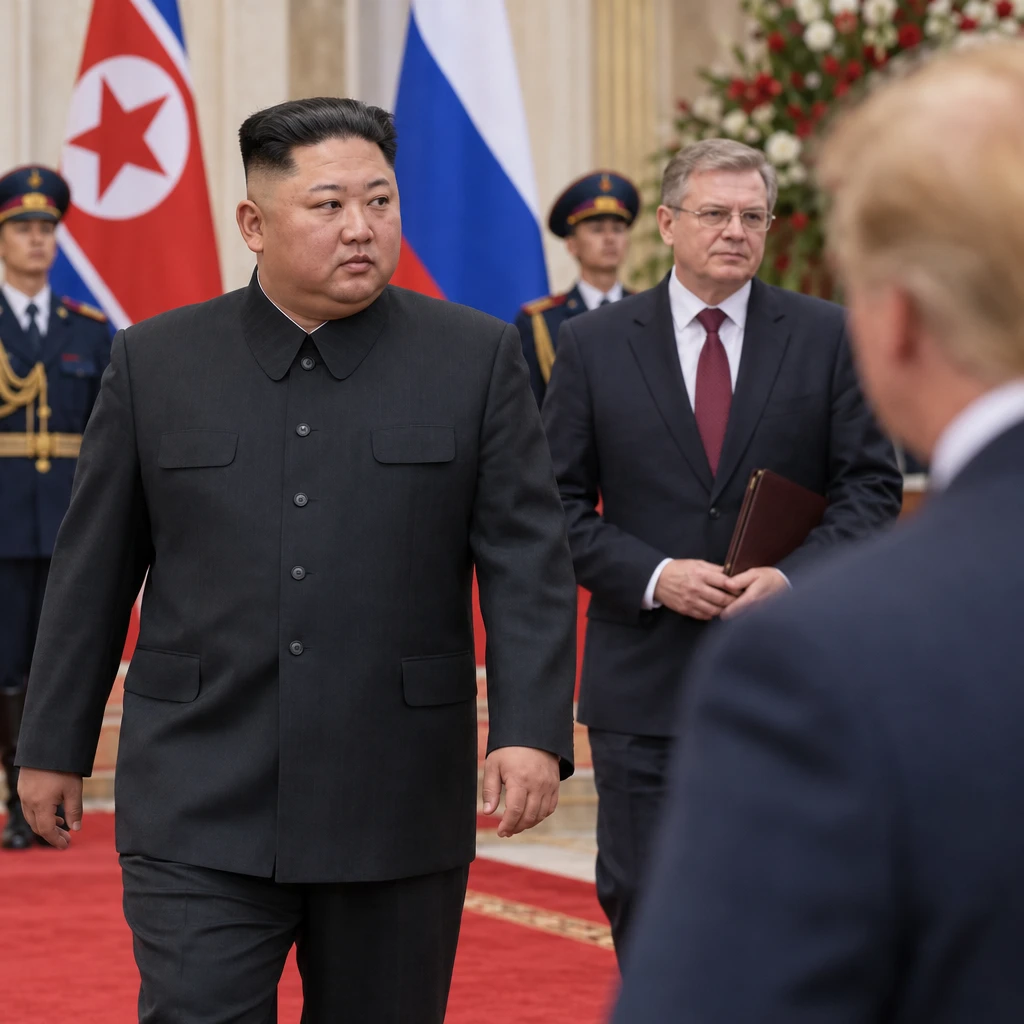
Kim Jong Un said North Korea seeks “power and capability” for security and peace, but “neither pursues supremacy nor expansion”, state media reported. He made the remarks at a rare ceremony to receive ambassador credentials himself, …
Every so often, a government says something so carefully worded that you can practically hear the diplomats sighing across three time zones. This week, North Korean leader Kim Jong Un gave us one of those statements.
According to state media, Kim said his country wants the power and capability to guarantee its security, but not supremacy over anyone else. It’s a tidy line, and it’s easy to read as a reassurance to the neighbors. It’s also easy to read as a message to Washington, which is where the story gets interesting.
The remarks came during a ceremony where Kim accepted credentials from newly appointed ambassadors, including the envoy from Russia. Ceremonies like this are normally routine, the kind of formal event where everyone wears their best suit and nobody says anything that makes the evening news. The fact that this one departed from established protocol is the detail that made people pay attention. When a leader changes the script at a ritual that is mostly script, observers start looking for hidden meaning.
The bigger context is Kim’s response to US President Donald Trump. Trump has repeatedly signaled interest in another meeting with Kim, and in the past he has made a point of publicly courting the North Korean leader. Their 2018 summit in Singapore was historic in the sense that it happened at all. The follow-up talks in Hanoi in 2019 ended without an agreement, and a brief meeting at the Demilitarized Zone later that year did not produce a breakthrough either. Since then, the two sides have been circling each other with more words than actions.
So when Kim turned down the latest overtures, it was not exactly shocking. Still, the headlines were quick to frame it as a ‘no-show,’ which has a pleasantly petty ring to it, like a dinner invitation that got left on read. Whether or not that framing is fair, it captures the mood: Trump wants a photo op and a deal, and Kim is making it clear he is not interested in being a supporting character in someone else’s victory lap.
The emphasis on sovereignty is where Kim’s message gets more substantial. North Korea has long insisted that it will decide its own path and will not be pressured into giving up its nuclear program on terms set by outsiders. Talk of sovereignty is a way of saying that the country is not interested in negotiating from a position of weakness, and that its security concerns, as Pyongyang sees them, come first. Framing the nuclear program as a guarantee of security rather than a bid for dominance is a familiar move, but it’s one that gets repeated because it resonates with the government’s domestic audience and its external critics alike.
The Russia angle adds another layer. North Korea and Russia have grown much closer in recent years, including a comprehensive strategic partnership treaty signed in 2024. Having the Russian ambassador at the center of a high-profile ceremony sends a signal that Pyongyang has options beyond Washington and Beijing. In diplomacy, showing that you have other friends at the table is often just as important as anything you say about your own intentions.
So where does this leave things? Probably where it was before: a stalemate with a lot of rhetoric on both sides. Kim is signaling that he will talk on his own timetable and on his own terms, if at all. Trump is signaling that he remains open to a deal and would welcome a meeting. Neither side has changed its core position, which is the most predictable part of the whole story.
For anyone following the Korean Peninsula, the takeaway is to watch the wording more than the headlines. ‘Security, not supremacy’ sounds modest, and it may be intended to sound that way. But the real question is what North Korea does next, and whether any future invitation gets a yes, a no, or the same polite refusal wrapped in careful language.
Inspired by: “N. Korea leader highlights ‘sovereignty’ in ties after Trump no-show” (r/News)