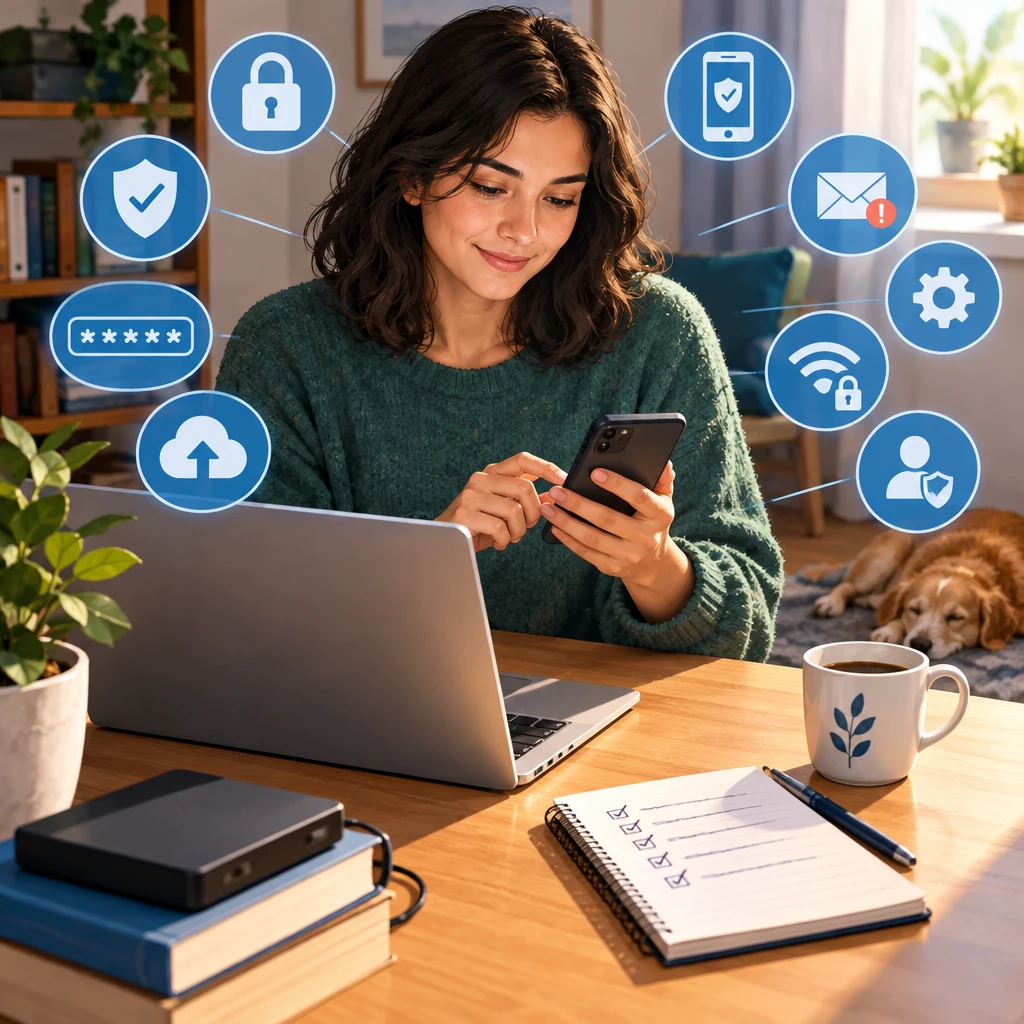
Review your network and device names . Is your cell phone or home network named using your last name or other personally identifying information? This can make your device more vulnerable to attack, since it connects the device to you and makes it easier for hackers to guess your password.
Let’s be honest: most of us know we should take online security seriously, and most of us also ignore it until something goes wrong. Maybe you got a weird login alert from a service you barely remember signing up for. Maybe a friend texted you asking why you sent them a link to a ‘miracle weight loss gummy.’ (You didn’t. Your account did, and it was not having a good day.)
The good news is that you don’t need to be a cybersecurity expert to dramatically reduce your risk. Most attacks succeed because of basic mistakes, not because some shadowy genius outsmarted a fortress. So let’s go through the simple habits that make a real difference.
Use strong, unique passwords
If your password is your pet’s name followed by the year you were born, we need to talk. Attackers use automated tools that try common words, names, and combinations within seconds. Long passphrases are much harder to crack than short, complicated strings with a random exclamation mark tacked on the end.
The bigger problem is reuse. If you use the same password for your email, shopping accounts, and social media, one data breach at one website can hand attackers the keys to everything else. Every important account should have its own password.
I know, remembering dozens of unique passwords sounds impossible. That’s exactly why password managers exist. They generate strong passwords, store them securely, and fill them in for you. You only need to remember one good master password, and yes, it should be long and not your dog’s name.
Turn on multi-factor authentication
Multi-factor authentication, often called MFA or two-step verification, means that logging in requires something besides your password, usually a code from an app or a physical security key. It’s one of the most effective protections available, and it’s often free.
Where possible, use an authenticator app or a security key rather than text message codes. Text messages can be intercepted or redirected through tricks like SIM swapping, so they are better than nothing but not as strong as the alternatives. Turn MFA on for your email first, since email is often the master key for resetting the passwords of your other accounts.
Be suspicious of urgent messages
Attackers rely heavily on panic. Messages that say your account will be closed in 24 hours, your package is stuck, or your bank has detected suspicious activity are designed to make you click before you think. This is called phishing, and it comes in emails, texts, social media messages, and even phone calls.
A few habits help. Don’t click links in unexpected messages. Instead, open the official app or type the website address yourself. Check the sender’s address carefully, because a lookalike domain with one swapped letter is a classic trick. And if someone claiming to be your bank, your employer, or a government agency pressures you for passwords or codes, hang up or close the message and contact them through a number or channel you already trust.
No legitimate company will ask you to read them a one-time code over the phone. If someone does, that’s your cue to end the conversation.
Keep your software updated
Software updates can feel like a personal attack. You’re halfway through a project, and suddenly your laptop wants to restart. But updates often patch security holes that attackers already know about and actively exploit. Turn on automatic updates for your operating system, browser, phone, and apps where you can. Delaying updates for months because the pop-up is annoying is how small vulnerabilities turn into big problems.
Be careful with downloads and attachments
Free software, cracked games, and mysterious attachments are common ways malware gets onto a device. If you didn’t expect a file, don’t open it. Download apps only from official app stores or the developer’s own website. Pay attention to browser extensions as well, since some request far more access than they need.
Think twice on public Wi-Fi
Coffee shop Wi-Fi is convenient, but open networks can be risky, especially if you’re logging into bank accounts or handling sensitive work. Avoid entering passwords or financial information on public networks without protection. A reputable VPN can add a layer of security, and using your phone’s mobile data for sensitive tasks is often a safer choice.
Back up your important data
Ransomware attacks lock your files and demand payment to unlock them. Regular backups are one of the best defenses, because if your files are recoverable, the attacker loses most of their leverage. Keep at least one backup separate from your everyday devices, such as an external drive that stays disconnected or a cloud backup service with version history.
Lock down your recovery options
Many accounts can be reset through a recovery email address or phone number. Make sure those recovery methods are current and secured with their own strong passwords and MFA. An old email address you no longer check is a weak link that attackers love to exploit.
Review your privacy settings
Oversharing makes life easier for attackers. Birthdays, pet names, hometowns, school names, and family details often show up in security questions or password guesses. Review who can see your social media posts and profile information, and consider removing details you don’t need to share publicly.
Check your accounts regularly
Make a habit of reviewing bank statements, login activity, and connected devices. Many services let you see where your account has recently been accessed and log out sessions you don’t recognize. If you spot something odd, change your password immediately, enable MFA if you haven’t already, and contact the service’s support team.
The bottom line
Cyber security isn’t about achieving perfection. It’s about making yourself a harder target than the next person. Attackers often go for the easiest option, so the simplest steps, like unique passwords, MFA, skepticism toward urgent messages, and regular updates, will protect you from most common threats.
So start with one change today. Turn on two-factor authentication for your email. Then tackle the rest when you have a spare afternoon and a cup of coffee you’re not planning to share with your router. Your future self, the one who doesn’t have to explain to the bank why they were buying gift cards at 3 a.m., will thank you.
Inspired by: “How to stay safe from hacks: The simple things you can do to protect yourself from cyber attacks” (r/RSS)