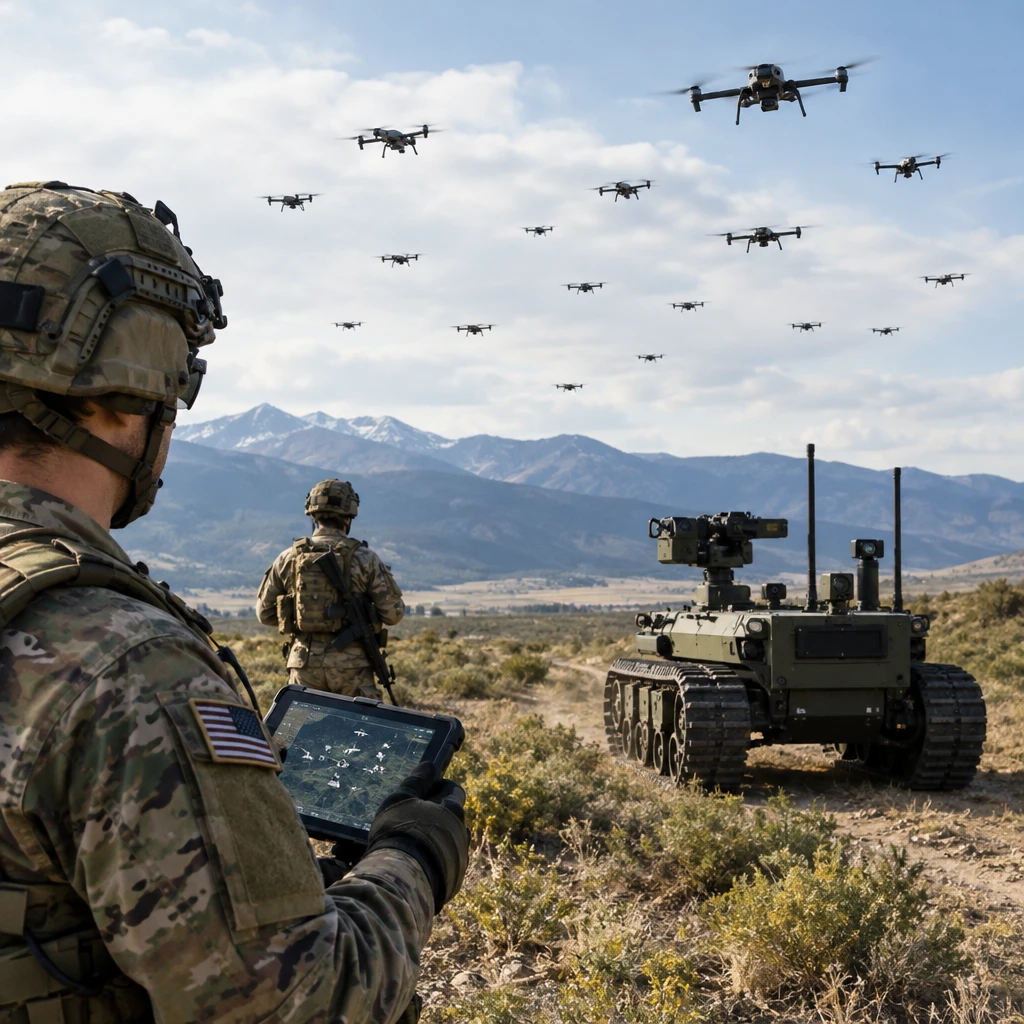
19, 2026.U.S. Army · Army engineers told Forbes that the tests marked a major step forward in pushing modern combat methods into all-out battles between robots rather than humans .
If you’ve spent any time reading defense news lately, you’ve probably noticed a pattern. Every few months, another headline announces that a military somewhere is experimenting with robots that fly in groups, roll across rough terrain, or do both at once. The latest one has the U.S. Army putting drone swarms and armed ground vehicles through their paces. Sounds like the setup for a sci-fi movie, right? Except it’s real, and it’s part of a much longer story about how militaries are rethinking the battlefield.
A quick caveat before we dive in: the full details of this particular story weren’t available to pull from the source, so this piece focuses on the broader context that’s already well documented in public. That’s still plenty to work with.
Start with the drone swarm idea. A swarm, in this context, means a group of relatively cheap, often small unmanned aircraft that work together as a coordinated unit instead of as a handful of expensive, individually piloted machines. The appeal is pretty straightforward. If one drone gets knocked out, the group keeps going. If you need to overwhelm an enemy’s sensors or defenses, you can send a lot of them at once. Researchers and defense planners have been studying this for years, and the Defense Advanced Research Projects Agency has funded programs focused on swarm tactics, including work on how groups of drones can share information and adapt without constant human micromanagement.
The hard part, of course, is getting dozens or hundreds of machines to cooperate reliably in messy real-world conditions. Wind, jamming, GPS interference, and simple communication dropouts all make the job harder. That’s exactly why testing matters. Lab demos look great. Open fields, contested airspace, and unpredictable weather are where the good ideas either hold up or fall apart.
Now bring in the armed ground vehicles. The Army has spent a long time exploring robotic and unmanned ground systems, from vehicles that haul supplies so soldiers aren’t carrying heavy loads through dangerous areas, to platforms that could eventually support or accompany troops in combat. Adding weapons to these vehicles is where things get more debated. Supporters argue that keeping people out of the most dangerous roles reduces risk to soldiers. Critics raise concerns about reliability, accountability, and what happens when a machine makes a bad call under pressure.
That debate isn’t new, and it isn’t limited to the United States. The Department of Defense has had a formal policy on autonomy in weapon systems since 2012, requiring that systems allow commanders and operators to exercise appropriate levels of human judgment over the use of force. Other countries and international groups have their own discussions about autonomous weapons, and those conversations are ongoing without any final global consensus. So when you see a test like this, it’s worth asking not just whether the technology works, but how much human control stays in the loop.
There’s also the lesson from recent conflicts. The war in Ukraine has shown just how much cheap drones can change the way fighting happens, from reconnaissance to direct attacks on vehicles and positions. Militaries watched closely, and a lot of the current urgency around swarms and unmanned systems comes from that experience. Nobody wants to be the army that learned these lessons the hard way.
So what should you take away from a story like this? Mostly that testing is the unglamorous but essential part of the process. Announcing that a concept exists is easy. Proving that it works under stress, with communications under attack and terrain fighting back, is the real work. Each test tells planners what to fix, what to abandon, and what to rethink entirely.
It’s also a reminder to read these headlines with a little healthy skepticism. Military press releases tend to sound confident, and they often describe tests in the most favorable light. That doesn’t mean the work is meaningless. It just means the real story usually sits between the hype and the caveats.
Whether you find this exciting or unsettling, the direction is clear. Unmanned systems are moving from experimental side projects toward central roles in military planning. The big open questions are less about whether the machines can fly or roll and more about how they’ll be used, who is responsible for their decisions, and how much of the future of warfare we’re comfortable handing over to software. Those are the conversations worth following as more tests like this make the news.
Inspired by: “U.S. Army Tests Drone Swarms and Armed Ground Vehicles” (r/RSS)