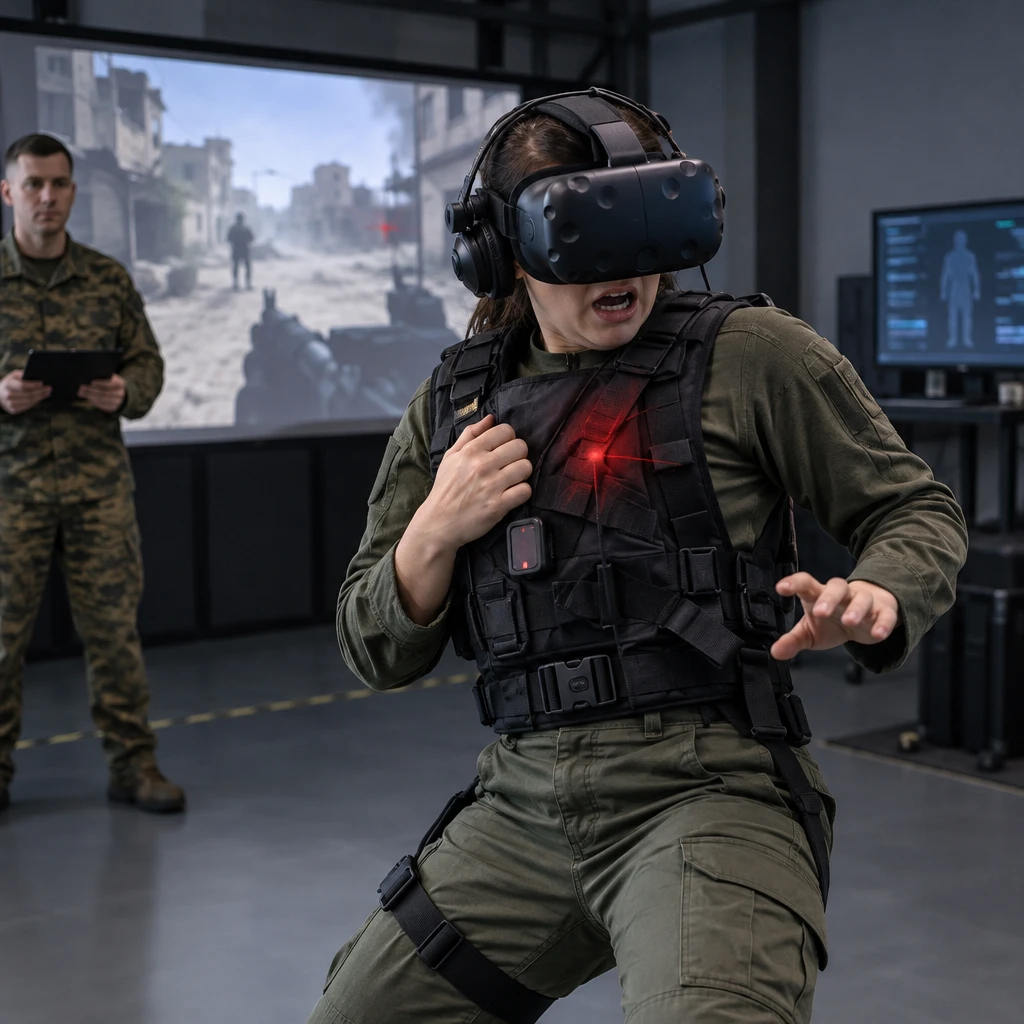
“If it’s to prepare soldiers for the realities of war,” I ask Higgs, “how do you simulate the consequences of being shot?” He grins and dashes off to retrieve a Teslasuit — a two-piece haptic suit sold only to defence companies and researchers. Electrodes woven into the fabric use, in Higgs’s words, “electrical impulses to trigger the user’s own muscles”, producing anything from “light rain on the shoulders” to a bullet strike. The biggest shocks, as Higgs shows me in training footage, drop soldiers to the floor, convulsing and shrieking.
Let’s start with the obvious question: why would anyone want a training system that zaps them when they get hit? The short answer is that getting shot in a simulation is easy to ignore. You take a virtual hit, you see a little red flash, and your brain shrugs and says, ‘Fine, I’ll respawn.’ Real combat doesn’t work that way, and the people who train for it need their bodies to take the lesson seriously, not just their eyeballs.
That’s the idea behind VR training systems that add physical feedback. Headsets handle the visuals and sound, and a suit, vest, or harness adds sensations like vibration, pressure, or a mild electrical pulse when a virtual round lands. The goal is to make a mistake register in the body, so the next time a trainee hesitates or ducks too late, the memory sticks a little better.
Military organizations have spent years experimenting with immersive training for good reasons. Live exercises are expensive, they take up a lot of space, and they carry real risks. A simulated environment can recreate a dusty street, a crowded market, or a building full of unknown threats without anyone getting hurt. Trainees can repeat the same scenario as many times as they need, and instructors can pause, rewind, and review what went wrong. For a lot of people, that kind of repetition is the whole point.
Now, the ‘shock’ part deserves some honest skepticism. Any system that delivers electrical stimulation needs careful design, clear safety limits, and proper supervision. Nobody wants a training tool that causes injury or turns a lesson into a medical event. Responsible developers tend to emphasize adjustable intensity, safety cutoffs, and screening for people with certain health conditions. If you ever see one of these systems, those are the questions worth asking before you strap in.
Then there’s the sensory side. Haptic feedback is already common in gaming controllers and some VR gear, but military-focused versions aim for something more pointed. A quick tap can signal a near miss, while a stronger pulse suggests a direct hit. Combined with realistic audio and motion tracking, that physical cue can make a simulated engagement feel surprisingly tense. Your heart rate might climb, your shoulders might tighten, and you might catch yourself saying something unprintable when the feedback hits. That reaction is exactly what trainers want to see, because it shows the lesson is landing.
Of course, there’s a limit to how far any simulator can go. Stress in a virtual room is still different from stress when real lives are on the line. People know, at some level, that the threat is not real, and that knowledge can blunt the experience. Good training programs account for this by layering in scenarios with uncertainty, time pressure, and consequences that make trainees think, not just react. A shock can grab attention, but judgment has to come from practice and feedback.
So does it all feel too real? In a sense, that’s the design goal. The closer a simulator gets to the physical and mental pressure of an actual engagement, the more useful it can be, as long as safety and ethics keep pace with the technology. It’s a little unsettling to think about a headset that can make you flinch on command, but it’s also a reminder of how much training is about building instincts before they’re needed.
If you ever get the chance to try one of these systems, go in curious and a bit humble. Expect to get hit, expect to feel it, and expect to walk out with a new appreciation for what people train for. Just don’t expect to hide your reaction. The simulator won’t judge you, but your coworkers will definitely notice.
Inspired by: “I tried the military VR simulator that shocks you when you get shot – and it felt all too real” (r/RSS)