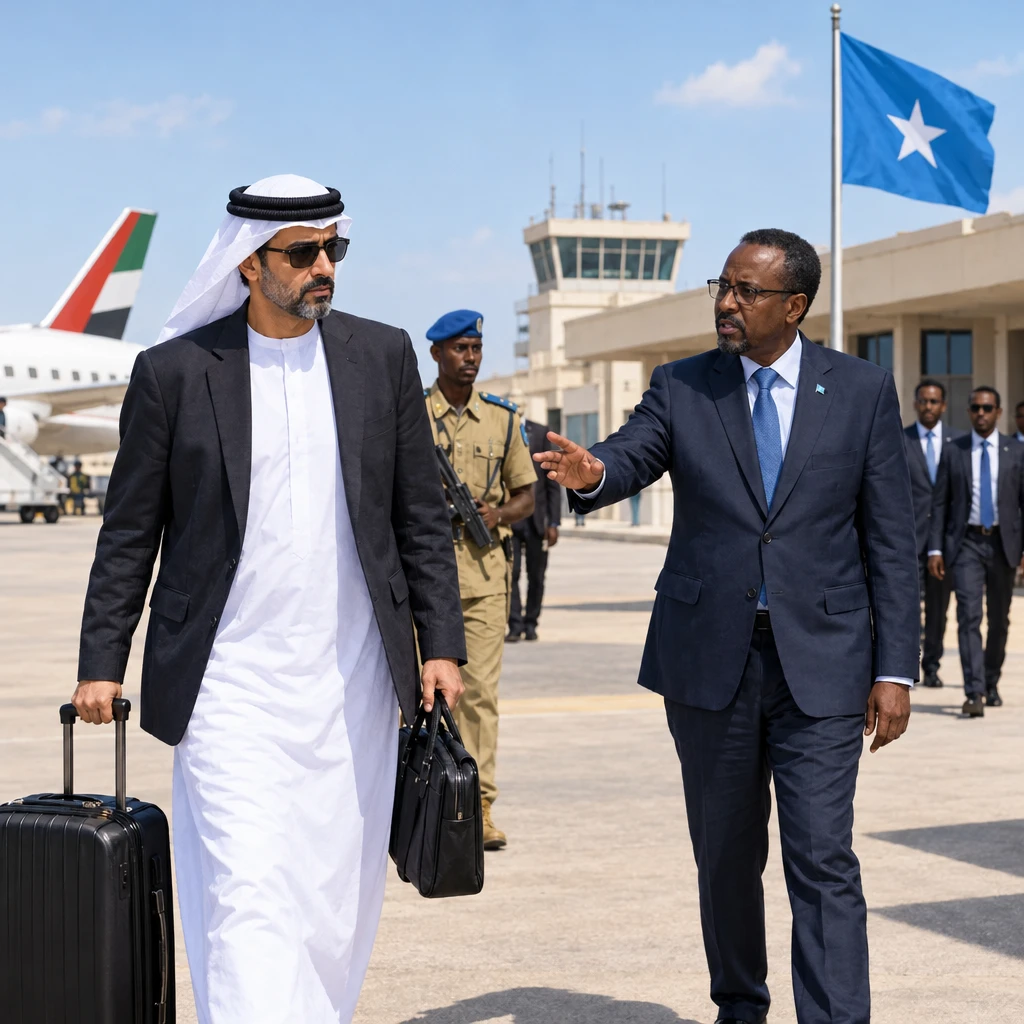
MOGADISHU, 19 November 2026 – Somalia's Defence Minister Ahmed Moallim Fiqi on Thursday publicly told the United Arab Emirates' ambassador to leave the country, accusing the envoy of representing "sedition and evil" amid escalating tensions …
Diplomatic news doesn’t usually come with a 72-hour deadline attached, so when Somalia ordered the United Arab Emirates ambassador to leave the country within three days, it grabbed attention fast. The government also recalled its own envoy from Abu Dhabi. The reason it gave was strong language: violations of Somalia’s sovereignty that amount to an “open invasion.”
That’s a heavy phrase to throw around between two countries that, on paper at least, have been partners for years. Diplomats tend to reach for words like “concern” or “regret” well before they reach for “invasion.” When a government picks the harsher word, it usually wants its citizens and its rivals to understand that it considers the situation serious.
What was announced
According to the reporting, the order followed a meeting of the Somali Council of Ministers. Information Minister Abdifatah Kasim Mohamud said that measures would be taken against those who cooperate with the UAE, and he urged Somalis to defend their nation. Those are the broad strokes, and they are about as specific as the public record gets for now.
The frustrating part for anyone trying to follow this story is that the specific actions prompting the response have not been released. We know Mogadishu is angry. We know it has put the ambassador on a short clock. We do not yet have a clear, detailed account of what the UAE is alleged to have done. Anyone who tells you they know the full story at this stage is either guessing or selling something.
Why the word ‘sovereignty’ carries so much weight
Sovereignty is one of those concepts that sounds abstract until a country feels it is being crossed. For Somalia, a nation that has spent decades dealing with internal conflict, a weak central state in earlier periods, and heavy reliance on outside actors for security and aid, questions about who has influence over its territory and its decisions are not academic. They go to the core of whether the federal government can say no to anyone.
Foreign governments have long been involved in Somalia in various capacities, from peacekeeping and training to economic investment and port development. Those relationships can bring real benefits, but they can also produce friction when local leaders feel their authority is being bypassed. Calling something an “invasion” is a way of saying that the relationship has crossed a line in the eyes of Mogadishu, whatever the other side might say.
The Gulf factor
The UAE has become a significant presence in the Horn of Africa over the last decade or so. Its investments in ports and infrastructure, along with security and training links, have made it a major player in the region. That kind of footprint is generally welcomed by governments hoping for development, but it can also attract suspicion, especially when regional rivalries and internal political disputes get mixed into the picture.
It would be too simple to frame this as a clean good-versus-bad story. Somalia’s politics are complicated, with competing federal and regional authorities, shifting alliances, and a population that has lived through much worse than a diplomatic spat. Outside powers often end up being pulled into these internal arguments, sometimes by choice and sometimes not.
What happens next
The 72-hour deadline is the most concrete element here. Whether it is enforced as written, extended, or quietly negotiated will say a lot about how both governments want this to play out. Recalling an ambassador is a serious step, but it is also a signal that leaves room for talks. Expelling a diplomat outright is harder to walk back.
The warning about measures against those who cooperate with the UAE is also worth watching. Statements like that can be aimed at specific individuals or businesses, or they can be a broader political message meant for a domestic audience. Until more details emerge, it is hard to say which one this is.
The bottom line
Somalia has taken a dramatic step, and the language used, “open invasion,” is intentionally strong. The public has heard the accusation and the deadline, but not yet the evidence or the specifics behind them. The smart move for readers is to hold off on strong conclusions until more reporting fills in the gaps. Diplomacy rarely moves at the speed of a headline, and this one has a lot of unanswered questions still waiting in line.
Inspired by: “Somalia orders UAE ambassador to leave, citing ‘invasion’” (r/News)