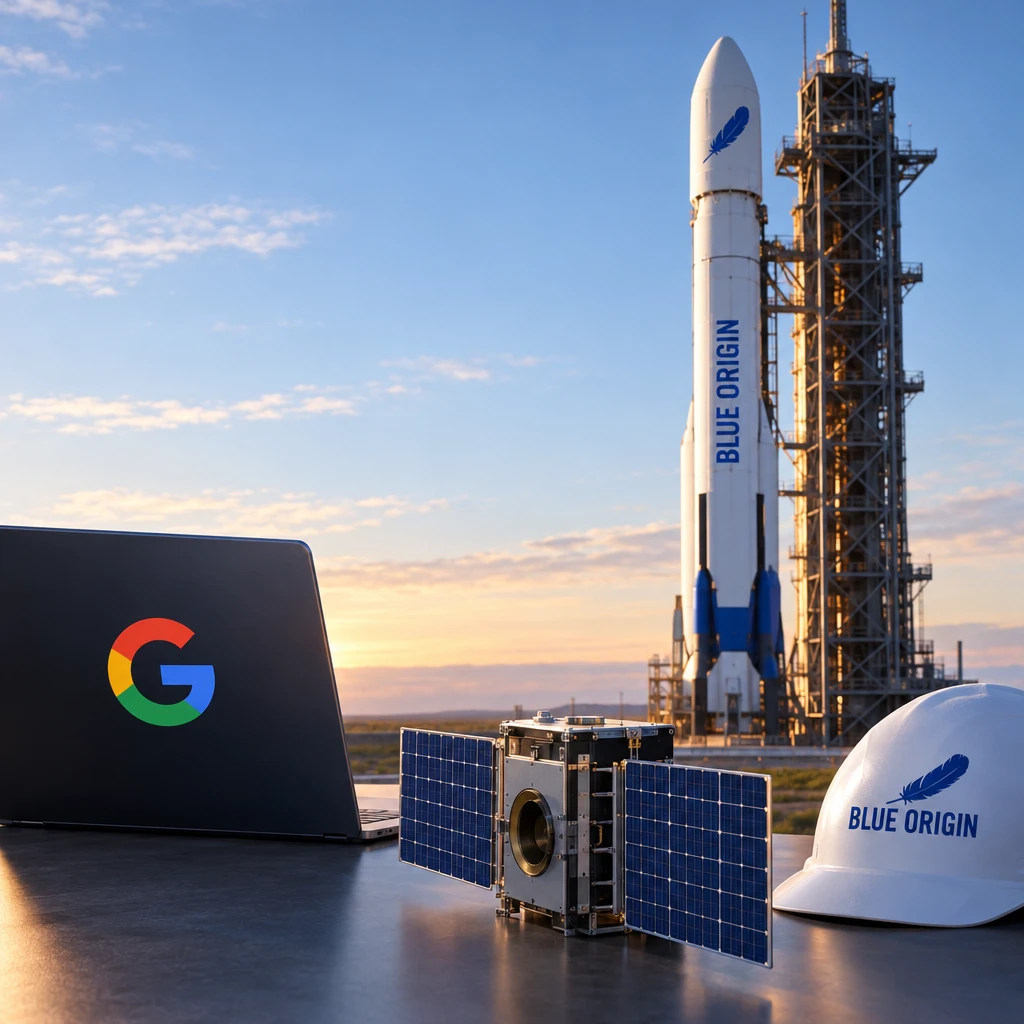
Nov 19 (Reuters) – Jeff Bezos’ Blue Origin said on Thursday that Alphabet’s Google had selected its New Glenn rocket to launch satellites for Project Suncatcher , an experiment aimed at running AI systems in space.
Every so often a headline comes along that makes you pause and reread it, just to make sure you didn’t skip a word. Google picking Blue Origin to launch satellites for AI computing in space is one of those. Yes, the company that answers your search queries wants to run some of its artificial intelligence systems above the atmosphere, and it has hired Jeff Bezos’s rocket company to get the hardware up there.
Here’s what we know. Google has selected Blue Origin to launch satellites for Project Suncatcher, an initiative focused on running AI systems in space. The stated goal is to move power-hungry AI computing beyond Earth by relying on sunlight, which could ease some of the strain on the infrastructure we have on the ground. Blue Origin’s New Glenn rocket is expected to handle the launch in the first quarter of 2029.
That’s the basic news. The more interesting question is why anyone would want to do this.
The Power Problem Nobody Wants to Talk About
AI is hungry. Training and running large models takes enormous amounts of electricity, and the data centers that house all that computing need cooling, land, and grid connections that are increasingly hard to find. If you’ve noticed utilities and tech companies talking more and more about power supply, this is a big reason why. Every new data center competes with homes, factories, and everything else for a slice of the same electrical grid.
So the pitch behind Project Suncatcher is essentially this: if the ground is getting crowded and expensive, why not look up? Sunlight in space is not interrupted by clouds, nighttime, or weather in the way it is on the surface. Solar panels in orbit can collect energy more consistently, and that steady supply is exactly what a computing system with constant demand would want. It’s a clever idea, and it also has the pleasant side effect of sounding like science fiction, which never hurts a press release.
Why Blue Origin?
Launching anything into orbit is hard, expensive, and unforgiving. Satellites don’t fly themselves to space, and a rocket has to be reliable enough to deliver them without drama. Blue Origin’s New Glenn is the vehicle selected for this mission, which makes the rocket the centerpiece of the whole plan. If the launch goes well, it’s a meaningful validation for a relatively newer player in the heavy-lift market. If it doesn’t, well, the internet will remember it forever.
The partnership also highlights how the tech industry and the space industry are increasingly intertwined. Companies that once only cared about software and servers are now booking rocket launches like they’re ordering a shipment of office chairs. Whether that’s exciting or a little unsettling probably depends on how much you enjoy the idea of a server rack drifting around the planet.
The Timeline Is Worth Watching
A 2029 launch target is a long way off in tech terms. A lot can change in a few years, including the technology itself, costs, regulations, and the actual engineering required to keep computing hardware running in orbit. Space is not a forgiving environment for electronics. Radiation, temperature swings, and the challenge of maintaining equipment that can’t be easily repaired all make this more complicated than a simple data center upgrade.
That said, the fact that a major company is committing to this path at all suggests it sees the idea as more than a daydream. Projects like this often start as ambitious experiments and eventually shape how the next generation of infrastructure gets built, even if the first versions look a bit clumsy.
So, Should You Be Impressed?
Cautiously, yes. The problem Google is trying to solve is real: AI needs more power than the current system can comfortably provide. Trying to use sunlight in space is a bold answer, and it’s at least more imaginative than arguing about who gets to build the next gas plant. Still, plenty of questions remain about cost, feasibility, and whether this becomes a practical solution or a very expensive proof of concept.
For now, the takeaway is simple. Google has picked Blue Origin, New Glenn is set to launch in 2029, and the idea of running AI from orbit has moved from theory into a concrete plan. Keep an eye on it. If nothing else, it will be a great story to tell when someone asks why the cloud suddenly got a lot higher.
Inspired by: “Google taps Blue Origin to launch solar-powered AI satellites in 2029” (r/Crypto)