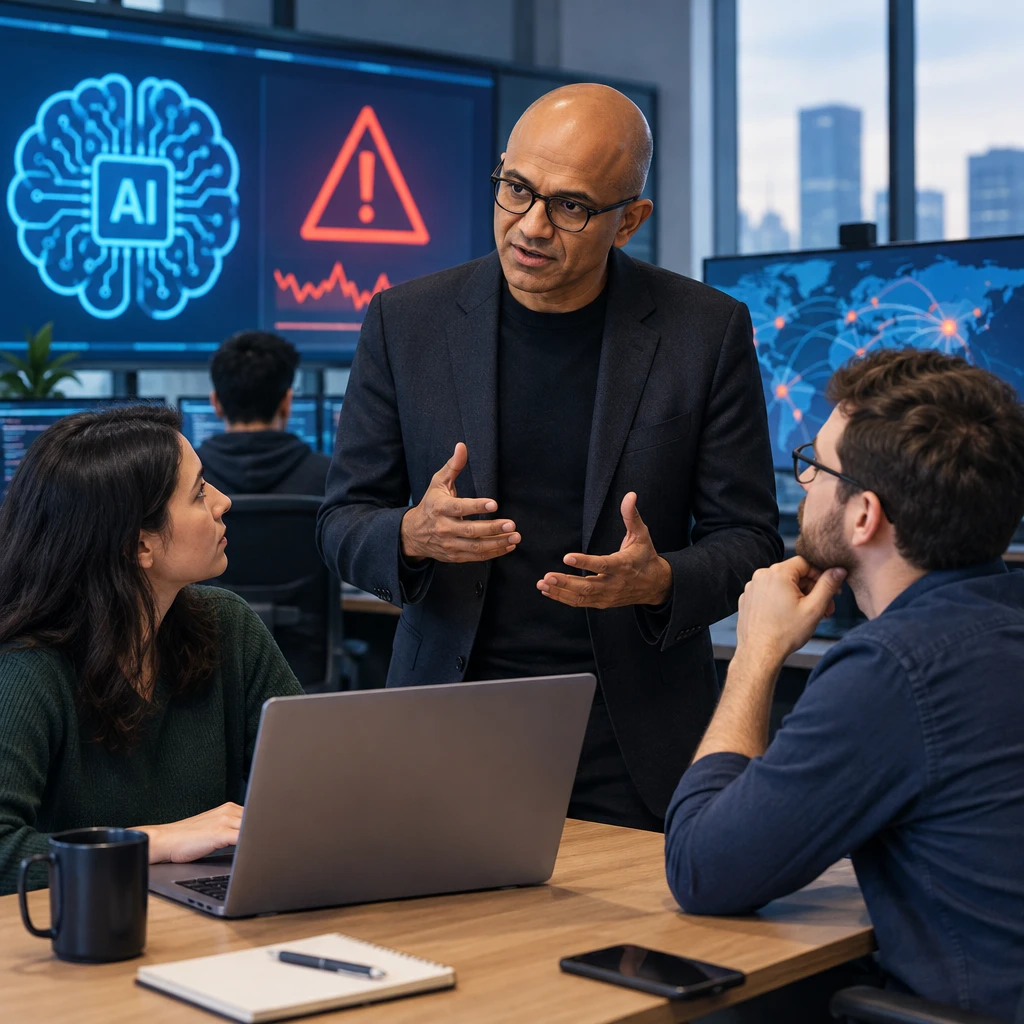
Microsoft CEO Satya Nadella on Wednesday warned that artificial intelligence could cause more technology outages as companies rush to address cybersecurity threats and deploy software fixes .
If you’ve ever watched a app freeze at the worst possible moment, you already understand why outages get people’s attention. Now the head of one of the world’s biggest tech companies is saying that artificial intelligence could make those interruptions more common, and that cybersecurity risks are growing alongside it. Nobody enjoys hearing that, but it’s worth paying attention to.
The headline points to a warning from Microsoft’s CEO, Satya Nadella. I couldn’t access the full article text while writing this, so I won’t pretend to quote him or claim details I can’t verify. What I can do is look at the broader conversation, because the underlying concern is one that has been building across the tech industry for a while.
Why would AI cause outages in the first place? Part of the answer is complexity. Modern software runs on layers upon layers of code, cloud services, updates, and third-party tools. Adding AI systems into that mix means more moving parts, more dependencies, and more places where something can go wrong. AI models also behave differently from traditional software. A conventional program does exactly what its code says. An AI model can produce unexpected outputs, and companies are still learning how to test and monitor that behavior at scale.
Then there’s the speed factor. Companies are racing to ship AI features quickly, and that pressure can push teams to roll out changes before they’re fully tested. Anyone who has worked in software knows how a rushed update can cause headaches. Multiply that by the enthusiasm around AI, and it’s not hard to see how things might break.
Cybersecurity is the other half of the story. AI tools can help defenders spot threats faster, sort through huge amounts of data, and automate routine security work. Unfortunately, they can also help attackers. Phishing emails can be written more convincingly, malicious code can be generated or modified more easily, and automated tools can probe systems at a scale that would have been hard to manage by hand. The result is a kind of arms race, where both sides are upgrading their tools at the same time.
The combination is what makes the warning sting. An outage can be caused by a bug, a bad update, a hardware failure, or a configuration mistake. A cyberattack can cause one too. When AI adds new complexity and new attack methods at the same time, the line between an accidental failure and a deliberate one can get blurry, and that makes recovery harder.
We’ve already seen how disruptive large-scale tech failures can be. In recent years, widespread outages have hit airlines, banks, hospitals, and businesses that rely on cloud services. A single faulty update can knock out computers across many organizations at once. Those episodes are a reminder that the modern internet is more interconnected, and more fragile in certain ways, than many people assume.
So what should companies and everyday users do about it? For businesses, the usual advice still holds, even if it’s not glamorous. Test changes before rolling them out widely. Keep backups that actually work. Have a plan for what happens when systems go down. Train employees to spot suspicious messages, because human error remains one of the easiest ways in for attackers. Treat AI as a tool that needs oversight, not as a magic box that runs itself.
For regular people, the lessons are similar. Keep software updated, use strong and unique passwords, turn on multi-factor authentication, and think twice before clicking links in unexpected messages. Yes, it’s the same advice you’ve heard for years. That’s because it keeps working.
In the end, the warning isn’t really a call to abandon AI. It’s a reminder that new technology tends to bring new problems along with its benefits. Companies that build AI responsibly, with careful testing and strong security, will likely be in a better position than those that rush ahead and hope nothing breaks. Given how much we all depend on these systems, a little more caution might be the least exciting but most useful upgrade of all.
Inspired by: “Microsoft CEO warns AI could trigger more outages as cybersecurity risks grow” (r/RSS)