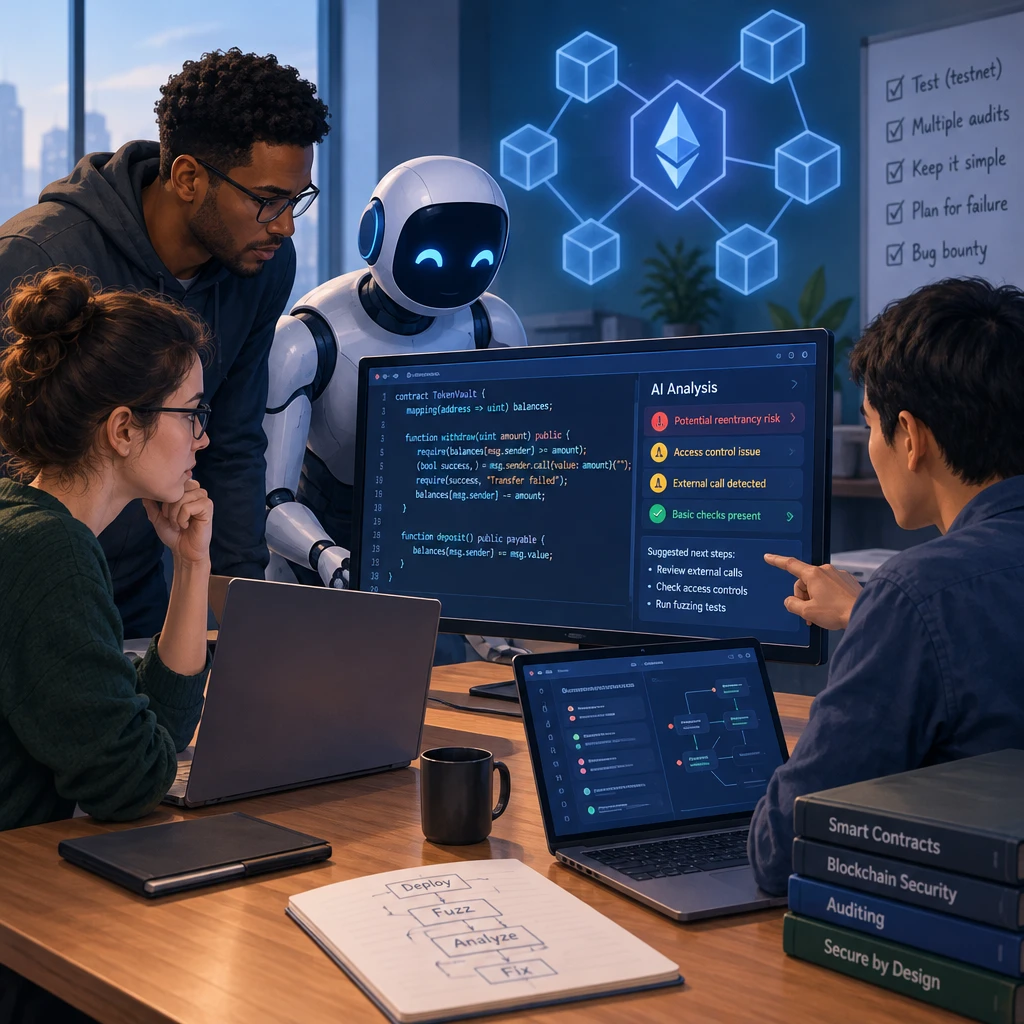
However, because an · AI agent can iterate and make use of dependencies, local blockchain forks, and decompilation, it weakens the protection gained by keeping source code secret , and can attempt attacks against complex vulnerabilities such …
If you have ever wondered whether a computer program can break into another computer program without a human sitting behind the keyboard, welcome to one of the more interesting corners of crypto security. The short answer is yes, and the longer answer is messier, more nuanced, and a lot more important than the hype cycle would suggest.
Let’s start with the basics. A smart contract is a piece of code that lives on a blockchain, most famously Ethereum, and runs automatically when certain conditions are met. Once it is deployed, it generally cannot be edited. That permanence is a feature when you want trustless systems, and a headache when someone finds a bug after millions of dollars are already locked inside. There is no customer support hotline for a contract that has been drained. There is no ‘please reverse the transaction’ button, at least not one that works for everyone.
That is why smart contract security has become its own specialized field. Auditors review code line by line, developers run test suites, and security firms look for well-known vulnerability patterns. Over the years, the industry has built up a fairly long list of classic mistakes, and many of them are depressingly familiar.
Some of the usual suspects include:
– Reentrancy, where a contract calls out to another contract before updating its own internal state, allowing the outside contract to call back in and repeat an action it should not be able to repeat.
– Access control errors, where functions meant only for administrators are accidentally left open to anyone.
– Arithmetic issues, such as overflows and underflows, which became far less common once modern compiler protections arrived but still show up in older or poorly written code.
– Oracle manipulation, where a contract trusts a price feed that an attacker can distort, often using a large trade or a flash loan.
– Logic errors, which are the most annoying category because the code does exactly what it was written to do, just not what the designers intended.
Now here is where AI enters the picture. Large language models and other AI systems are very good at reading code, spotting patterns, and generating text. That combination makes them useful for auditing. An AI model can scan a contract, flag suspicious functions, explain what a block of code appears to do, and suggest where a human reviewer should look more carefully. For busy security teams, that kind of first-pass review can save real time.
The same abilities cut the other way, too. If an AI can help a defender understand a contract, it can help an attacker do the same thing. Reading unfamiliar code and finding the weak spot is exactly the sort of task these systems handle well. That does not mean a chatbot will autonomously drain a protocol while you make coffee, but it does mean the barrier to finding and exploiting certain bugs may be getting lower.
This is where the concept of AI agents becomes important. An agent is more than a single question and answer. It is a system that can plan steps, call tools, run scripts, read the results, and try again. In security research, that could mean an agent that deploys a contract to a test network, runs fuzzing tools to generate unusual inputs, observes what breaks, and adjusts its approach. Done responsibly, this is a powerful way to test code before real money is at stake. Done irresponsibly, it is a very efficient way to find vulnerabilities in other people’s live systems.
That dual-use nature is the real story. The technology itself is neutral, but the incentives around it are not. Defenders want to find bugs before attackers do. Attackers want to find bugs before defenders do. Both sides now have access to similar tools, and both are moving faster.
So what does a healthier approach look like? A few practices seem sensible and widely accepted:
– Test on local or test networks before anything touches real funds.
– Use AI as an assistant for review, not as a replacement for human auditors who understand the business logic.
– Combine multiple methods, including formal verification, static analysis, fuzzing, and manual review.
– Keep contracts simple where possible, since complexity tends to hide bugs.
– Plan for failure with upgrade paths where appropriate, pause mechanisms, and bug bounty programs that reward responsible disclosure.
That last point deserves a little extra attention. Bug bounties exist precisely because the best way to handle a vulnerability is to hear about it from someone who wants a reward rather than someone who wants to empty a wallet. As AI makes vulnerability discovery faster, the window between a bug existing and someone finding it may shrink, which makes quick disclosure channels even more valuable.
There is also a human lesson buried in all of this. Many of the worst smart contract failures were not caused by exotic mathematics. They were caused by ordinary mistakes, rushed deployments, or assumptions nobody questioned. AI tools may catch some of those mistakes, but they will not eliminate the need for careful thinking. A model can tell you a function looks risky. It cannot always tell you whether the business design behind that function makes sense in the first place.
So can AI hack smart contracts? In a practical sense, AI systems can help identify and possibly exploit certain vulnerabilities, especially in code that is already known to be weak or in environments where someone is actively looking. Whether that becomes a routine threat or a manageable one depends on how quickly the security community adapts, how seriously teams treat audits, and how responsibly these tools are used.
The blockchain world has a long habit of promising that code is law. AI is pushing that idea to its limits. If the code is law, then the people who read it fastest and most thoroughly will have a lot of power, and that is a good reason to make sure defenders are using these tools just as aggressively as attackers are.
So test your contracts, audit them twice, and maybe do not deploy something to mainnet at 2 a.m. because a chatbot said it looked fine.
Inspired by: “Can AI Hack Smart Contracts? How AI Agents Are Changing Blockchain Security” (r/RSS)