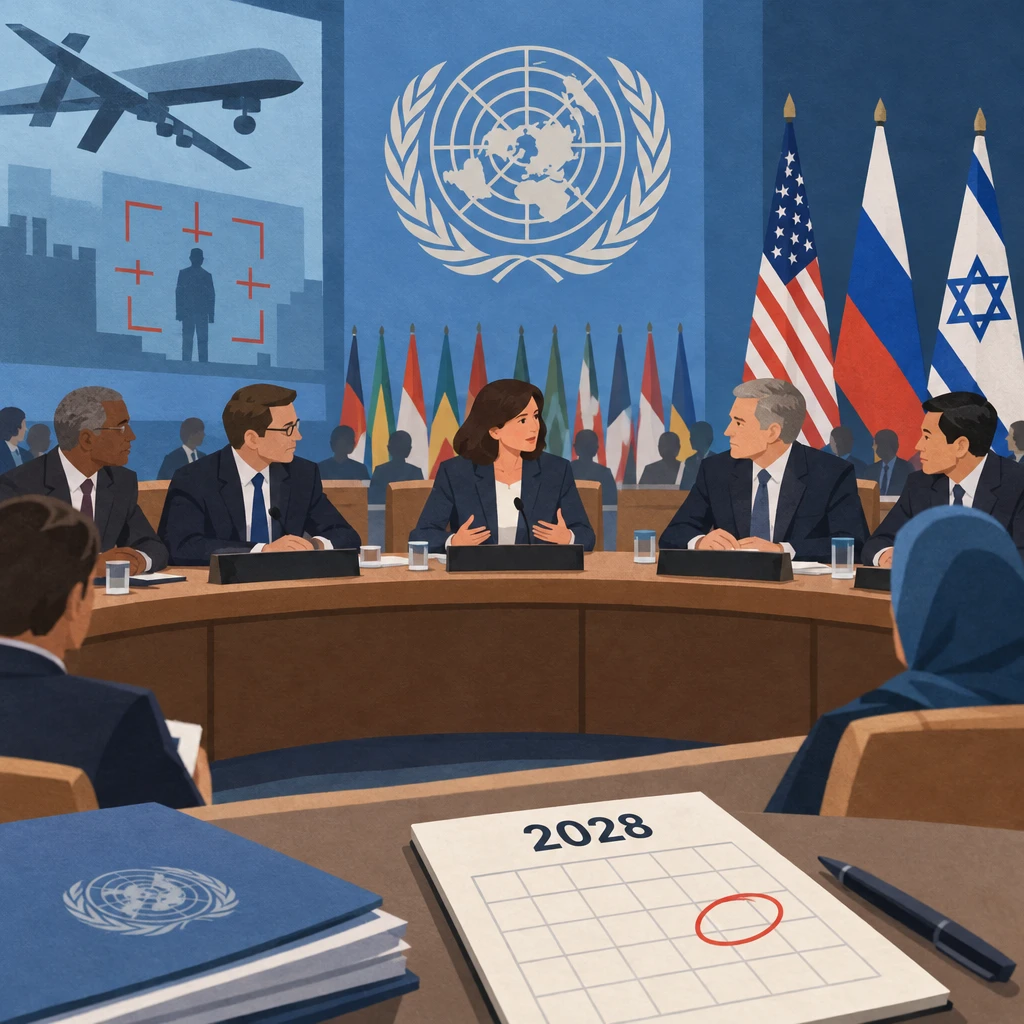
UN talks on regulating weapons with little or no human oversight ended on Saturday with a pledge for further talks to develop new rules within two years .
Every so often, the world’s diplomats gather in a large room, speak carefully, and agree to keep talking. This past Saturday was one of those days. After UN discussions wrapped up, states agreed to keep working on rules for weapons systems that can select and engage targets on their own, with a goal of getting something in place within two years. The target year is 2028. Mark your calendars, or don’t, since we have been here before.
The basic idea behind the talks is simple enough. Lethal autonomous weapons, often called ‘killer robots’ in the headlines, are systems that can identify and attack targets with limited or no direct human control. That might sound like science fiction, but the underlying technology already exists in various forms, from drones that navigate without constant piloting to targeting software that processes information faster than any human operator could. The question on the table is whether governments should agree on firm limits for these systems before they become even more common.
About 100 states wanted legally binding rules. That is a significant number of countries pushing for enforceable commitments, not just nice speeches. Binding rules would mean obligations that countries are expected to follow, with consequences for breaking them. Supporters argued that without such rules, the development of autonomous weapons could move ahead with little meaningful oversight, and that the risks to civilians and to basic principles of humanitarian law are too high to leave to good intentions.
Unfortunately, good intentions were pretty much what the room ended up with. The United States, Russia, and Israel opposed binding restrictions, and their objections were enough to shape the final result. What emerged was a non-binding pledge to keep discussing the issue. In diplomatic terms, that is a commitment to commit to talking more. In everyday terms, it is a promise to keep the conversation going, which is better than nothing, but not by much if you were hoping for guardrails.
Advocates were understandably disappointed. Many had hoped for more immediate restrictions, something concrete that would limit how these systems are developed and used. Instead, they got a timeline and a process. Some will see the two-year window as a genuine opportunity to build momentum. Others will see it as a familiar pattern in which the most powerful militaries agree to discuss a problem for as long as possible while their research programs keep moving forward.
To be fair, the disagreement is not just stubbornness. Governments that oppose binding rules often argue that existing international humanitarian law already applies to new weapons, and that tailored treaties could be too rigid for technology that changes quickly. They may also worry about giving rivals an advantage or about defining terms in a way that could limit defensive systems. Those concerns are real enough to be taken seriously, even if you find them frustrating. The tension is between wanting clear limits now and wanting flexibility to keep up with fast-moving technology, and nobody has yet found a formula that makes everyone happy.
There is also a practical question about accountability. When a machine makes a targeting decision, who is responsible if it goes wrong? The operator, the commander, the company that built the software, or the government that approved its use? International law generally depends on clear lines of responsibility, and autonomous systems blur those lines. That is a big reason many advocates pushed for rules that keep meaningful human judgment in the loop, rather than letting algorithms make final decisions about who lives and who does not.
The coverage of the talks has been widely shared across outlets, including The Independent, the Jerusalem Post, CNA, Salem Radio Network News, and The Straits Times. The headlines vary in tone, but the core facts are consistent: a two-year timeline, a non-binding outcome, and clear opposition from a few major military powers. If you read only the headlines, you might think a treaty is on the way. If you read the details, you will see that the agreement is more about continuing discussions than settling the matter.
So what happens next? Probably more meetings, more draft texts, more statements about the urgency of the issue, and more debate about definitions. Whether 2028 brings real rules will depend on whether enough countries are willing to push, and whether the states that are currently resisting decide that a shared framework serves their interests. History suggests that these negotiations can move slowly, but it also shows that international norms sometimes emerge once enough pressure builds.
For now, the takeaway is this: the world has agreed that autonomous weapons deserve serious attention, and it has agreed to keep talking. That is a start, though it is not the same as protection. Whether the next two years produce meaningful limits or just a longer list of meeting minutes is the question worth watching. Consider this your reminder to check back in 2028, and to keep your expectations appropriately cautious in the meantime.
Inspired by: “States agree to UN talks aiming to regulate ‘killer robots’ by 2028” (r/World)