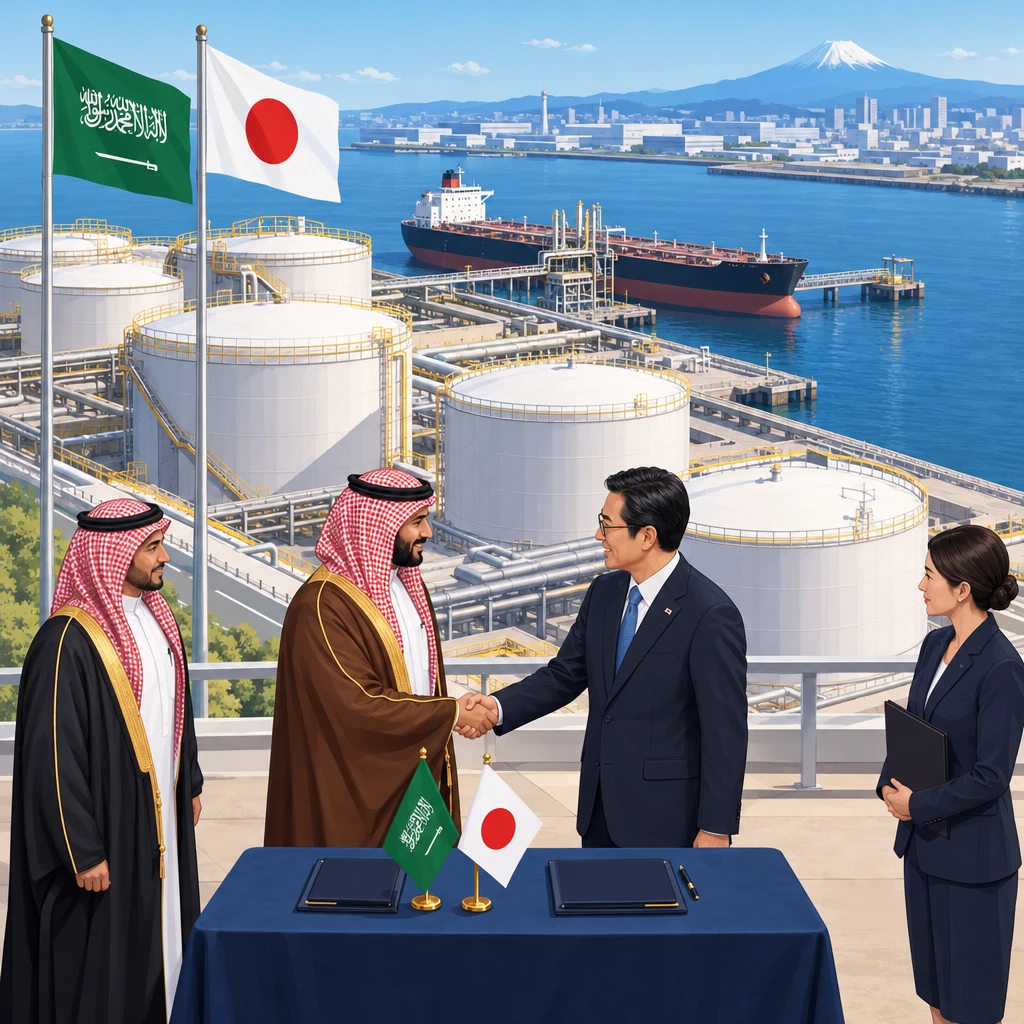
The Japanese government has agreed to let Saudi Arabia use oil tanks in Japan capable of storing up to 16 million barrels of crude oil.
If you’ve ever wondered who keeps the lights on when the world’s oil supply gets jittery, the answer is a lot of unglamorous storage tanks, quiet government planners, and a few big bilateral deals. This week’s news fits that description nicely. Saudi Arabia has agreed to store an additional 16 million barrels of crude oil in Japan, a move meant to strengthen Japan’s energy security.
The deal is not a brand-new idea. It expands a storage arrangement that was first set up back in 2010. Think of it as a partnership that has been running in the background for over a decade, now getting a bigger footprint. Both sides have clearly decided that the existing setup was worth building on rather than replacing.
Why does a country like Japan care so much about this? Japan imports the great majority of the energy it uses, so anything that disrupts supply is a serious problem, not a minor inconvenience. Having crude stored within the country, or in facilities it can reach quickly, gives policymakers a cushion. If shipments are delayed, prices spike, or a crisis hits somewhere far away, that stored oil can help keep refineries running and fuel flowing to homes and businesses. Strategic reserves are a bit like an emergency fund: you hope you never need it, and you are very glad it’s there when you do.
The agreement includes a second piece that is just as important. Japan will be able to purchase up to 8 million barrels of Saudi Arabian crude. That turns storage into a practical commercial relationship rather than just a parking arrangement. Japan gets access to a major supplier, and Saudi Arabia gets a reliable buyer. In the oil business, predictable customers are worth a lot.
The deal also ties into a broader initiative called “POWERR Asia,” which is aimed at improving energy security across the region. This matters because energy problems rarely stay within one border. A supply shock in one part of Asia can ripple outward, affecting prices, shipping, and planning for neighboring countries. A regional framework gives participants a way to coordinate instead of scrambling separately when trouble arrives.
Not everyone will find this exciting. Energy policy has a reputation for being dry, and storage agreements sound about as thrilling as a spreadsheet. But that is sort of the point. The most important infrastructure in modern life is often the kind nobody notices until it fails. A deal like this is designed to make sure nobody has to notice.
The coverage of the agreement has been consistent in its basic facts. Asharq Al-Awsat reported the 16 million barrel expansion, while Japan Today framed the news as Saudi Arabia agreeing to triple the crude oil stored in Japan. Headlines love a clean, dramatic number, so it’s worth reading the details carefully. The core facts are the additional 16 million barrels, the earlier project from 2010, the option for Japan to buy up to 8 million barrels of Saudi crude, and the regional cooperation under POWERR Asia.
In the end, this is a story about planning ahead. Governments and energy companies cannot control every disruption, but they can prepare for them. Adding storage, locking in purchasing options, and coordinating with neighbors is the unglamorous work of keeping a country supplied. It may not make for thrilling reading, but for the people who depend on steady energy every day, it is exactly the kind of news they want to see.
Inspired by: “Saudi Arabia Agrees to Store Additional 16 Million Barrels of Crude in Japan” (r/World)