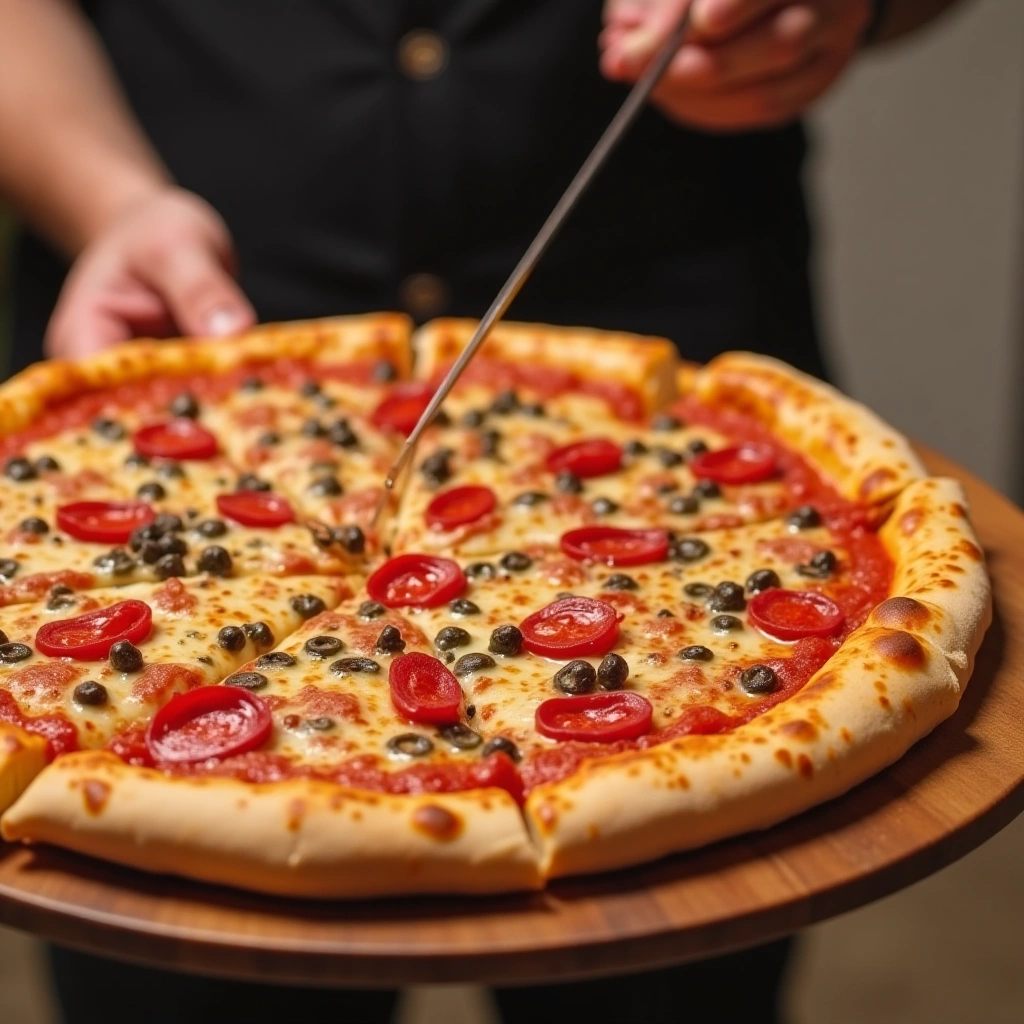
Nov 16 (Reuters) – Papa John’s wants AI to have a look at your pizza before you take your first bite.
There was a time when the only thing that inspected your pizza before you ate it was you, standing in the kitchen and deciding whether the slightly charred bit was a flaw or a feature. Those days are apparently over. Papa John’s has decided that your delivered pizza deserves a second opinion, and that opinion is coming from artificial intelligence.
According to a Reuters report by Waylon Cunningham, the pizza chain is running a promotion that offers customers a free pizza in exchange for a photo of their delivered order plus some feedback. The photos feed into an AI-based quality-control effort meant to make sure each pizza is properly cooked and cut. So yes, you are now being invited to photograph your dinner for reasons other than Instagram. Progress.
The “Achilles’ Heel” of Pizza
Papa John’s CEO Todd Penegor was refreshingly candid about why the company is doing this. In his interview with Reuters, he said inconsistency across the chain’s franchised restaurants has become the “Achilles’ heel” of the brand.
That’s a pretty honest admission for a CEO. Most corporate messaging about quality sounds like it was written by a committee that has never eaten food. Penegor basically said the quiet part out loud: sometimes you get a great pizza from Papa John’s, and sometimes you get one where the pepperoni looks like it was cut during a minor earthquake.
Anyone who has ordered from a big chain knows the problem. The menu is the same everywhere, the logo is the same everywhere, but the actual pizza depends heavily on which location made it, who was working that night, and how many orders came in at once. Consistency is the whole promise of a chain. If you wanted a surprise, you’d go to the independent place down the street and roll the dice.
Teaching a Computer What a Good Pizza Looks Like
The goal, Penegor said, is to build a system that mirrors the chain’s existing in-store quality-control cameras. Those cameras already use AI to check that:
– The cheese isn’t burnt
– The pepperoni slices are cut smoothly
– The outer crust is shaped like “a beautiful breadstick”
That last one deserves a moment. Somewhere at Papa John’s, a defined, measurable standard exists for whether a crust qualifies as a beautiful breadstick, and a computer has been trained to enforce it. You may not appreciate your crust that much, but Papa John’s does.
The catch is that these in-store cameras are only installed in a few hundred locations out of roughly 6,000 worldwide. Putting high-tech cameras in every kitchen costs money and takes time. So the company has turned to the cheapest camera network on the planet: its customers’ phones.
Crowdsourcing Quality Control, One Slice at a Time
This is the clever part. Rather than install expensive equipment in thousands of kitchens, Papa John’s is asking customers to do the photography for free. Well, almost free. The “payment” is a pizza, which is a pretty good deal for both sides. You get dinner, and they get data.
Penegor acknowledged that user-submitted photos aren’t yet as accurate as the in-store cameras. That makes sense. The in-store cameras presumably get a consistent angle, consistent lighting, and a pizza that hasn’t spent time sliding around in a box. Customer photos, on the other hand, will come from kitchen counters, coffee tables, car hoods, and dimly lit living rooms. Some will be blurry. Some will have a cat in the frame. At least one is surely a photo of a pizza with a slice already missing, because people are hungry and patience is a myth.
Still, the potential upside is big. Customer photos let the company apply image-based quality control far more widely and far more cheaply than its current setup. It also captures the pizza at the moment that actually matters: when it arrives at the customer’s door, not when it leaves the oven. A pizza can look perfect in the kitchen and then arrive looking like it lost a fight with the delivery bag.
A Very Large Dashboard of Pizza
Penegor said the company has a “huge dashboard with all of the pictures that are coming in,” along with the feedback customers submit. The promotion reportedly generated thousands of photos in its first few days after starting on November 9. It’s set to run until November 20.
Somewhere, someone at Papa John’s headquarters is looking at a giant screen full of pizza photos as part of their actual job. Whether that sounds like a dream or a slow descent into madness probably depends on how close it is to lunchtime.
Jokes aside, that volume of data matters. Thousands of photos tied to specific orders can show patterns that a few mystery shoppers never would. If one location keeps sending out pizzas with burnt cheese, or a particular region consistently struggles with slicing, the data should make that visible.
Built In-House, With a Little Help From Google
Penegor said the technology was relatively cheap to develop in-house and builds on existing AI work the company has done with Google Cloud. That’s worth noting, because “AI initiative” often makes people picture enormous budgets and teams of consultants. In this case, the company appears to be extending tools it already had rather than starting from scratch.
That’s a sensible approach. A pizza chain doesn’t need to invent a new branch of computer science. It needs a system that can look at a photo and say, with reasonable confidence, “that pepperoni was cut by someone in a hurry.”
Why Now? Follow the Sales Numbers
The timing isn’t random. Papa John’s reported a 6.5% decline in quarterly same-store sales on November 5, just days before this promotion launched. Same-store sales are a key measure for restaurant chains because they show how existing locations are performing without the boost from new openings.
A 6.5% drop is not the kind of number a CEO enjoys explaining. So it makes sense that the company is looking for ways to win customers back, and quality is an obvious place to start. If people stop ordering because their last pizza was disappointing, giving them a free pizza and a chance to complain is a pretty direct way to address both problems at once.
It’s also a decent marketing move. “Send us a photo, get a free pizza” is a lot more appealing than “please fill out our 14-question survey about your recent delivery experience.”
What Franchisees Get Out of It
Penegor said the feedback will help the chain decide which fixes to prioritize and give franchisees a clear view of where their restaurants may fall short.
This is where things could get interesting. Franchise systems depend on independent operators following brand standards, and enforcing those standards across thousands of locations is hard. Photo evidence tied to specific orders is much harder to argue with than vague complaints. It’s one thing to hear “customers say your pizzas are inconsistent.” It’s another to see a dashboard full of photos showing exactly what went wrong.
For franchisees who are doing a great job, this could be validation. For the ones who aren’t, it may feel a bit like a report card nobody asked for. Either way, it gives everyone a shared, visual reference point for what “good” looks like.
The Bigger Picture: AI in Your Takeout
Papa John’s isn’t the first company to use AI in food service, and it won’t be the last. Restaurants have been experimenting with automation in ordering, kitchen management, and delivery logistics for years. What stands out here is how practical and modest this use case is. Nobody is claiming AI will make the pizza. It’s just checking whether the humans who made it hit the mark.
That’s arguably the kind of AI application that makes the most sense: a narrow, specific task where a computer can spot visual patterns faster and more consistently than a person scrolling through thousands of photos. A burnt spot is a burnt spot. A badly cut slice is a badly cut slice. You don’t need a philosophical breakthrough to identify either one.
So, Should You Send In Your Pizza Photo?
If you’re ordering from Papa John’s before November 20, there’s not much downside. You take a picture, share some thoughts, and get a free pizza. Your feedback might even help the location near you get better. That’s a pretty good return on ten seconds of phone photography.
Just maybe take the photo before you start eating. The AI is smart, but it probably can’t grade a crust that’s already in your mouth.
In the end, this is a pizza company admitting it has a consistency problem and trying a cheap, scalable way to fix it. Whether a dashboard full of customer photos can actually turn things around remains to be seen. But if it means fewer burnt cheese disasters and more crusts worthy of the title “beautiful breadstick,” most pizza lovers will happily say cheese.
Inspired by: “Papa John’s turns to AI to check pizzas from customers’ photos” (r/News)