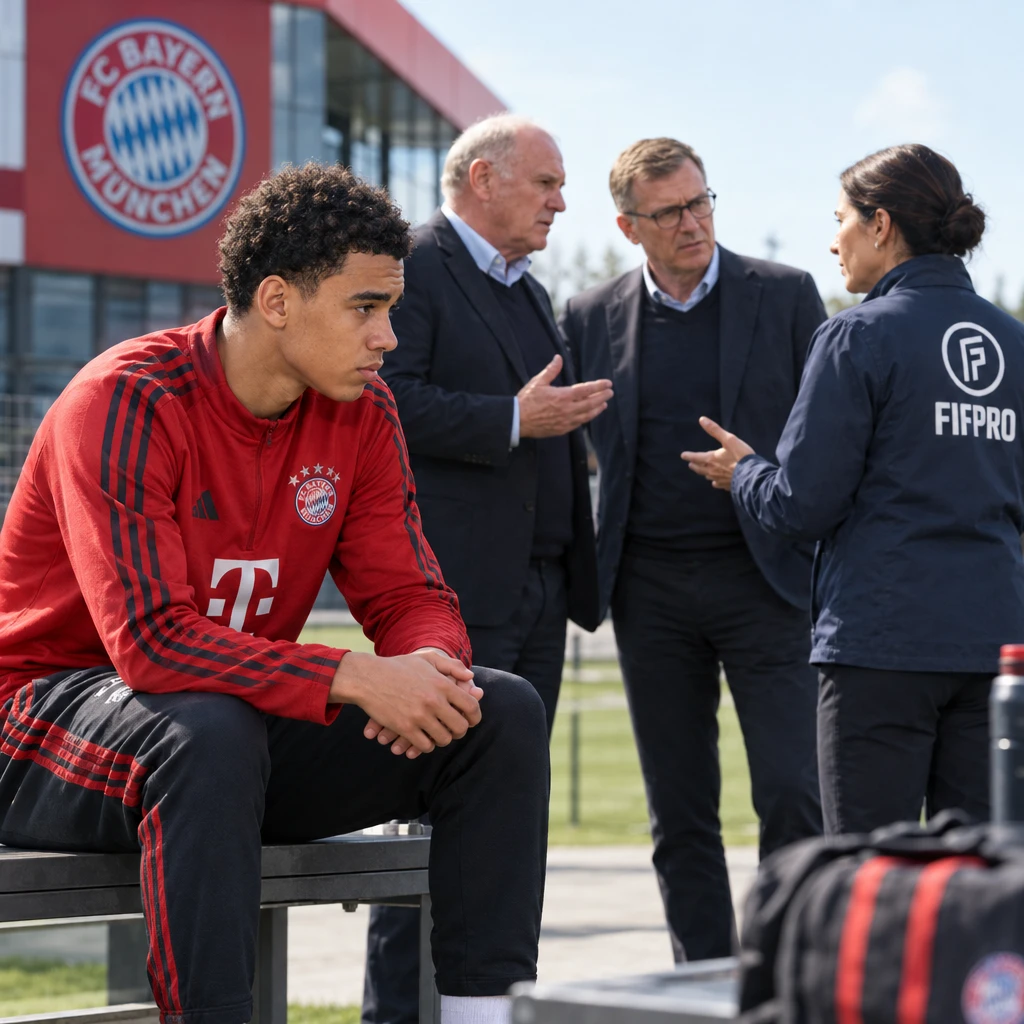
FIFPRO laid out its position in an official statement, expressing deep concern over remarks from Bayern's leadership. Honorary president Uli Hoeness, chief executive Jan-Christian Dreesen and former chief executive Karl-Heinz Rummenigge had all, in similar terms, cast doubt on aspects of Musiala's contract as he returned from injury, it noted.
Every so often a football story comes along that makes you wonder whether anyone in a boardroom has ever had to watch their own words get replayed back to them. The latest example involves Bayern Munich, one of the most successful clubs in world football, and Jamal Musiala, one of its most gifted players. FIFPRO, the global body that represents professional footballers, has said it is ‘deeply concerned’ by comments from senior club leadership about Musiala’s contract and his health.
Here is what has been reported. Senior figures at the club, including honorary president Uli Hoeness and chief executive Jan-Christian Dreesen, have publicly questioned whether Musiala will be able to return to his previous level of play. This follows a neurological disorder diagnosis, which has understandably made his situation a sensitive one. FIFPRO’s response was blunt: it accused the German champions of putting pressure on a player who is still in the middle of his recovery.
It is worth pausing on that last point, because it is the heart of the story. Recovering from any serious medical condition is hard enough without a steady drip of commentary about whether you still have ‘it.’ Athletes already live with a constant audience. Add a contract negotiation into the mix and suddenly every comment from the people who sign the cheques can be read as a message, whether it was intended as one or not.
For anyone who has not followed player unions closely, FIFPRO exists precisely for moments like this. It is the worldwide federation of players’ associations, and its job is to speak up for footballers on health, welfare, working conditions and their rights. Unions do not usually jump into public arguments lightly. When one says it is ‘deeply concerned,’ that is diplomatic language for ‘we are not happy and we want everyone to know it.’
There is also a broader question about how clubs talk about injured or recovering players. Football has a long habit of treating fitness like a simple on-off switch. A player is either fit and useful or he is a problem to be managed. Yet medical recovery, particularly from a neurological condition, rarely follows a neat timetable. Public speculation about whether someone will ‘return to form’ can be unhelpful even when it is meant as honest analysis. Nobody benefits from a young player feeling that his health is being discussed as a financial inconvenience.
Then there is the contract angle, which is where things get especially tricky. Clubs are entitled to think about the long-term value of their players, and negotiations are part of professional sport. But there is a difference between a hard-nosed business conversation held in private and remarks made in public that appear to tie a player’s future to his medical progress. The second approach tends to damage trust, and trust is not an easy thing to rebuild once it has been dented.
So what happens next? Realistically, the most likely outcome is that both sides keep talking, with a lot of careful wording on all fronts. Clubs rarely enjoy being publicly rebuked by a players’ union, and FIFPRO rarely makes a statement like this without expecting some form of follow-up. Musiala, meanwhile, is the one who matters most here, and his focus will presumably be on his health first and his contract second.
The lesson for anyone running a football club is fairly simple, even if it is not always easy to follow. Think before you speak about a player’s body, and especially before you speak about his medical future. A few sentences in an interview can travel around the world in minutes and be picked apart by every outlet from Singapore to New York. Silence, or at least restraint, is sometimes the most professional move available.
In the end, this row is about more than one contract. It is a reminder that behind every headline about transfers and wage negotiations is a person who may be dealing with something far more serious than a football match. Whatever the final resolution, the hope across the game should be that Jamal Musiala gets the time, support and respect he needs to recover properly.
Inspired by: “FIFPRO 'deeply concerned' by Bayern leadership's remarks on Musiala contract” (r/News)