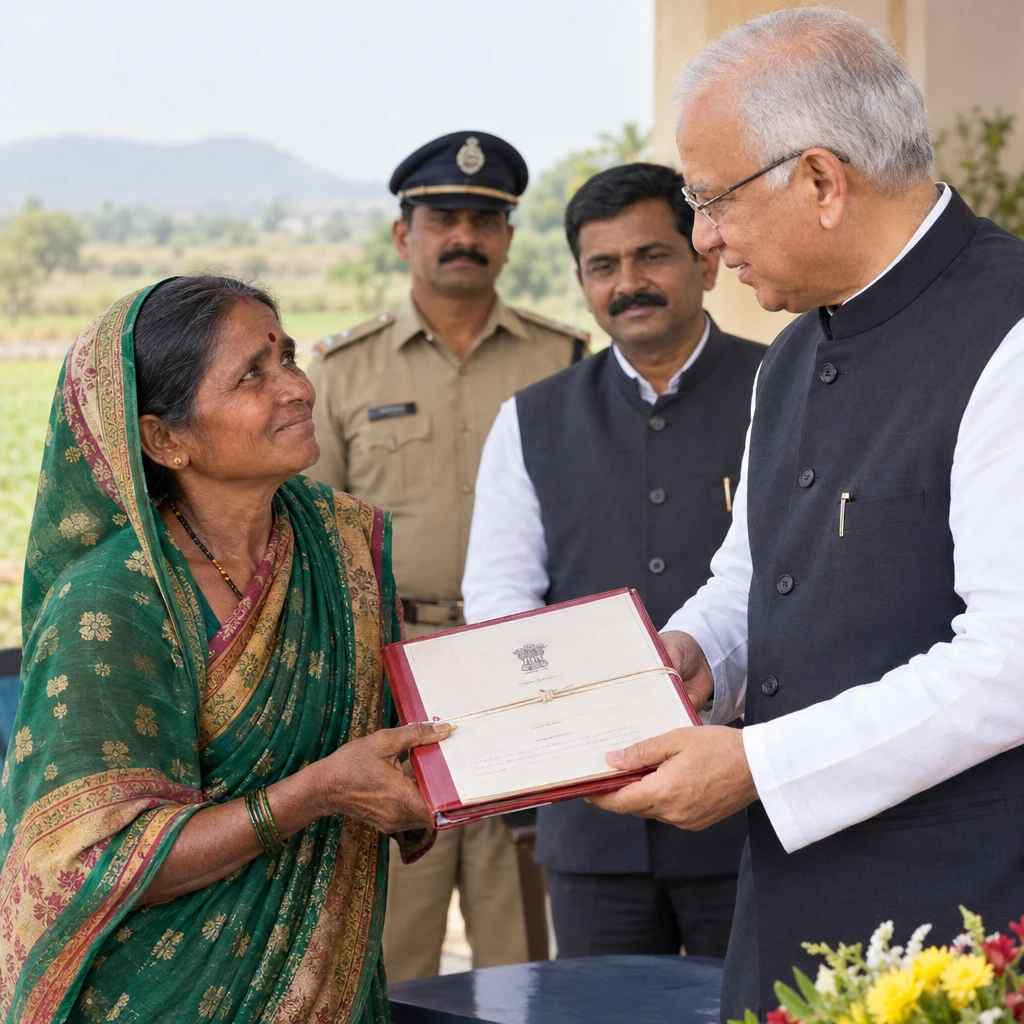
A woman from Maharashtra's Latur district has regained ownership of 4.5 acres of land that was allegedly taken over by a private moneylender after she borrowed Rs 25,000 for her daughter's wedding nearly three decades ago , officials told news …
Some disputes are so long that you half expect them to come with their own pension plan. The story of a woman in Latur, Maharashtra, is one of them. After roughly three decades, she has recovered 4.5 acres of land that were tied up in a fight that began with a loan of just ₹25,000.
The amount is small enough to make the whole saga feel absurd. The loan was taken for her daughter’s wedding, the kind of expense that every Indian family knows well, whether it comes from savings, relatives, or, too often, a lender willing to help with terms that look generous on paper. According to the report, Mundubai Irappa Davre alleges that the moneylender first gained control of the land through a produce-sharing arrangement. Over time, she says, the ownership was fraudulently transferred. Her complaint is a familiar one, and it is worth a closer look.
How a Small Loan Can Become a Big Problem
Produce-sharing arrangements, in which a lender takes a share of crops in place of regular interest, have a long history in rural India. In principle, such an arrangement can seem fair. The borrower keeps the land, farms it, and hands over a portion of the harvest. In practice, the balance of power is lopsided. A farmer who needs money urgently has little bargaining strength, and a lender who controls the harvest, the paperwork, or the local records has many ways to tilt the outcome.
When a loan is repaid slowly, or when a bad season disrupts the crop, the debt can keep growing while the borrower’s options shrink. Land that was meant to be collateral can slowly shift from being a guarantee to being a prize. Davre’s allegation describes exactly that kind of slide: from a sharing arrangement to a transfer of ownership she says was not legitimate.
Why These Cases Drag On
If you are wondering why a case like this takes thirty years, you are not alone. Land disputes in India are notorious for their length, and there are several reasons for that. Land records may be incomplete, outdated, or difficult to interpret. Transfers can be recorded in ways that are hard for ordinary people to challenge. Legal processes are slow, and the person who has held the land for years often has the advantage of possession. Meanwhile, the original borrower may face age, poverty, and fatigue, which make persistence exhausting.
Many states have also introduced laws to regulate moneylending, partly because informal lenders have long been accused of charging unfair terms and exploiting people during emergencies. Such rules can help, but they only work when people know their rights, can afford to pursue them, and trust that the system will respond. A story like this one suggests how much patience that trust can require.
A Moment of Public Recognition
The part of the story that offers real relief came when Governor Jishnu Dev Varma formally handed the land documents back to Davre during a visit to the district this week. A document is not a plow, and paperwork does not bring back lost years, but an official return of land titles carries a symbolic weight. It says, in effect, that the matter has been acknowledged at a high level and that the land belongs to the person who lost it.
It is also a reminder that public attention can matter in cases like this. Coverage by several outlets, including Hindustan Times, NDTV, and Deccan Herald, reached a wide audience. Visibility does not automatically solve a dispute, but it can make officials and institutions pay closer attention than they might have otherwise.
What the Story Leaves Us With
The most striking thing about this story is the contrast between the size of the original loan and the scale of what followed. A wedding expense of ₹25,000 turned into decades of uncertainty over 4.5 acres. For the family involved, the land is not just an asset; it is a source of livelihood, identity, and security.
It is also worth remembering that stories like this are often reported only when they reach a happy ending. Many similar disputes never make headlines, and many borrowers never get their land back. Davre’s victory is genuine and deserves to be celebrated, but it also highlights how much depends on individual endurance rather than reliable, easy-to-use protections.
If there is a lesson here for ordinary people, it is to keep careful records of any loan involving property, to read agreements closely, to seek advice before signing anything that transfers land or crop rights, and to act early if something seems wrong. And if there is a lesson for the wider system, it is that land records should be clear, transfers should be transparent, and people should not need thirty years and a visit from the Governor to get back what they were promised.
For now, though, it is worth pausing to acknowledge the outcome. After three decades, Mundubai Irappa Davre has her land documents back. That is a long wait, but it is a victory.
Inspired by: “Latur woman gets 4.5 acres back after 30-year land dispute over <span class=’webrupee’>₹</span>25,…” (r/News)