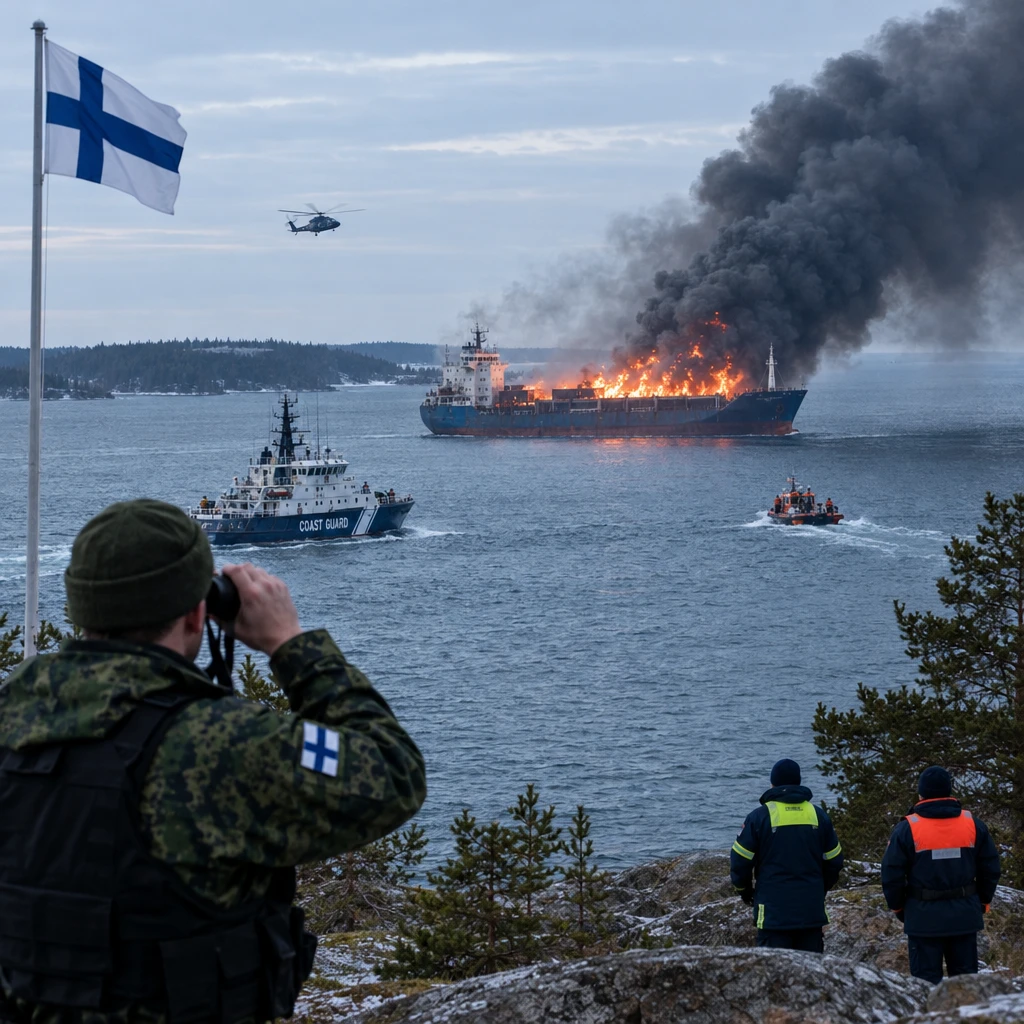
In a statement, the ministry said the Finnish Defence Forces had detected the attack on Saturday morning, against a Russian cargo vessel west of Suursaari, in the eastern Gulf of Finland .
Most people spend Saturdays doing chores, watching sport, or hunting for the last good parking spot. Somewhere in the Gulf of Finland, things went considerably more dramatic. A Russian cargo ship caught fire after a drone attack, and then, as if it had somewhere else to be, it drifted into Finnish territorial waters. Nobody on shore was going to describe that as a relaxing weekend.
Here is what we know. The Finnish Defence Forces said they detected the attack in international waters west of Gogland Island, known in Finnish as Suursaari, in the eastern part of the Gulf of Finland. The ship was on fire, and once it crossed into Finnish waters, the situation became a maritime rescue operation. Authorities also raised concerns about possible environmental damage, which is the kind of phrase that makes everyone within a few hundred kilometres sit up a little straighter.
It is worth stepping back for a second to picture the geography. The Gulf of Finland is a long, narrow arm of the Baltic Sea. Finland sits on its northern shore, Estonia on the southern side, and Russia at the eastern end. It is busy with commercial traffic, ferries, and cargo vessels heading to and from Russian ports, which means it is also a place where a single burning ship can quickly become everyone’s problem. Narrow waterways do not leave much room for error, and they certainly do not leave much room for a drifting vessel that is on fire.
The fact that the attack was detected in international waters matters too. International waters are supposed to be the calm, neutral part of the sea, the place where rules are rules and everybody agrees to play nicely. A drone strike there is the sort of event that makes lawyers, diplomats, and insurance companies start reaching for their coffee and their phones at the same time. Who was responsible, and under what framework it gets discussed, are questions that will certainly keep people busy long after the smoke clears.
Then there is the environmental angle, which deserves more attention than a quick scroll past the headline would give it. A cargo ship on fire carries the obvious risk of fuel and cargo leaking into the water. Anyone who lives near the Baltic knows how sensitive that sea is. Its waters are relatively shallow and slow to renew themselves, so pollution tends to linger. Officials raising environmental concerns is not them being dramatic for the sake of it; it is them doing their job.
The story also got covered widely, and it is a good example of how one event gets filtered through different outlets. World Helsinki Times framed it around the fire and the drift into Finnish waters. The Hindu focused on Finland detecting the drone attack in the Baltic. Euronews emphasised that Finnish authorities were the ones providing the information. Three outlets, one incident, and slightly different angles, which is pretty much how breaking news always works. If you want the full picture, reading more than one of them is a smart move.
So what should you take away from all this? Mostly that the Baltic is not a place where anyone should assume things will stay calm. A burning ship, a drone strike, a rescue operation, and an environmental warning all landed in the same few hours. For the people responsible for maritime safety in the region, that is a very long Saturday.
We will keep an eye on how this develops. Until then, if your weekend plans involve nothing more than chores and a bit of sport, consider yourself lucky. Somebody in the Gulf of Finland definitely did not get that memo.
Inspired by: “Russian cargo ship on fire after drone attack, drifts into Finnish waters” (r/World)