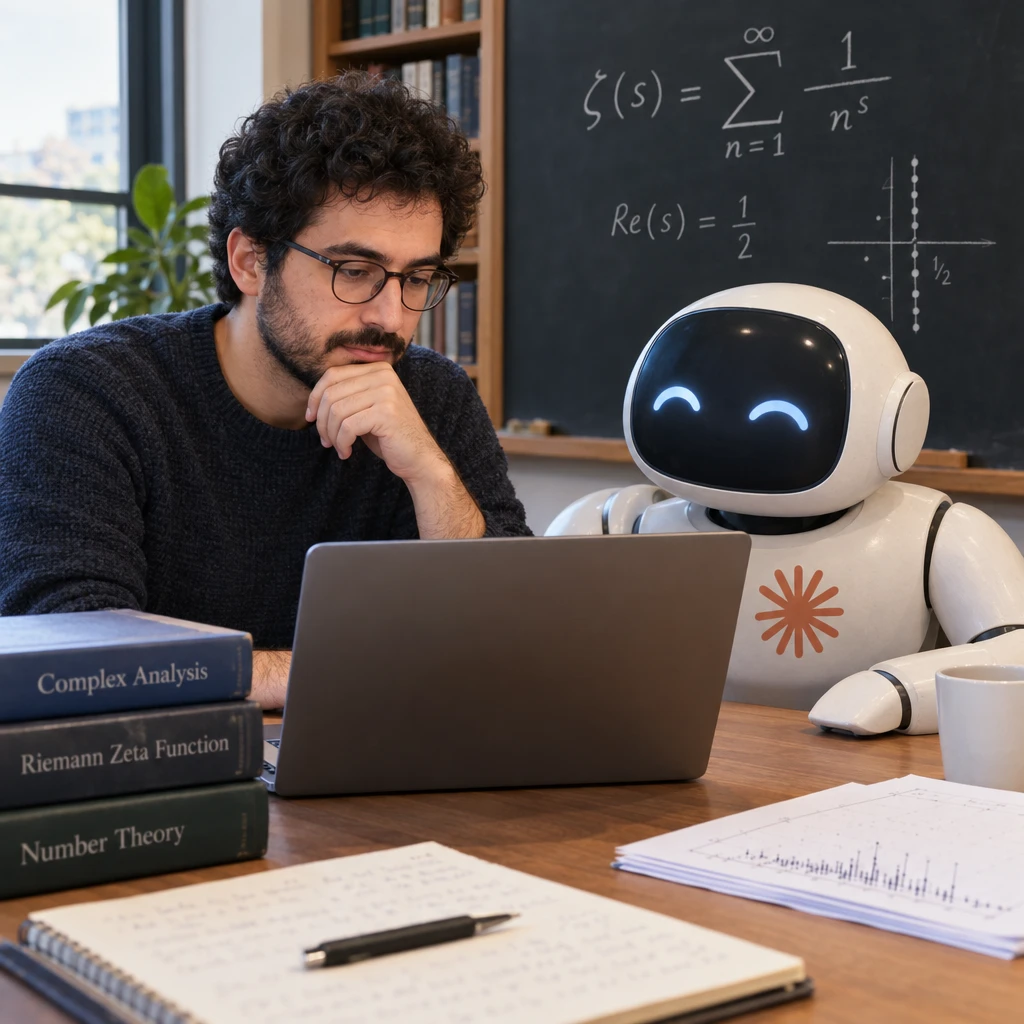
Levent Alpöge , a mathematician and employee at artificial intelligence company Anthropic, claimed on Friday to have proven the most famous problem in all of mathematics using an LLM.
Every so often a headline shows up that makes you put down your coffee. This week’s was one of those: a researcher at AI company Anthropic says he used the firm’s Claude chatbot to prove the Riemann Hypothesis, one of the most famous unsolved problems in mathematics.
The researcher is Levent Alpoge. He released a four-page note laying out his findings, which he says were produced in collaboration with Claude. Then came the part that matters most: the claim has not been verified, and it hasn’t yet been reviewed by outside experts. So we’re in that delightful stretch where a bold announcement exists, but the scrutiny that normally follows it hasn’t happened yet.
If you’re wondering why this is such a big deal, here’s the quick version. The Riemann Hypothesis was proposed by the German mathematician Bernhard Riemann in 1859. It’s a statement about the zeros of the Riemann zeta function, and it predicts a very specific pattern for where those zeros sit on the number line. Mathematicians have tested it extensively and found it holding up in an enormous number of cases, but nobody has ever proved it holds in general. It’s been stubbornly resistant for more than 160 years, which is why it’s on the Clay Mathematics Institute’s list of Millennium Prize Problems, with a $1 million prize attached to a correct proof.
So yes, it’s a big deal. It’s also exactly the kind of claim that deserves a healthy dose of skepticism. Mathematics has a long history of confident-sounding proofs that turned out to have holes. Proofs of major results usually go through years of careful reading by specialists before the community accepts them. A four-page note, however interesting, is the start of that process, not the end of it.
Now, about the AI angle. There’s been a lot of excitement about large language models helping with math, and it’s fair to be curious about what role Claude played here. The source reporting says Alpoge worked with Claude on the findings, but it does not spell out in detail how the work was divided between the human and the machine. That’s a reasonable thing to want to know before drawing conclusions about what AI can do in research. Who checked the reasoning? How much of the argument came from the model, and how much came from the researcher steering it? Those questions matter more than the headline.
There’s also a healthy reason to keep your expectations in check. AI chatbots are very good at producing text that sounds rigorous. Fluent, confident writing is not the same thing as a valid mathematical argument. Mathematicians are famously unforgiving of small errors, and a single flawed step can sink an entire proof. The fact that something reads well doesn’t tell you much on its own.
It’s also worth noting how widely the story has spread. The same announcement was picked up by multiple outlets, including Phys.org, the South China Morning Post, The Hindu, CTVNews, and The Straits Times. Wide coverage is a sign of how much attention AI-and-math stories attract right now. It is not, by itself, evidence that the claim is correct. Repetition is not verification, no matter how many times a headline gets reshared.
So where does that leave us? Possibly somewhere interesting, possibly somewhere disappointing. If the proof holds up, it would be a remarkable moment for both mathematics and AI. If it doesn’t, it will still be a useful lesson in how to read big claims. Either way, the next step is the one that hasn’t happened yet: experts need to examine the argument in detail.
Until then, treat this as an open question rather than a settled fact. The Riemann Hypothesis has survived 160-plus years of attempts. It can probably survive one more weekend of hype while the mathematicians do their job.
Inspired by: “Anthropic researcher says Claude solved math’s greatest riddle” (r/Science)