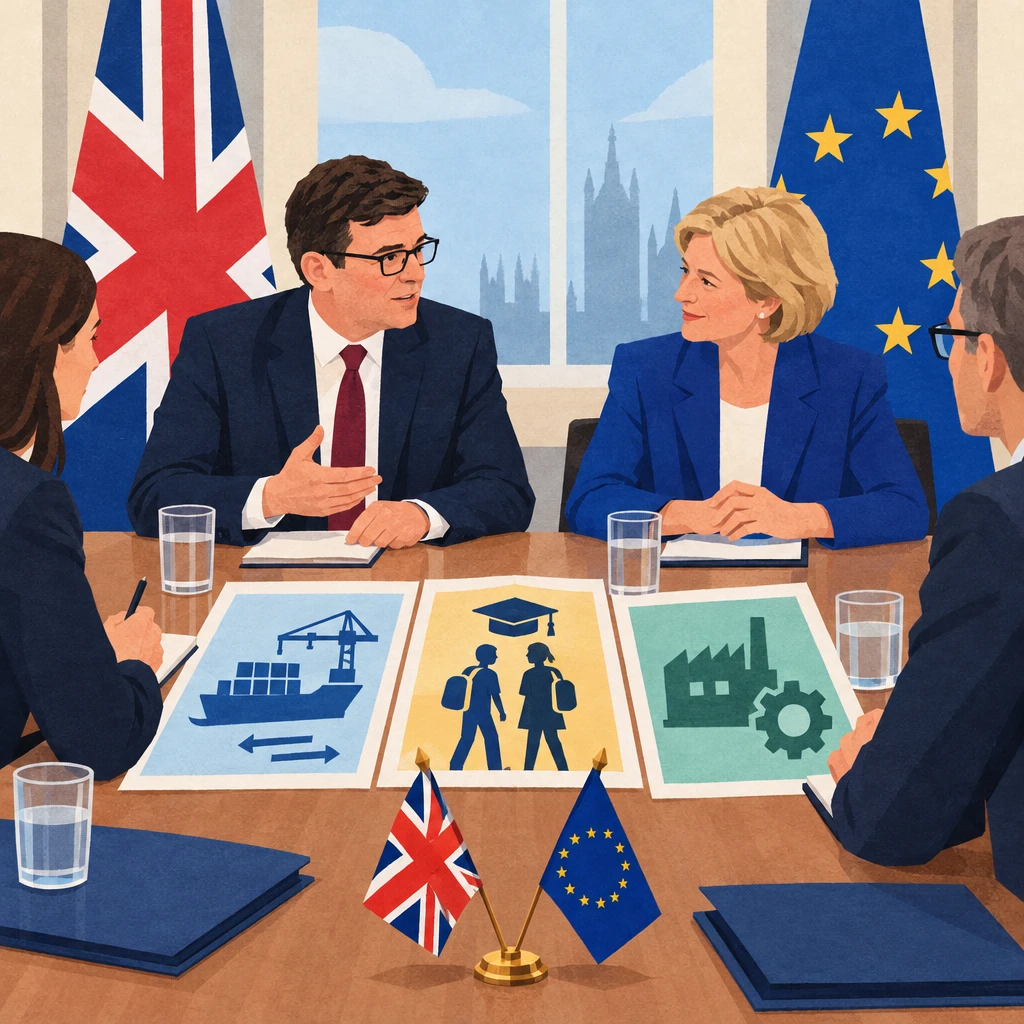
Prime Minister Andy Burnham is meeting EU officials in Brussels on Friday to discuss closer ties between the UK and the bloc that it left in 2020.
Every so often, two parties who have been giving each other the cold shoulder for years sit down at the same table and pretend it’s no big deal. That’s pretty much what happened on Friday, when United Kingdom Prime Minister Andy Burnham met with European Union officials for a rare summit aimed at strengthening ties after Brexit.
If you’ve followed British politics even loosely, you’ll know that Brexit was never a tidy divorce. The UK left the EU, and the fallout has been messy, slow, and very expensive in ways that different people still argue about. Trade got more complicated, paperwork multiplied, and plenty of people on both sides of the Channel started to wonder whether anyone had really thought through the practical side. So a summit focused on repairing the relationship is, at the very least, a sign that both sides have decided the silence is getting awkward.
The main topics on the table were trade and youth mobility. Trade is the obvious one. Businesses on both sides want fewer barriers, less friction at borders, and rules they can plan around without needing a legal team on speed dial. Youth mobility is a little more personal. It’s about giving young people the chance to live, work, or study in each other’s countries. For many families, that kind of exchange was just a normal part of life before Brexit, and losing it made a lot of people feel like something valuable had quietly gone missing.
The discussions also pointed toward future negotiations on student fees and manufacturing rules. Student fees are a sore spot. Since the UK left the EU, EU students have generally faced higher tuition costs than they once did, which has made studying in Britain a much bigger financial decision for them. Universities have felt the pinch too, since many depended on a steady flow of international students. Any deal to lower those fees would be a big win for students and for the institutions that rely on them.
Manufacturing rules are less glamorous but just as important. If you make things, you care deeply about whether your products can move across borders without being held up by extra checks, certificates, and confusion. Getting rules aligned makes life easier for factories, suppliers, and the people who depend on them.
Here’s the part that makes this summit feel a bit like a negotiation between two people who both want the same dinner reservation but don’t want to be the first to say so: the agreements are contingent. In plain terms, the deals on youth mobility and related areas depend on reaching an agreement to lower university tuition fees for EU students in the UK. So nothing is simply handed over. Each piece is linked to another, which is sensible from a negotiating point of view and mildly exhausting if you’re just hoping for some good news.
Still, it’s hard not to see the value in the effort. Relations between the UK and the EU are not going to be fixed in one afternoon, and nobody serious expects that. But choosing to meet, to talk about specifics, and to acknowledge that the relationship needs work is a start. Rebuilding trust after a painful separation takes patience, and it tends to happen in small, unglamorous steps rather than dramatic breakthroughs.
So, will this summit change everything? Probably not overnight. Will it help businesses, students, and families who have been caught in the middle? That’s the real question, and the answer will depend on whether these talks turn into concrete agreements that people can actually feel in their daily lives. For now, the message from Friday seems to be that both sides would rather work together than keep glaring across the room. In post-Brexit Britain and Europe, that counts as progress.
Inspired by: “UK, EU Hold Rare Summit to Strengthen Ties as Burnham Seeks to Mend Brexit Damage” (r/World)