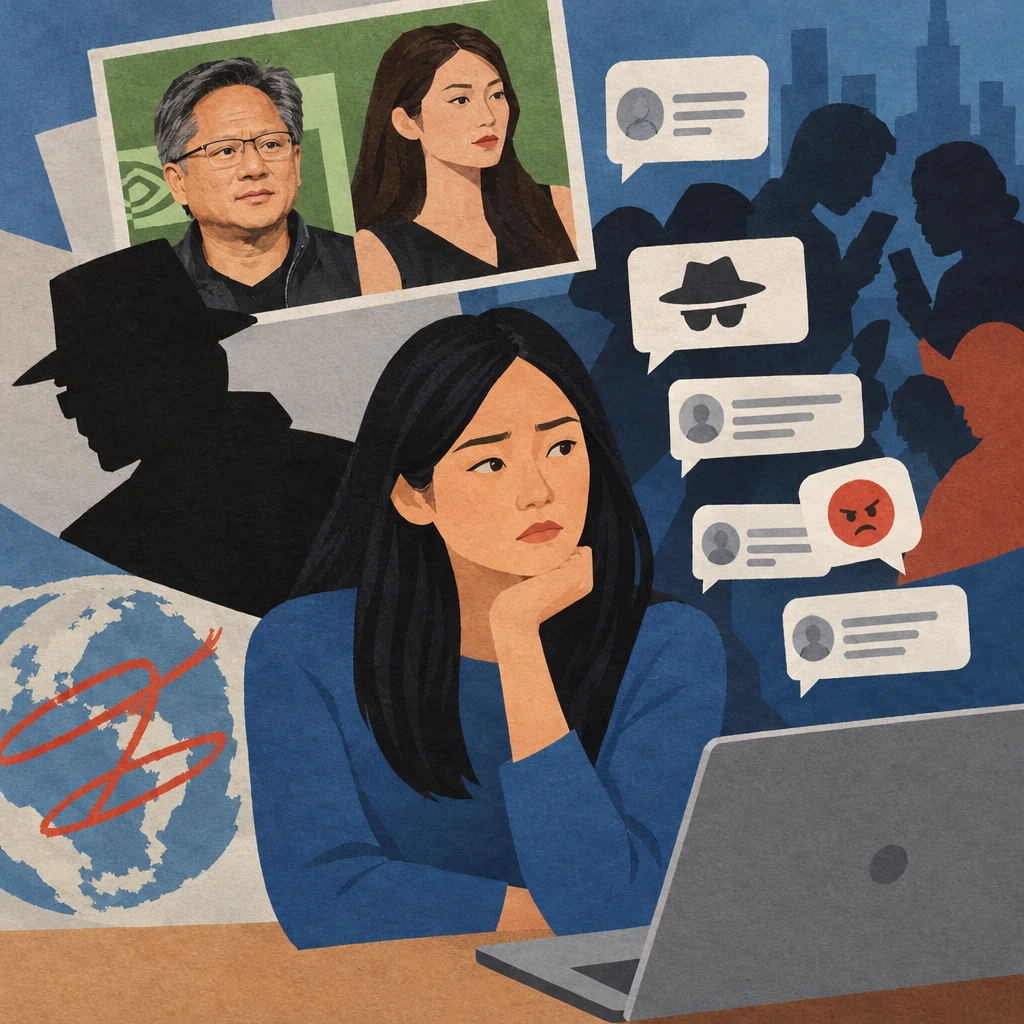
The reveal earlier this month that … women is the discourse around the allegation that Alice Huang, a Chinese businesswoman at the centre of the scandal, was possibly a spy ….
Every so often, a story about a powerful man’s personal life turns into something much bigger, and the people who end up holding the bag are often the ones who had nothing to do with it. The recent revelation of extramarital affairs involving Nvidia CEO Jensen Huang is a good example. It has become a lightning rod, especially among Asian Americans, many of whom had previously looked at Huang as a kind of success story to be proud of.
The scandal took a turn when accusations surfaced that Alice Huang, a businesswoman linked to the affair, might be involved in espionage. Suddenly, a messy personal situation was being discussed as if it were a thriller plot, and online conversations quickly reached for an old and familiar script. Asian women, it seems, are once again being cast as suspicious outsiders, mysterious and untrustworthy, with hidden loyalties to someone other than the country they live in.
If that sounds like a stretch, you are not alone in thinking so. Many Asian American women have reported feeling the sting of this kind of talk. It is one thing to criticize a public figure’s behavior, and it is another to take a woman with a shared surname and make her the face of a national security panic. The reported concern is that the discourse does not just target one person. It reinforces a broader set of harmful tropes that have followed Asian women for generations, the idea that they are inherently deceptive, exotic, or a potential threat.
There is something almost exhausting about how predictable this pattern is. A personal scandal breaks. People start speculating. Someone brings up espionage, and suddenly a woman’s ethnicity and gender become the main evidence in the case, with no real proof required. Anyone who has spent time online knows how quickly a rumor can outrun the facts, and how much easier it is to lean on stereotypes than to wait for actual information.
It also highlights a double standard that rarely gets enough attention. The affair itself is a matter of personal conduct, and the people directly involved are the ones who should be answering questions about it. Yet the public conversation has spread outward to include other people, and those people are left defending their identity rather than their actions. That is a lot to ask of anyone, and it is especially unfair when the accusations are built on the same old assumptions that have been used to question Asian Americans’ loyalty for decades.
So what should readers take from all of this? First, it is worth separating the parts of the story that are about personal behavior from the parts that are about national security. The first can be discussed openly. The second requires evidence, not vibes. Second, it is worth paying attention to how language shifts when the subject is an Asian woman. Words like ‘spy’ get tossed around casually in ways that would seem much more careful if the same accusations were aimed at someone else.
The Asian American women feeling the impact of this story are not asking for special treatment. They are asking for the same basic fairness everyone else gets: judge people on what they have actually done, not on what a stereotype says they might be. That seems like a reasonable request, even if the internet has never been especially reasonable about anything.
Inspired by: “Asian American women feel the impact of Nvidia CEO affair scandal and ‘spy’ accusations” (r/World)