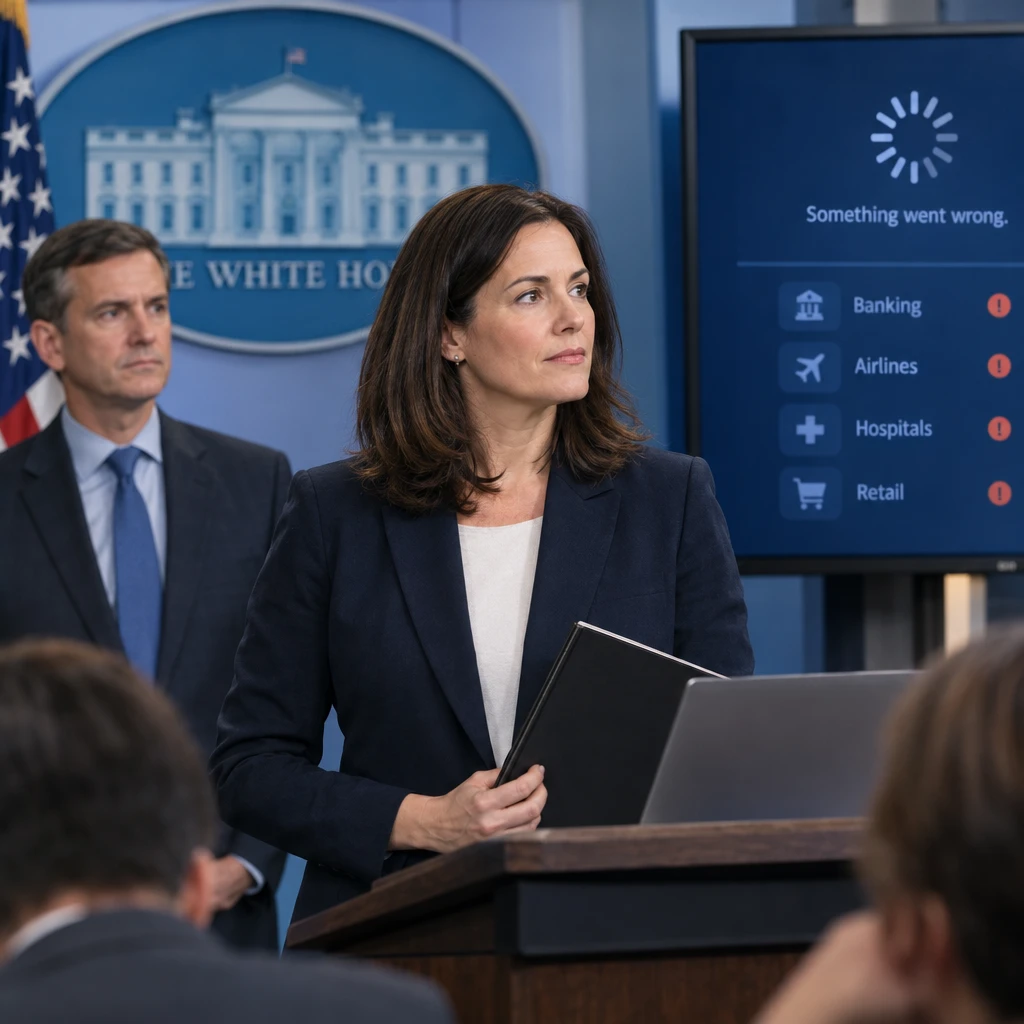
Trump administration officials said on Thursday that the White House was replacing its top cybersecurity official , a move that came after a series of technological outages in recent days that plagued major U.S.
If you’ve ever watched a spinning wheel on your screen while your bank app refused to load, you already know why the White House is paying attention to cybersecurity right now. The administration has named Kirsten Davies as the new national cyber director, replacing Sean Cairncross. The timing is hard to ignore, because the change follows a string of technology outages that hit companies like Microsoft and several banks.
Davies is no stranger to government technology work. She previously served as chief information officer at the Defense Department, so she comes to the job with experience running large, complicated IT operations. In statements about the appointment, she has said she is committed to modernizing cybersecurity infrastructure and strengthening resilience. Those are the kinds of goals that sound great in a press release and are much harder to deliver when a system is down and millions of people are refreshing their browsers.
For anyone wondering what a national cyber director actually does, the job sits at the center of the government’s efforts to coordinate cybersecurity policy across federal agencies and work with the private sector. It is less about personally fixing broken servers and more about setting priorities, getting departments to cooperate, and making sure the right people are talking to each other before something goes wrong. In theory, that’s a tidy job description. In practice, it means dealing with a lot of people who all think their piece is the most important one.
The outages that prompted the attention were a reminder of how much of daily life depends on a fairly small number of large technology providers. When a major software company or cloud service stumbles, the effects ripple outward into airlines, hospitals, retailers, and banks. Customers who had never thought about the plumbing behind their favorite apps suddenly find themselves very interested in it. Lawmakers and regulators tend to get interested in that same plumbing shortly afterward.
It’s worth noting that the coverage of the change has not been uniform. Some outlets framed the decision as a straightforward appointment of a new cyber chief, while others described Cairncross as having been fired. Those are different stories, and the details matter. Readers who want the full picture should look at more than one report and pay attention to what each outlet actually confirms rather than what its headline implies.
There is also a broader question hanging over all of this: can a single official, however qualified, meaningfully reduce the risk of outages and cyberattacks in a system this sprawling? Cybersecurity is one of those fields where success is mostly invisible. When everything works, nobody writes about it. When something breaks, everyone suddenly has an opinion. That imbalance tends to make officials feel like they are always one bad week away from the next hearing.
Still, the appointment signals that the government considers resilience a priority, at least on paper. Davies will have to turn those priorities into concrete steps, whether that means better coordination between agencies, clearer expectations for critical industries, or stronger defenses against the kinds of failures that disrupt ordinary people’s lives. Those steps are where the real test will be.
For now, the takeaway is simple. A new cyber director has been named, the reasons for the move are tied to recent outages, and the rest of us will be watching to see whether the next few months bring fewer spinning wheels and fewer panicked headlines. Given how much we all rely on these systems, that seems like a reasonable thing to hope for.
Inspired by: “White House names new national cyber director following outages” (r/Local)