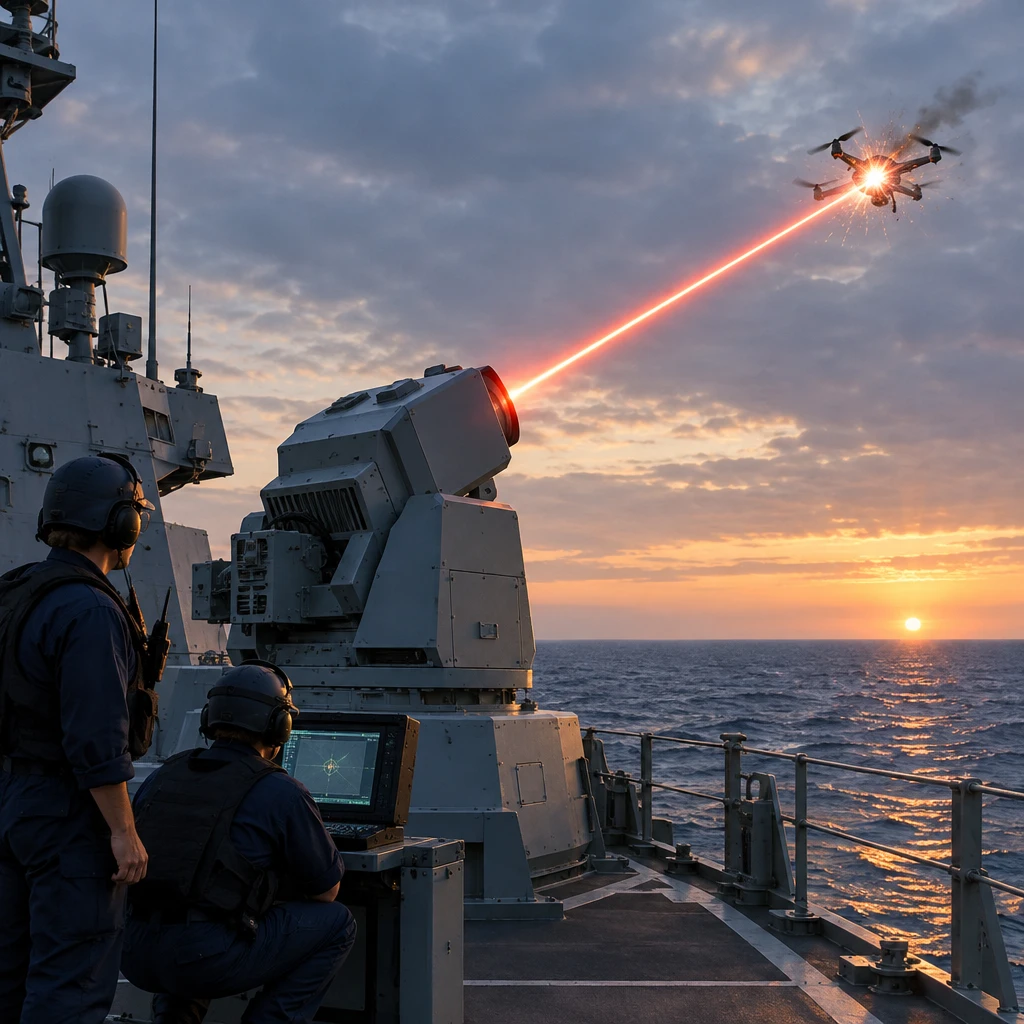
Prototypes have been used to destroy … once in a war zone, but the revolutionary destructive ray that would change the face of battle as fundamentally as the longbow or the airplane has yet to appear ….
Ever since science fiction gave us ray guns that could melt a spaceship in one blast, people have wondered when real militaries would catch up. Lasers have moved well past the comic book stage, and the question of whether they will reshape warfare is now a serious one. The short answer is that they probably will, though not in the dramatic, instant way movies suggest.
First, a quick reality check. A laser weapon works by focusing a beam of concentrated light energy on a target. When that energy hits, it heats the surface until the material weakens, burns, or fails. Unlike a missile, a laser doesn’t carry explosives or fuel that needs to be loaded. As long as the power supply holds up, it can keep firing. That is a big part of the appeal, because it turns the cost of each shot into something closer to the price of electricity rather than an expensive interceptor missile.
The idea is not new. During the Cold War, the United States explored ambitious space-based and ground-based concepts under the Strategic Defense Initiative, which was nicknamed “Star Wars” by critics and reporters, partly because it sounded like a movie plot. Many of those grand plans were never built. Still, the research laid groundwork that later programs used. Engineers learned a lot about beam control, power generation, and cooling along the way, and those lessons still matter today.
In more recent years, navies and armies have started putting smaller, practical systems into the field. The U.S. Navy has tested and deployed laser systems aboard warships, mainly to counter small boats, drones, and other lower-end threats. Other countries, including Israel, have pursued laser air defense systems designed to shoot down rockets, mortars, and drones. These are not the planet-cracking weapons of fiction. They are more like precise tools for dealing with cheap threats that would otherwise cost a fortune to stop with conventional missiles.
That cost issue is probably the biggest reason lasers are getting attention. Modern militaries have been struggling with a strange economic problem: a hobbyist-grade drone can cost a few hundred dollars, while the missile used to shoot it down can cost many thousands or even millions. Lasers offer a way to flip that math. If a weapon can disable incoming drones for the price of the power it uses, defenders suddenly have a more sustainable option. Anyone who has ever watched a budget get eaten alive by a cheap threat will appreciate the appeal.
Of course, lasers come with their share of headaches. Weather is a major one. Fog, rain, smoke, dust, and even heat shimmer can scatter or absorb a beam, reducing its power before it reaches the target. That means a laser that works wonderfully on a clear desert day may struggle in a coastal storm. Power is another challenge. High-energy lasers require serious electricity and cooling systems, which are hard to fit onto small vehicles or aircraft. Aiming is also tricky, since the beam has to stay on a moving target long enough to do damage, and a jittery drone or a spinning rocket can make that difficult.
There is also the question of what lasers can’t do easily. Long-range strategic targets, such as distant missile sites or armored vehicles under heavy protection, are much harder to handle with current technology. Lasers are generally best suited to short to medium ranges and to targets that are vulnerable to heat or optical damage. In other words, they are likely to complement existing weapons rather than replace them outright. Anyone predicting that missiles and tanks will vanish overnight is probably getting ahead of the engineers.
Lasers may also change the rules of conflict in subtler ways. Lower-power laser systems can be used to dazzle or blind optical sensors on aircraft, satellites, or drones without permanently destroying them. That raises questions about what counts as an attack and how to handle incidents that fall into a gray zone. International agreements have discussed restrictions on blinding lasers, and that debate is likely to continue as the technology spreads.
So will laser weapons change warfare? Most analysts would say yes, but gradually. Lasers are unlikely to become the single decisive weapon of future wars. Instead, they will probably become one more layer in a crowded toolkit, especially for defending against cheap drones, rockets, and other fast, low-cost threats. The real shift may come from how they change the economics of defense. If a country can stop attacks without spending a fortune on each interception, that alone could alter military planning.
The ray gun of science fiction may never arrive exactly as imagined, but the laser of the real world is already on the battlefield in limited form, and it is getting more capable every year. For anyone who grew up assuming death rays were pure fantasy, that is a pretty surprising turn of events.
Inspired by: “Will laser weapons change warfare?” (r/RSS)