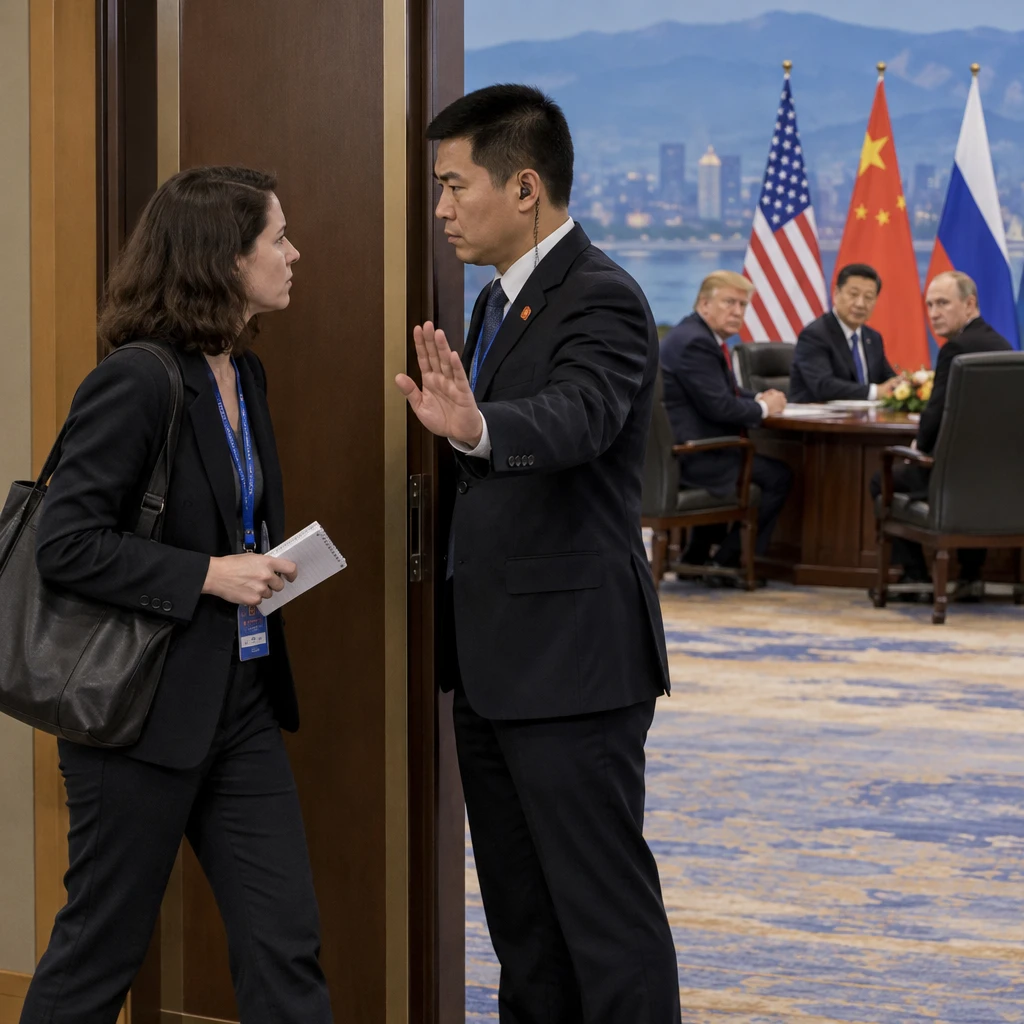
A reporter traveling with the White House press pool was excluded from covering trilateral meetings in China after shouting a question at President Donald Trump about former Nvidia CEO Jensen Huang.
If you’ve ever wondered whether asking a tough question at a summit is a good career move, here’s a fresh data point. During the Asia-Pacific Economic Cooperation (APEC) Summit in Shenzhen, China, a Bloomberg reporter was barred from a trilateral meeting involving President Donald Trump, Chinese President Xi Jinping, and Russian President Vladimir Putin. Her crime, as far as the reports go, was asking Trump a question during an earlier bilateral session. The question concerned Jensen Huang, the former CEO of Nvidia.
That’s the whole story in one sentence, and yet it’s packed with things worth unpacking.
What happened
The sequence is fairly simple. The reporter, identified in coverage by Hindustan Times as Annmarie Hordern, directed a question at Trump during a bilateral session. Mediaite described it as her shouting the question, which tells you something about the setting, though the details of the exchange are thin in the available reporting. Afterward, Chinese officials kept her out of the trilateral meeting. The White House reportedly made efforts to get her access restored, and those efforts did not change the outcome.
So, to recap: a reporter asks a question, and the reporter is the one who gets left in the hallway. Not exactly the outcome most of us picture when we imagine press freedom in action.
Why a question about Jensen Huang matters
Jensen Huang is a major figure in the tech world, and Nvidia sits at the center of a lot of conversations about chips, AI, and trade with China. Any question connecting a president to Huang is going to touch on those themes, which is probably why it landed so awkwardly. Reporters ask about business leaders at summits all the time, but the combination of a high-stakes trilateral setting and a sensitive trade topic made this one more pointed.
We should be careful here, though. Nothing in the available reporting spells out exactly what was asked or what Trump said in response, so anyone claiming to know the precise diplomatic motive is guessing. What is clear is that the restriction followed the question, and that’s the part that has everyone talking.
Access, retaliation, and the diplomatic shrug
Host countries generally control who gets into closed-door meetings, and they don’t always need to explain themselves. That’s the reality of summits. Still, when a reporter is removed from a meeting after asking a question, it raises the obvious concern: is this about security logistics, or about punishing someone for being annoying?
China’s officials kept the restriction in place even with White House pressure, which suggests they weren’t especially interested in a quick fix. In diplomacy, that kind of stubbornness is a message in itself. It says the decision was made, and it’s not up for negotiation in the press pen.
The bigger takeaway
For readers, the lesson is less about one reporter and more about how much access shapes the story. When journalists can’t get into the room, the public depends on whatever officials choose to share afterward. That’s a reminder to read summit coverage with a healthy skepticism and to pay attention to who was there and who wasn’t.
For reporters, the episode is a reminder that asking questions in a foreign-hosted event can come with consequences you don’t control. Maybe that’s fair, maybe it’s petty, but it’s definitely a lesson in knowing the room you’re standing in.
Until more details emerge, this one will likely remain a small but telling footnote in a summit that already had plenty going on. Just don’t expect the press seats to be the most comfortable place to watch history happen.
Inspired by: “China blocks Bloomberg reporter from Trump-Putin-Xi meeting over question to Trump” (r/News)