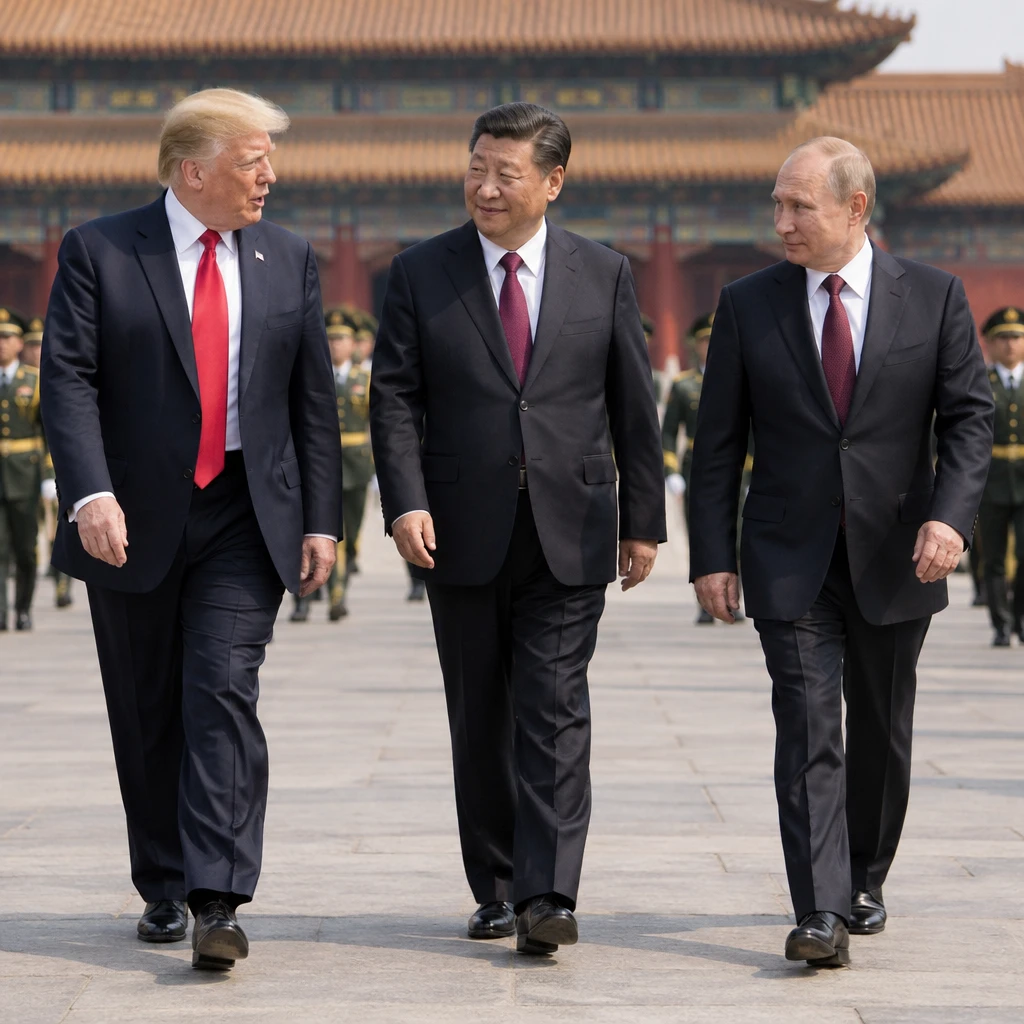
Donald Trump, Vladimir Putin, and Xi Jinping issue a "joint declaration on peace" after 90-minute talks in China
Three world leaders who rarely share a room, let alone a joint statement, just produced one. According to coverage from The Hill, Newser, and Deutsche Welle, President Donald Trump, Chinese President Xi Jinping, and Russian President Vladimir Putin issued a four-point “peace declaration” after their summit in China on Thursday. Newser called it a rare summit, and Deutsche Welle tied the talks to the APEC summit. Whatever you call it, it’s an unusual piece of paper.
Here’s what we know. The declaration covers four areas: United Nations reform, oil production and supply, the International Criminal Court, and nuclear conflict. The text was released by Russia and China, which is worth keeping in mind. When a document comes out through the governments that helped write it, it’s usually written to make everyone look thoughtful, and the wording tends to be generous to the authors.
Let’s take those topics one at a time, because they don’t really belong together on a single list. UN reform is an old argument. Plenty of countries have complained for years that the organization’s structure reflects the world of the 1940s more than today’s. Oil production and supply matters because energy prices touch almost everything, from the cost of driving to the cost of heating a home. The International Criminal Court is a body that investigates serious crimes like war crimes and genocide, and it has been controversial, with some major powers refusing to join it. Nuclear conflict is the heavyweight of the group, the topic that gets the most attention and, somehow, often the least concrete follow-up.
That mix is part of what makes the declaration interesting. Four broad topics is a lot of ground for one statement, and it suggests the leaders wanted to show they could talk about more than one problem at a time. It also means that each point gets only a short mention, and a short mention can mean a lot of different things depending on who reads it.
The headlines themselves are a small lesson in media framing. The Hill went with a straightforward summary: a four-point declaration toward peace. Newser emphasized how rare the gathering was. Deutsche Welle placed it within the APEC context. None of these framings is wrong, but they each nudge readers toward a slightly different takeaway. One reads it as a diplomatic milestone, another as a surprising meeting of rivals, and a third as one item on a busy international calendar.
So should you get excited? Maybe a little, with a healthy dose of skepticism. Joint declarations are easy to sign and much harder to carry out. The real questions are the ones the summary can’t answer: What specific commitments do the four points contain? Who is responsible for following through? How will progress be measured, and what happens if nobody follows through at all? Those details matter far more than the photo op.
Still, the basic fact that these three leaders agreed on a shared statement is notable. Diplomacy often advances in small, unglamorous steps, and a document like this can serve as a starting point for future talks, even if it doesn’t solve anything on its own. The best outcome would be that the declaration becomes a foundation for real action. The worst would be that it becomes one more piece of paper that sounds nice and gathers dust.
For now, the sensible approach is to read the coverage, watch for follow-up statements, and resist the urge to treat a four-point list as a finished peace treaty. Peace declarations are at their best when they lead somewhere. Whether this one does is a question we’ll have to answer later.
Inspired by: “Trump, Xi, Putin issue 4-point ‘declaration toward peace’ after summit” (r/Politics)