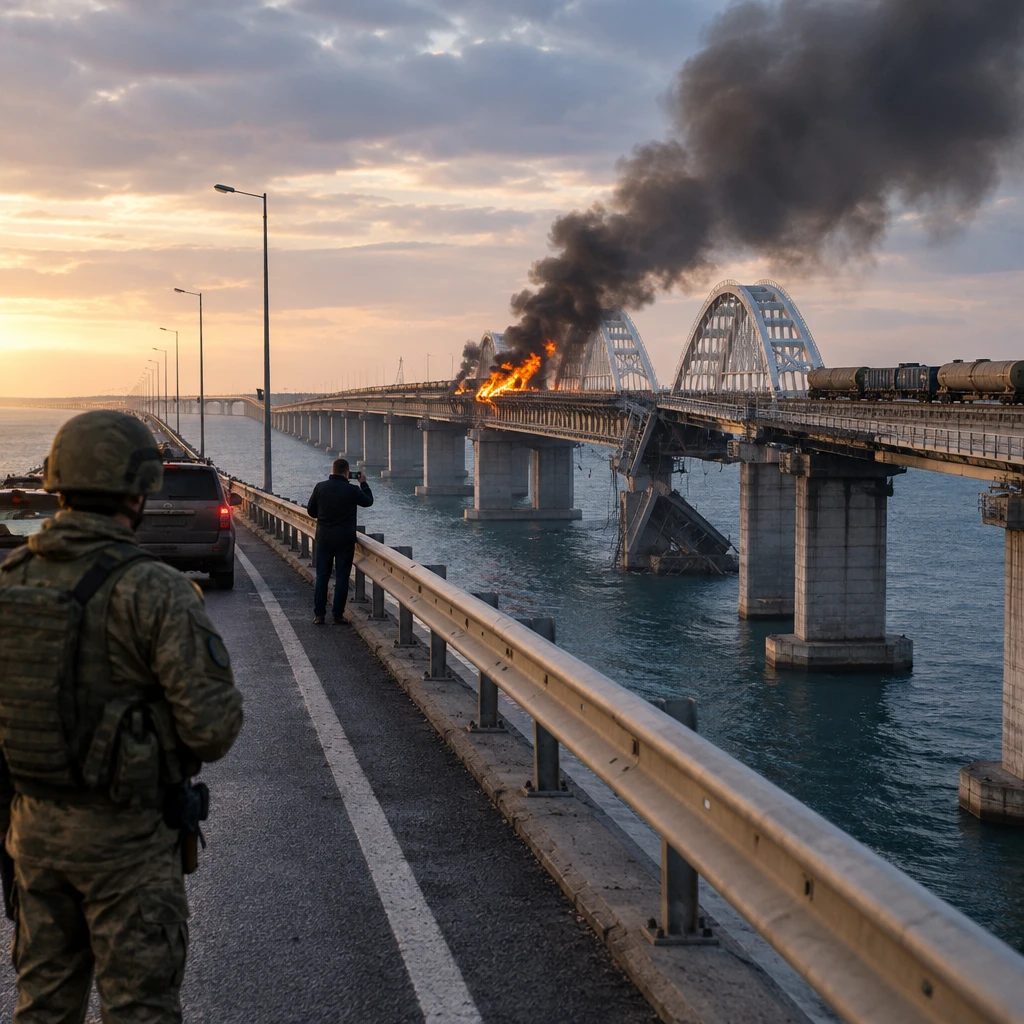
Moscow's retaliation for attacks … has vowed. In the early hours of Thursday, the double-arched, 12-mile bridge connecting Russia to Ukraine's occupied peninsula of Crimea was hit for a third time this week. …
If you were hoping for a quiet week in the Black Sea region, I have some bad news. The Kerch Bridge, the long span linking Russia to the Crimean Peninsula, has been hit for the third time in roughly four days, and rail traffic across it has been halted again.
According to Russian authorities, the latest attack happened overnight on Thursday, local time. Officials installed by the Kremlin in occupied Crimea said experts were assessing the damage and working to restore service. Much of the early reporting has been careful to say that damage details are still coming in, which is the sort of sentence you read when nobody wants to commit to anything yet.
Why this bridge matters
The Kerch Bridge is not just another piece of infrastructure. It opened in 2018 and was built as a showpiece after Russia annexed Crimea in 2014, a move that Ukraine and most of the international community do not recognize. It carries road and rail traffic, and it became a symbol of Moscow’s control over the peninsula. Russian leaders have spoken about it with obvious pride, so when it gets hit, the blow lands on both the logistics side and the ego side.
That is why Vladimir Putin’s reaction has drawn so much attention. Headlines report that he has vowed to retaliate against Ukraine. Whether that turns into concrete action is a separate question, but the promise itself tells you how seriously the Kremlin is taking these strikes.
The timing raised eyebrows
One of the more striking details in the coverage is the timing. Some outlets noted that the strikes seemed to coincide with a high-profile meeting involving Putin, Chinese leader Xi Jinping, and US President Donald Trump. Coverage from several outlets framed the attacks as embarrassing for Moscow at a moment when it wanted to look in control.
Plenty of readers will read that as a pointed message, and it is hard to blame them. Governments rarely pick dates by accident, and a bridge being disrupted during a summit-level gathering makes for a very loud headline. Still, it is worth remembering that linking a strike to a political meeting is often more about the narrative than about proof of intent. Analysts will argue about that for a while.
A pattern of pressure
The repeated strikes on the same structure are what make this story stand out. A single attack can be written off as a one-off. Three in a few days suggests a sustained effort to disrupt supply routes and rail links that matter to Russian operations in the south. Rail is especially important for moving heavy materiel and fuel, so even a temporary shutdown can create headaches far beyond the bridge itself.
For Ukraine, the strikes send a message that Crimea is not a safe rear area. For Russia, they highlight how exposed its supply lines remain, despite years of investment and public boasting about the bridge’s strength.
What to watch next
A few questions will shape how this develops. How long will rail service remain suspended? Will Russia respond with strikes of its own, and if so, where? And will the diplomatic backdrop, including the summit talks that have been dominating headlines, shift anything about how these events are interpreted?
For now, the bridge is closed to trains, officials are counting the damage, and Putin has promised a response. If history is any guide, this story has more chapters coming, and the bridge will probably keep making headlines for as long as it stays in the middle of this conflict.
So, third time’s the charm? Maybe not for the people trying to get their freight across. But for anyone following the war closely, it is a reminder that some of the biggest stories are built on very long bridges.
Inspired by: “Putin vows to retaliate against Ukraine for attacks on Crimea bridge” (r/World)