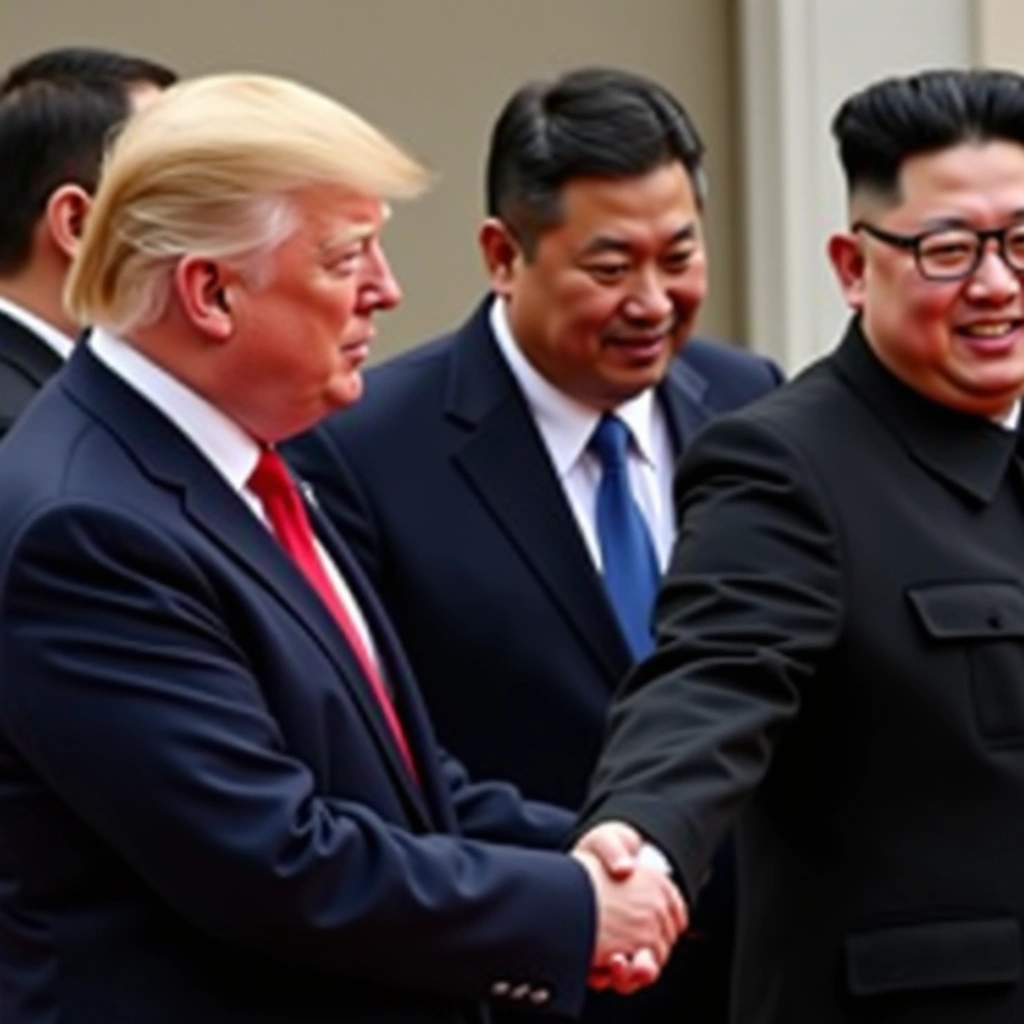
The two leaders met in Singapore in June 2018, Hanoi in February 2019 and at the inter-Korean border village of Panmunjom. The meetings took place during Trump ’ s first term.
Some diplomatic relationships are defined by careful protocol, endless position papers, and decades of patient negotiation. Others are defined by a handshake at a border, a few headline-grabbing summits, and the occasional exchange of very enthusiastic letters. President Trump and North Korean leader Kim Jong-un fall firmly into the second category, and it looks like the relationship may be getting a new chapter.
As President Trump heads out on an upcoming trip to Asia, he has floated the possibility of meeting with Kim. If it happens, it would be their first in-person encounter in years. Their last meeting was in June 2019 at the Demilitarized Zone between North and South Korea. The story has been covered by several outlets, including the Washington Times, Newsweek, The Washington Post, and Political Wire, so this isn’t a single stray remark that slipped out between bites of airplane food.
What We Actually Know
The facts here are relatively simple, and it’s worth sticking to them, because this topic tends to attract more speculation than a reality TV finale.
– President Trump has indicated that a meeting with Kim Jong-un is possible during his Asia trip.
– According to the reporting summary, a potential discussion could take place around the APEC summit.
– The idea is being considered as the United States looks to reengage with Pyongyang on its nuclear capabilities.
– Trump and Kim last met in June 2019 at the DMZ.
Note the key word sprinkled throughout: possible. Floated. Considered. Nothing has been locked in, no seating chart has been published, and nobody has announced which brand of bottled water will be on the table. This is a trial balloon, and trial balloons have a long and proud history of either soaring or quietly drifting off into the sky never to be mentioned again.
A Quick Refresher on the Trump-Kim Saga
For anyone who has understandably filed this storyline away somewhere between ‘remember when’ and ‘wait, that happened?’, here’s the short version.
During his first term, Trump did something no sitting U.S. president had done before: he met face-to-face with North Korea’s leader. The first summit took place in Singapore in 2018 and produced a lot of handshakes, a lot of photos, and a joint statement that was long on aspiration and short on specifics. A second summit followed in Hanoi in early 2019, which ended without an agreement, demonstrating that warm vibes alone do not dismantle nuclear programs.
Then came the June 2019 meeting at the DMZ, which was arranged on remarkably short notice and featured Trump briefly stepping across the line into North Korean territory. It was dramatic, symbolic, and very much made for television. What it was not, unfortunately, was the start of a breakthrough. Talks stalled, and North Korea’s nuclear and missile programs carried on.
So when people hear ‘Trump might meet Kim again,’ the reactions range from ‘finally, diplomacy’ to ‘didn’t we already watch this movie?’ Both responses are, in their own way, reasonable.
Why Now?
The stated goal is reengagement on North Korea’s nuclear capabilities. That has been the central issue in U.S.-North Korea relations for a very long time, and it remains stubbornly unsolved. Years of sanctions, pressure, summits, and silence haven’t changed the basic reality: North Korea has nuclear weapons and has shown little interest in giving them up.
An Asia trip, with a major gathering like APEC on the calendar, offers a natural opportunity. When leaders are already in the region, an extra meeting is logistically easier than arranging a standalone summit from scratch. Think of it as the diplomatic equivalent of ‘well, since I’m already in the neighborhood.’
There’s also the personal element. Trump has frequently described his relationship with Kim in positive terms, and he clearly views personal rapport as a valuable diplomatic tool. Whether that rapport translates into concrete results is the question that has followed this relationship from the start.
The Case for Talking
Let’s give the idea its fair hearing. There are genuine arguments in favor of a meeting:
Talking beats not talking. When two nuclear-armed countries aren’t communicating, the risk of misunderstanding goes up. Even a meeting that doesn’t produce a grand deal can lower tensions and reopen channels that have been dormant.
Leader-level contact can cut through bureaucracy. North Korea’s system is extremely centralized. If anyone can make a decision, it’s Kim himself, so direct contact with him is not nothing.
It’s been years. The longer the silence lasts, the harder it gets to restart. A meeting, even a brief one, could reset the clock.
The Case for Caution
And now, the part where the skeptics clear their throats:
Meetings without substance can look like rewards. Critics have long argued that summits give North Korea legitimacy and international attention without requiring meaningful concessions in return. A photo op is a nice souvenir, but it’s not a nuclear agreement.
The track record is mixed. The previous three meetings were historic, but they didn’t lead to denuclearization. Repeating the format and expecting a different outcome is a strategy that has, historically, been described less than flatteringly.
It’s not confirmed. It’s entirely possible this idea fizzles. Pyongyang has its own priorities and is under no obligation to accept an invitation just because it was floated in public.
What to Watch For
If you’re following this story, here are a few things that would signal whether this is real momentum or just a passing thought:
– A response from North Korea. Pyongyang’s reaction, or lack of one, will say a lot. Silence is also an answer, just a less satisfying one.
– Concrete logistics. Talk of location, timing, and format would suggest planning is actually happening.
– Stated goals. Watch for any sign of what the U.S. hopes to achieve beyond simply meeting. A clear agenda is usually the difference between a summit and a photo shoot.
– Reactions from regional partners. Countries in the region, especially South Korea and Japan, have a significant stake in anything involving North Korea’s nuclear program.
The Bottom Line
President Trump floating a meeting with Kim Jong-un is a classic example of high-stakes diplomacy delivered with a dash of showmanship. The underlying issue, North Korea’s nuclear capabilities, is deadly serious. The method, a possible impromptu-style meeting tacked onto a broader trip, is very much in keeping with how these two leaders have interacted before.
Will it happen? Maybe. Will it produce a breakthrough? History suggests keeping expectations modest. Will it generate a lot of headlines, strong opinions, and at least one memorable photograph? If past performance is any guide, that part is practically guaranteed.
For now, the best approach is cautious attention. Diplomacy with North Korea has a habit of surprising people, sometimes for the better and sometimes in ways that leave everyone back where they started. Either way, this is one sequel worth keeping an eye on, even if we’ve seen a few of the earlier episodes already.
Inspired by: “Trump floats possible meeting with Kim Jong-un during Asia trip” (r/Politics)