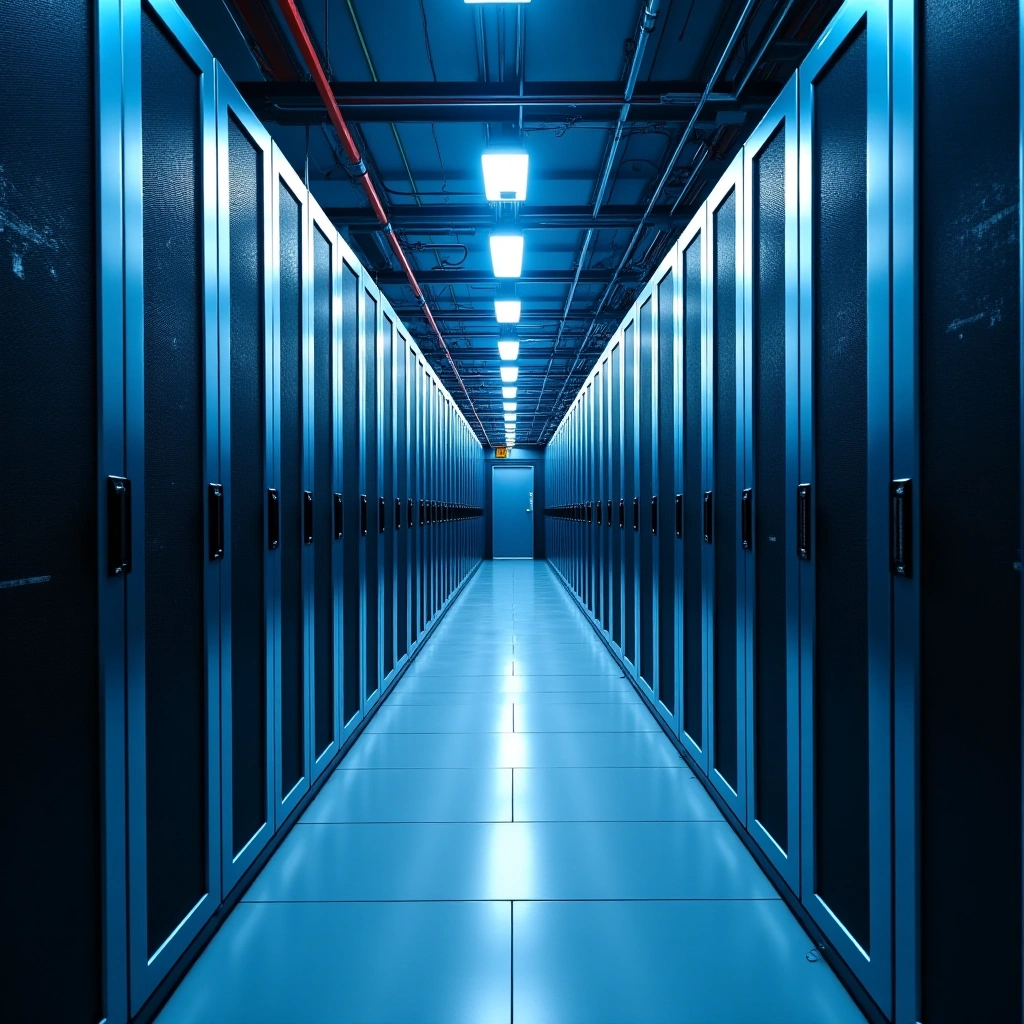
New Harvard research shows that … with off-grid gas plants. … Just 400 hyperscale data centers connected in the US used as much electricity as the state of Michigan in a single year , new Harvard research has …
There’s a fun new way to measure how much computing America does: in Michigans.
A new study published in Nature Sustainability and covered by Fast Company, Wired, Phys.org, and New Atlas found that roughly 400 hyperscale data centers in the United States collectively use about as much electricity each year as the entire state of Michigan. Not a city. Not a county. A state, with millions of residents, factories, hospitals, and an impressive number of people running space heaters in February.
That’s 400 buildings, give or take, matching the appetite of a whole state. If you ever wondered where your chatbot conversations and endlessly backed-up photos go to live, the answer is apparently “somewhere very, very hungry.”
First, What Is a Hyperscale Data Center?
A regular data center is a building full of servers. A hyperscale data center is that same idea after it found the protein powder. These are the massive facilities run by the largest tech and cloud companies, built to handle huge amounts of computing, storage, and networking at once. They power cloud services, streaming, search, online storage, and, increasingly, artificial intelligence.
They are also built to scale up quickly, which is a polite way of saying they are designed to keep getting bigger. Keep that in mind, because it explains a lot of what follows.
The Headline Numbers
The main findings, according to the coverage of the study:
– About 400 US hyperscale data centers use roughly as much electricity per year as Michigan.
– Most of that electricity currently comes from fossil fuels.
– Carbon dioxide emissions tied to these facilities are now more than three times higher than they were in 2018.
– Researchers connect the growth in energy use and emissions to the expansion of AI infrastructure and cloud computing.
That third point deserves a moment. Tripling emissions in a handful of years is not gentle growth. That’s the curve your phone bill takes after you accidentally stream a movie while roaming abroad.
Why Is This Happening?
The short answer, per the researchers, is AI and the cloud.
Cloud computing has grown steadily for years as businesses moved their software, storage, and operations off their own servers and into giant facilities run by someone else. Convenient, efficient in many ways, and absolutely dependent on a lot of electricity.
Then came the AI boom. Training and running large AI models takes a lot of computing power, and computing power takes energy. Every time someone asks an AI to summarize an email they could have read in eleven seconds, a server somewhere does real work. Multiply that by everyone, constantly, and you get a meaningful slice of the national grid.
None of this means any one prompt is ruining the planet. It means the infrastructure behind all these tools is huge and growing fast, and the power has to come from somewhere.
The “Somewhere” Is Mostly Fossil Fuels
This is the uncomfortable part. Tech companies love talking about clean energy commitments, and the slides announcing them are often lovely. But the study found that most of the electricity powering these hyperscale facilities still comes from fossil fuels.
It makes sense when you think about it for more than five seconds. Data centers need steady power around the clock. They don’t get to log off when the wind dies down. When demand jumps quickly, the easiest power to get is often whatever the local grid already has, and in many places that still means a big helping of fossil fuels.
The result is emissions more than three times higher than 2018 levels. So while the industry has been building the future, it’s also been leaning pretty heavily on the past to keep the lights on.
Why Comparing to a State Is Useful
“Data centers use a lot of electricity” is the kind of sentence people nod at and immediately forget. “Data centers use as much electricity as Michigan” sticks.
The state comparison makes clear that this isn’t a niche power draw. It’s on the scale of an entire population’s homes, businesses, and industry. And the comparison involves only about 400 facilities. That kind of concentrated demand matters for local grids, utility planning, electricity prices, and climate goals.
It also raises a reasonable question: if these facilities are already consuming state-sized amounts of power, what happens as AI and cloud demand keep growing? The phrase “hyperscale” doesn’t exactly suggest the industry plans to stop here.
What This Doesn’t Mean
Before anyone throws their laptop into a lake (please don’t, that’s also bad for the environment), some perspective.
The study isn’t saying cloud computing or AI are useless, or that data centers should be shut down. These facilities run services people and businesses rely on daily. Centralized data centers can also be more efficient than lots of scattered, poorly managed server closets.
What the research does highlight is that the energy cost is real, growing, and still largely powered by fossil fuels. That’s a problem worth looking at directly instead of hiding behind phrases like “the cloud,” which makes it all sound weightless and fluffy. The cloud is, in fact, a lot of very heavy buildings plugged into the grid.
So What Happens Now?
The obvious pressure point is where these facilities get their power. If data center demand keeps climbing, the energy source behind it makes a huge difference to emissions. More clean power for these facilities would mean a much smaller climate footprint for the same computing.
There’s also the question of transparency. Numbers like these are useful because they make the scale visible. It’s much easier to plan for, regulate, and improve something when you actually know how big it is.
And for the rest of us, it’s a useful reminder that digital doesn’t mean free. Every “unlimited” storage plan and instant AI answer is backed by physical infrastructure with a physical energy bill.
The Bottom Line
About 400 hyperscale data centers in the US now use roughly as much electricity as Michigan, mostly from fossil fuels, with emissions more than triple 2018 levels. Researchers link the surge to the growth of AI and cloud computing.
The internet may feel invisible, but it turns out it has the electricity habits of a mid-sized state. Maybe it’s time we started treating it that way.
Inspired by: “Harvard study: Hyperscale data centers collectively power through more electricity than some U.S. s…” (r/Science)