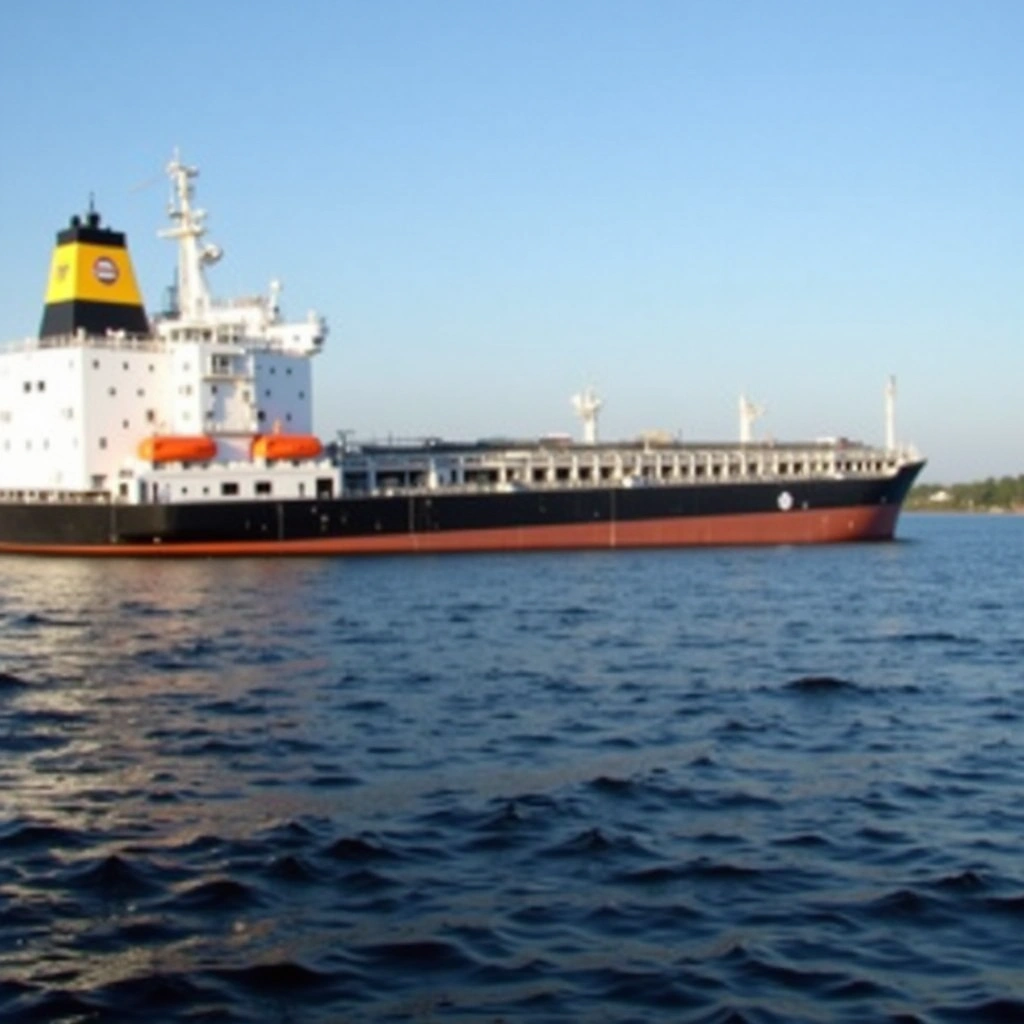
A tanker’s steering system failed and kept its rudder in a position that sent it crashing into a cruise ship docked in New Orleans, U.S. government safety officials said Sunday. The preliminary finding from National Transportation Safety Board officials provided the first official word on what caused Friday’s crash of the Atlantic Asphalt tanker into the American Heritage cruise ship, which sent passengers, crew and two police officers plunging into the Mississippi River. NTSB officials said during a briefing in New Orleans that it’s not yet clear what caused the steering failure.
There are plenty of things you want working on a large ship. The coffee machine, sure. The Wi-Fi, ideally. But near the top of the list, somewhere just below the hull staying watertight, is the ability to steer.
Unfortunately, that last one apparently wasn’t cooperating on a tanker moving along the Mississippi River near New Orleans last week. According to U.S. transportation safety officials, the tanker suffered a steering malfunction that left its rudder stuck in a starboard position. The tanker then collided with a docked paddlewheel cruise boat, the American Heritage, which capsized after the impact.
The good news, and it is genuinely good news, is that there were no fatalities. There were 190 people aboard the passenger vessel, a number that makes the outcome feel like a very large exhale.
What Actually Happened?
The National Transportation Safety Board (NTSB) has said the collision was caused by what it calls a “steering casualty.” If that sounds like the steering wheel filed a workers’ compensation claim, it’s actually maritime language for a failure in a vessel’s steering system. In this case, the rudder got stuck turned to starboard, which is the right-hand side of the ship for those of us who still have to think about it.
Now picture this: you’re piloting something enormous and heavy along a river, and the part responsible for pointing it where you want to go decides it has a new favorite direction. Ships don’t stop or swerve like cars. They have a lot of momentum, and they take their time responding even when everything is working perfectly. When the rudder is jammed, your options shrink fast.
The result was a tanker heading somewhere it was never supposed to go, and a docked paddlewheel boat that was very much in the wrong place at the wrong time. Docked, it should be emphasized. It wasn’t racing anyone or cutting anybody off. It was just sitting there, being a paddlewheel boat, minding its own business.
A Rudder 101, Because Why Not
For anyone who hasn’t spent much time thinking about ship anatomy (which is most of us, and honestly, that’s fine), the rudder is the flat, movable piece at the stern that redirects the flow of water and turns the ship. Turn the rudder one way and the vessel turns that way.
It’s a simple concept that relies on a fairly complex system to actually move the rudder, since steering a large vessel isn’t exactly a matter of muscle power. When something in that system fails, the rudder can end up locked at an angle. And a rudder stuck hard to one side means the ship will keep trying to turn in that direction whether anyone on board likes it or not.
So when the NTSB says the rudder was stuck in a starboard position, that’s not a small technical footnote. That’s essentially the whole story of how a tanker ended up meeting a cruise boat.
What the NTSB Still Needs to Figure Out
Here’s where we have to be a bit patient. The NTSB has identified the steering casualty as the cause of the collision, but it is still investigating what exactly caused the malfunction in the first place.
That distinction matters. Knowing the rudder got stuck explains what happened. Knowing why it got stuck explains how to stop it from happening again. Was it a mechanical failure? A maintenance issue? Something else entirely? At this point, the official answer is: they’re working on it.
This is pretty typical of how the NTSB operates. Investigations into transportation accidents tend to be methodical and slow, which can be frustrating if you want answers by lunchtime. But the goal isn’t a quick headline. It’s to understand the chain of events thoroughly enough that the lessons can actually be applied. Speculation is cheap. Findings that hold up are not.
So anyone online who has already confidently diagnosed the problem from their couch might want to hold that thought until the investigators finish their job.
The Passengers Had Quite a Day
Let’s not skip past the human side of this. A paddlewheel cruise boat is, for many people, a relaxing way to experience the Mississippi River. It’s supposed to be leisurely. Scenic. Maybe a little nostalgic. It is not supposed to involve being struck by a tanker and capsizing.
With 190 people aboard, the fact that nobody was killed is the single most important detail in this entire story. Whatever the final investigation finds about the steering system, that outcome is something everyone involved can be grateful for.
It also serves as a reminder that even a vessel tied up at a dock isn’t immune to what’s happening out on the water. Rivers are shared spaces, and when something goes wrong on one ship, the consequences can land on another.
Why This Matters Beyond New Orleans
The Mississippi River near New Orleans is a working waterway, which is a polite way of saying it’s busy. Commercial vessels, passenger boats, and all sorts of other traffic share the same stretch of river. When everything works, that coexistence is smooth enough that most people never think about it.
Incidents like this one pull back the curtain a little. They show how much depends on equipment functioning exactly as designed, every single time. A single component failing at the wrong moment can turn routine traffic into a serious accident.
That’s why the second half of the NTSB’s work, figuring out the precise cause of the malfunction, is the part worth watching. If there’s a lesson about inspections, maintenance, equipment design, or emergency procedures, that’s where it will show up.
The Bottom Line
Here’s what we know so far:
– A tanker on the Mississippi River near New Orleans experienced a steering malfunction.
– Its rudder became stuck in a starboard position.
– The tanker struck the docked paddlewheel cruise boat American Heritage, which capsized.
– There were 190 people aboard, and no one was killed.
– The NTSB has attributed the collision to a “steering casualty” and is investigating the exact cause of the malfunction.
And here’s what we don’t know yet: why the steering failed. That answer will have to wait for the investigators, who, unlike the internet, prefer evidence over vibes.
In the meantime, it’s a sobering reminder that the most important part of any ship isn’t the shiny stuff. It’s the boring, unglamorous machinery that makes it go where it’s supposed to go. When that works, nobody notices. When it doesn’t, everybody does.
Inspired by: “Steering problem on tanker in New Orleans caused ship collision, NTSB says” (r/News)