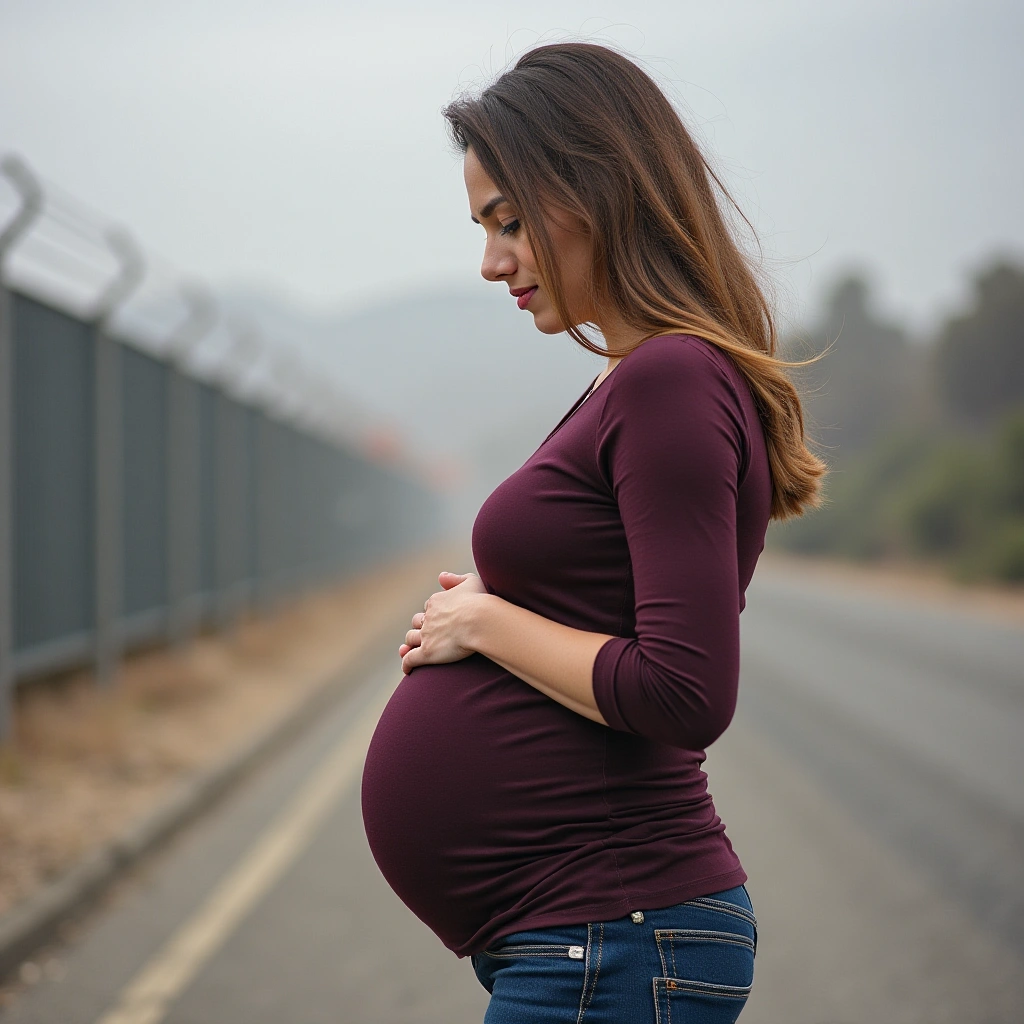
US Immigration and Customs Enforcement (ICE) agents pepper-sprayed a pregnant US citizen and threw her to the ground during a protest in California on Sunday , according to her family’s attorney, who shared footage of the incident.
Some headlines don’t need much decoration. This one shows up nearly identically across a long list of newspapers: the Miami Herald, the Fresno Bee, The Island Packet, the Sun Herald, the Idaho Statesman, the Fort Worth Star-Telegram, the Rock Hill Herald, and the Charlotte Observer. Their version reads: “12 weeks pregnant, she says ICE forced her to the ground in California. She’s sharing her story.”
The Miami Herald went with “forced her down” instead of “forced her to the ground,” which I assume took a heated editorial meeting. Either way, the core claim is the same, and it is not a small one.
I’m going to be upfront about something. The material available here is basically that headline, syndicated across a lot of mastheads. There is no name, no specific city, no date, no detailed account of what happened before or after, and no response from ICE. So this post is not going to pretend to know things it doesn’t. Plenty of people online will happily fill those gaps with whatever confirms their worldview. Let’s try something more old-fashioned and look at what the headline tells us, what it doesn’t, and why a story like this deserves attention.
What the Headline Actually Says
Three facts are in play:
1. A woman says she was 12 weeks pregnant at the time of the encounter.
2. She says ICE agents forced her to the ground in California.
3. She is choosing to share her story publicly.
Notice the word “says.” That’s standard journalistic practice, not a hint that anyone thinks she’s lying. It means this is her account, attributed to her, and the outlets are reporting her claim rather than declaring it a proven fact. That’s how responsible reporting works when one side is describing events the other side may describe differently. It’s not as exciting as “SHOCKING VIDEO PROVES EVERYTHING,” but it has the advantage of being honest.
Why “12 Weeks Pregnant” Matters
Twelve weeks is the tail end of the first trimester. In many cases a pregnancy isn’t visibly obvious at that point, which raises a fair question: would the agents involved even have known? We don’t know whether she told them, whether it came up, or whether it was visible.
That detail isn’t a gotcha in either direction. If agents knew she was pregnant and still took her to the ground, that’s alarming. If they didn’t know, it still raises a serious question about how much force is appropriate in an immigration encounter, given that you often can’t tell who in front of you is pregnant, injured, or otherwise vulnerable. “We didn’t know” explains a lot less when the force was unnecessary to begin with.
The first trimester is also a period when a lot of people are dealing with exhaustion, nausea, and the specific anxiety of not yet having told the world. Being pushed to the ground is frightening for anyone. Being pushed to the ground while worrying about a pregnancy you may not have even announced adds a layer most of us would rather not imagine.
Why She’s Sharing It
The second half of the headline, “She’s sharing her story,” might be the most significant part.
Going public with an account like this carries real risk, especially for someone caught up in immigration enforcement. Depending on her circumstances, which the headline doesn’t spell out, speaking out could mean public scrutiny, online harassment, and the general joy of strangers in comment sections deciding they understand her life better than she does. People don’t usually volunteer for that unless they think the story needs to be told.
There are generally a few reasons people speak up after an encounter like this:
– To create a public record. Once a story is reported, it’s harder for it to quietly vanish.
– To warn others. Communities often rely on these stories to understand what enforcement looks like on the ground.
– To push for accountability. Public attention tends to prompt official responses that private complaints don’t.
We don’t know which of these, if any, motivated her. But the decision itself is worth respecting.
The Questions Any Reader Should Be Asking
Since the headline leaves out a lot, here’s a list of things worth looking for in fuller coverage of this case, or of any similar one:
– What led up to the encounter? Was this a targeted arrest, a stop, a raid, or something else?
– Is there video? These days there often is, whether from bystanders, phones, or security cameras.
– Was she injured, and was the pregnancy affected? The headline doesn’t say, and nobody should guess.
– What does ICE say? Agencies typically issue a statement, and their version matters for a full picture, even if you approach it with the same skepticism you’d bring to anyone describing their own conduct.
– What happened afterward? Was she detained, released, charged, or something else?
If an article answers these, great. If it doesn’t, that’s not necessarily a failure. Sometimes reporters genuinely don’t have the answers yet. But it’s a good reason to hold off on loud conclusions.
A Brief Word on Media Syndication
You may have noticed I listed eight newspapers. That’s not because eight separate reporters independently stumbled on the same woman on the same day. Many of those papers share content within the same newspaper chain, which is why the headline appears almost word for word everywhere, give or take the Miami Herald’s bold experiment with the word “down.”
This is useful to know because it’s easy to see a story in eight places and assume it’s been confirmed eight times. In reality, it’s often one piece of reporting distributed widely. That doesn’t make it less credible. It just means the volume of headlines isn’t the same as the volume of independent sources.
Why Stories Like This Keep Coming Up
Immigration enforcement in California is a recurring source of tension. The state has a large immigrant population, and federal enforcement there regularly sparks debate about tactics, oversight, and how agents treat the people they encounter. Questions about use of force, and especially force against people who may be pregnant, have come up repeatedly in public discussion of immigration policy.
You can hold whatever position you like on immigration law and still agree on a pretty basic principle: the government should use only as much force as a situation actually requires, and that standard should be applied with extra care when someone’s health, or a pregnancy, is on the line. That’s not a radical position. It’s roughly what most people expect from anyone carrying a badge.
The Bottom Line
Here’s what we can say with confidence: a woman reports that she was 12 weeks pregnant when ICE agents forced her to the ground in California, and she has decided to tell people about it. That’s the story, and it’s serious enough without any embellishment.
What we can’t say, based on the available material, is who she is, exactly where and when it happened, what preceded it, how she’s doing now, or how ICE describes the encounter. Anyone claiming to know all that from a headline is either very well connected or making things up, and statistically it’s usually the second one.
So read the full reporting when you can, look for the agency’s response, pay attention to whether there’s video or other evidence, and remember there’s an actual person at the center of this, not just a talking point. She chose to speak. The least the rest of us can do is listen carefully before we start shouting.
Inspired by: “12 weeks pregnant, she says ICE forced her down in California. She’s sharing her story” (r/News)