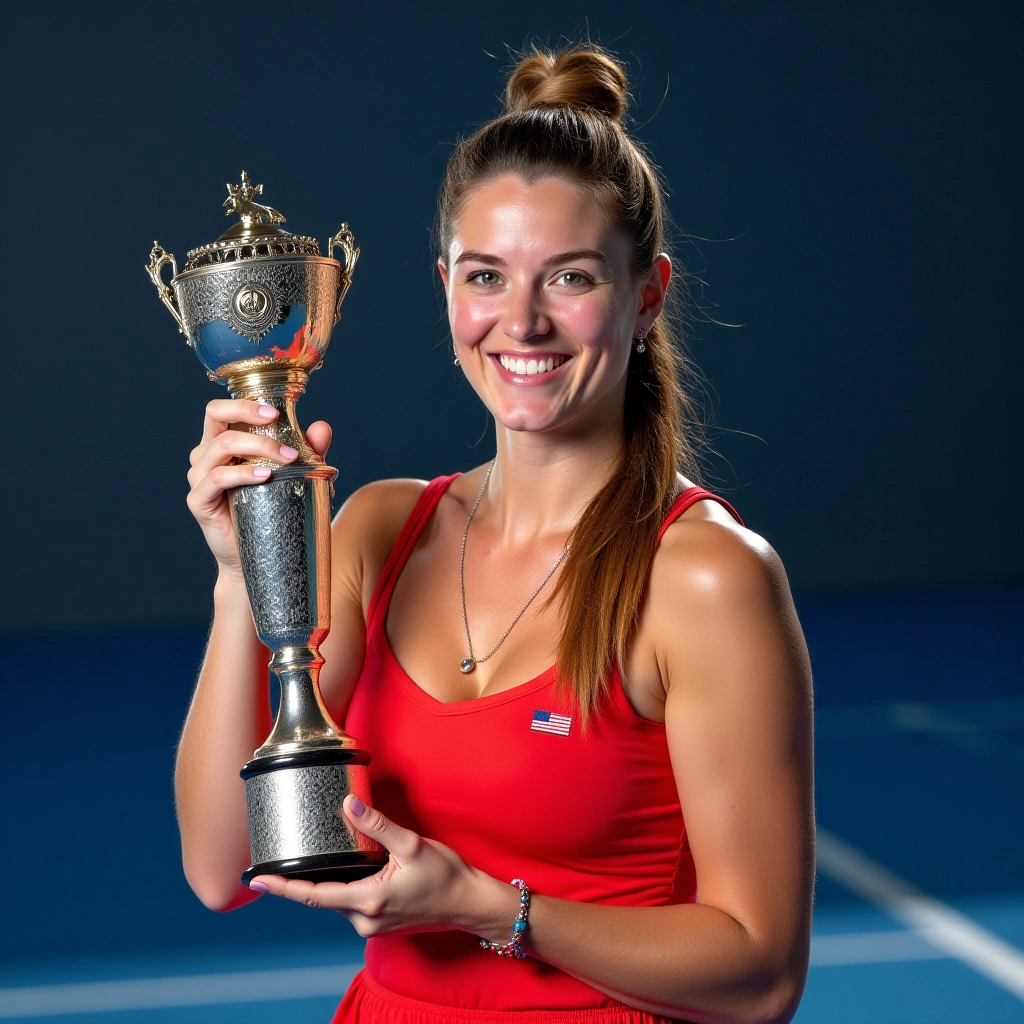
… Mirra Andreeva said a stream of positive self-talk helped her overcome her nerves and stay composed in the biggest moments as the teenager beat Elina Svitolina to win the WTA Finals title on Sunday.
There are plenty of ways to win a big tennis tournament. You can have a monster serve. You can have legs that never get tired. You can have a forehand that makes opponents question their career choices. Or, apparently, you can have a very good conversation with yourself.
Mirra Andreeva went with that last one, and it paid off. On Sunday, the Russian teenager beat Elina Svitolina 7-5, 6-3 to win the WTA Finals title in Indian Wells, California. She didn’t just win the final either. She finished the whole tournament unbeaten, which is the tennis equivalent of showing up to a group project and doing every part yourself, flawlessly.
When asked what got her through, Andreeva didn’t credit a new racket, a secret diet, or a mysterious pre-match ritual involving lucky socks. She credited positive self-talk, the habit of speaking to yourself kindly and constructively instead of spiraling into doom. According to reports from CNA, The Straits Times and The National, she said it helped her manage her nerves and stay composed during the match.
So yes, the internal monologue won a trophy. Somewhere, every motivational poster in existence is feeling very smug.
The Scoreline Tells a Story
Let’s look at that 7-5, 6-3 result for a second. A 7-5 first set is not a stroll in the park. It means the opening set was tight and could have gone either way before Andreeva edged ahead. Those are exactly the moments when nerves like to show up uninvited, pull up a chair, and start whispering unhelpful things like “What if you lose this?” and “Everyone is watching, no pressure.”
Then came the second set, which Andreeva took 6-3. That looks a lot more settled. Whatever she was telling herself between points seems to have done the job. Close first set, cleaner second set, title secured. It’s a neat little arc, and it fits the story she told afterward about keeping her composure when it mattered.
And it was Svitolina on the other side of the net, a seasoned competitor who is not exactly known for handing out free wins. Beating an experienced opponent in a final takes skill, but it also takes the ability not to panic when things get tight. That’s where the mental side comes in.
Unbeaten, Which Is Annoyingly Impressive
Going through an entire tournament without a loss is hard in any sport. In tennis, where every match is one-on-one and there’s no teammate to blame, it’s even more remarkable. You can’t sub yourself out. You can’t hide behind a defensive line. It’s just you, a racket, an opponent, and your own brain, which is sometimes the least cooperative of the four.
Andreeva’s unbeaten run means she kept her level match after match. Consistency is often the thing that separates a good week from a great one, and it’s also where mindset tends to quietly do a lot of the heavy lifting. One bad mental day can undo a lot of good tennis. She apparently didn’t have one.
So What Is Positive Self-Talk, Anyway?
In plain terms, positive self-talk is choosing to be your own supportive coach instead of your own harshest critic. Instead of “I always mess this up,” it’s “Okay, reset, next point.” Instead of “I’m so nervous I might pass out,” it’s “I’m nervous, and that’s fine, I can still play well.”
It sounds almost too simple. Surely elite athletes are doing something more complicated than giving themselves a pep talk? But the reason it gets discussed so much in sport is that pressure doesn’t care how talented you are. A tight first set in a final feels tight whether you’re a teenager or a veteran. What changes is how you respond to it.
Tennis is particularly brutal here. There’s a lot of downtime between points, and downtime is when your mind wanders off to dark places. Every changeover is an opportunity to either calm down or overthink. Andreeva’s comments suggest she used those moments to steady herself rather than unravel, which is a skill plenty of people twice her age are still working on. Some of us still haven’t mastered it while replying to emails.
The Teenager Part Deserves a Mention
It’s worth stressing that Andreeva is a teenager. Winning a title like this at any age is a big deal, but doing it while still in your teens, and then calmly explaining that the key was managing your nerves with positive thoughts, is the kind of maturity that makes the rest of us look back at our own teenage years with mild embarrassment.
Most teenagers are managing nerves about exams or awkward social situations. Andreeva was managing nerves in a final against Svitolina, and she came out with the trophy. Different scale of stress, same basic principle: talk yourself through it.
Why This Story Resonated
Three different outlets ran with essentially the same angle: the power of positive thinking. That’s not a coincidence. Sports fans love a good mindset story because it’s the one part of elite performance that feels relatable. Most of us will never hit a forehand like a professional, but all of us have stood somewhere nervous, heart pounding, trying to convince ourselves we can handle it.
When a top player says the difference-maker was how she spoke to herself, it makes the achievement feel a little more human. It’s a reminder that even the people winning big titles are dealing with nerves. They just have a plan for them.
Of course, let’s not get carried away. Positive self-talk didn’t hit the shots for her. Andreeva still had to actually play excellent tennis to go unbeaten through the event. Nobody is winning a WTA Finals title by sitting on a bench repeating affirmations. The mental game supports the physical game; it doesn’t replace it. But at the top level, where everyone can play, the mental edge is often what tips the balance.
A Few Takeaways for the Rest of Us
You don’t need to be chasing a trophy in California to borrow a page from Andreeva’s book. A few lessons translate pretty well to everyday life:
Nerves aren’t the enemy. Andreeva didn’t claim she felt no nerves. She talked about managing them. That’s an important distinction. Feeling nervous before something important is normal. The goal is to keep it from running the show.
Tight moments call for calm, not panic. A 7-5 set is the definition of a tight moment. Staying composed through it set up a smoother second set. The same idea applies to stressful meetings, interviews, or any situation where things feel like they could go either way.
What you tell yourself matters. If your inner voice sounds like an angry sports commentator who has given up on you, maybe try swapping it for something more supportive. It costs nothing, and apparently it can win titles.
Consistency comes from steadiness. An unbeaten run isn’t built on one great day. It’s built on showing up the same way, match after match. A steady mindset helps make that possible.
The Bottom Line
Mirra Andreeva beat Elina Svitolina 7-5, 6-3 on Sunday to win the WTA Finals title in Indian Wells, finishing the tournament without a loss. The Russian teenager pointed to positive self-talk as the thing that helped her handle her nerves and stay composed when it counted.
It’s a great result, a great story, and a gentle reminder that sometimes the most important conversation in a tennis match isn’t with your coach or your opponent. It’s the one happening quietly in your own head. Andreeva clearly had a good one on Sunday, and she has the trophy to prove it.
Inspired by: “Power of positive thinking helps Andreeva to WTA Finals title” (r/News)