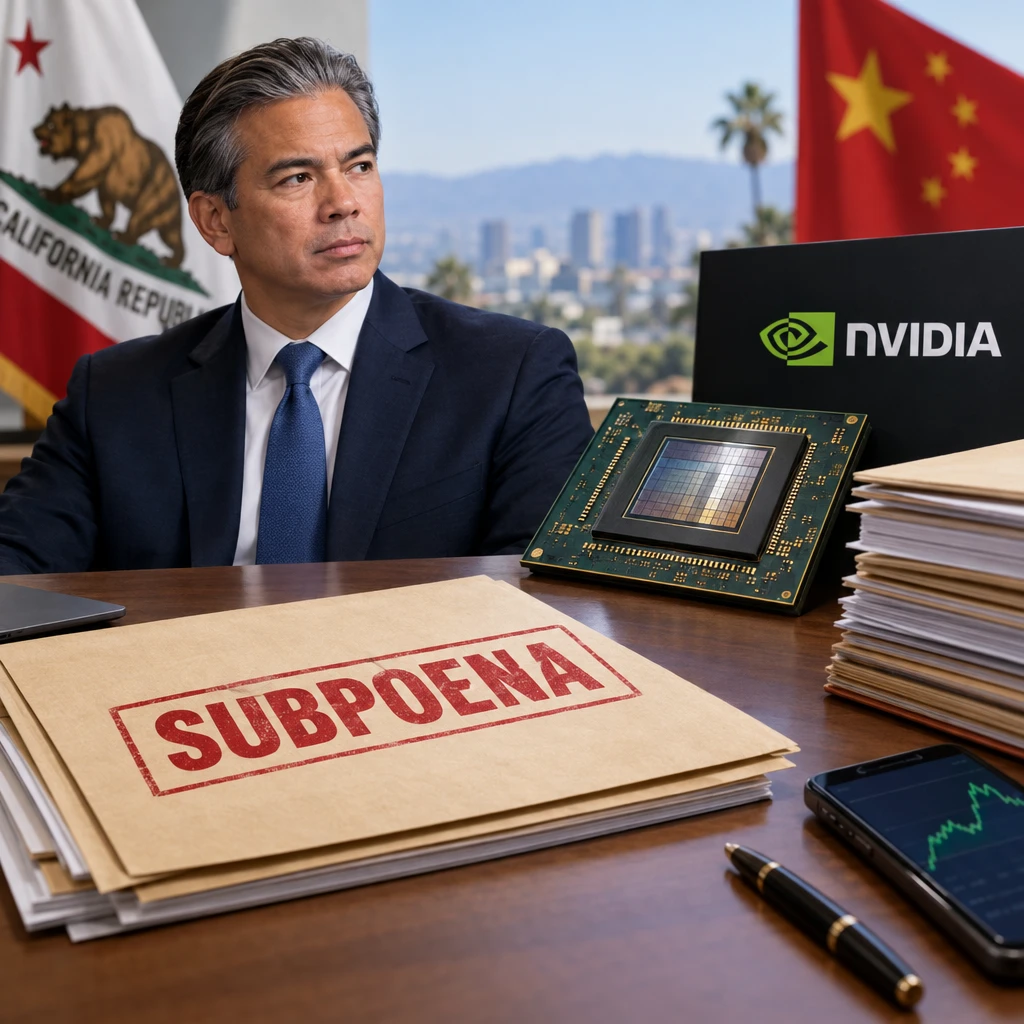
The California Department of Justice is asking Nvidia whether its advanced chips or confidential information may have gone to China and whether Nvidia misled investors and the public .
If you thought chip stocks were only about gaming graphics cards and AI hype, California’s Attorney General has a different plotline for you. Rob Bonta has issued an investigative subpoena to Nvidia as part of a probe into whether the company’s advanced semiconductors or confidential information made their way to China. That’s the kind of sentence that makes a compliance department reach for the antacids.
The core question is pretty simple to state, even if the answer will take a while. U.S. export restrictions limit how certain advanced chips and related technology can reach China. The investigation is looking at whether those rules may have been violated, either through chips themselves or through confidential information. Nothing here is a conclusion. A subpoena is a request for documents and information, not a verdict, and it’s a reminder that a state investigation can run alongside federal scrutiny of the same industry.
The probe also comes at a dramatic moment for the company. According to the reports summarized here, former CEO Jensen Huang recently resigned amid allegations of affairs, one of which reportedly involved a suspected Chinese spy. Those are serious claims, and they are allegations, not established facts. They also raise an obvious question for investors: how does a leadership shake-up like that intersect with a regulatory inquiry about China? Authorities are reportedly examining that connection too, including whether Nvidia misled investors and the public about these matters.
That last point deserves a moment. Companies can get into legal trouble for what they say as much as for what they do. If a firm downplays a problem, or describes its China business in ways regulators later find incomplete, the disclosure question can become its own headache. Investors rely on accurate statements, and when there’s doubt about whether they got the full picture, lawyers tend to get very busy.
Why is this getting so much coverage? Part of it is simply that Nvidia matters. Its chips sit at the center of the AI boom, and anything touching its China business is going to attract attention from business press, national security watchers, and anyone with a retirement account invested in tech. The story combines several things people love to read about at once: high-stakes technology, geopolitics, a powerful executive, and personal scandal. Honestly, if this were a TV drama, critics would say the writers were trying too hard.
The coverage has been broad. Business outlets, radio news, cable business networks, the Los Angeles Times, and the New York Post have all reported on the subpoena, each with slightly different framing. Some emphasize the export control angle, others the personal allegations, and others the investor disclosure questions. Reading across them gives you the fuller picture, though it also reveals how fast a developing story can get tangled.
What happens next is unclear from the available reporting. Subpoenas typically lead to document production and, sometimes, further questions or negotiations. Whether the investigation leads to charges, settlements, or nothing at all is anyone’s guess right now. The smart move for readers is to watch for official statements, company filings, and follow-up reporting rather than treating every headline as the final word.
For now, the takeaway is this: California has put Nvidia on notice, the China chip question is back in the spotlight, and the allegations surrounding its former CEO have turned a regulatory matter into a full-blown saga. Stay curious, stay skeptical, and maybe keep that antacid handy.
Inspired by: “California AG Rob Bonta serves Nvidia with subpoena in wake of ex-CEO Jensen Huang’s Chinese spy, a…” (r/Business)