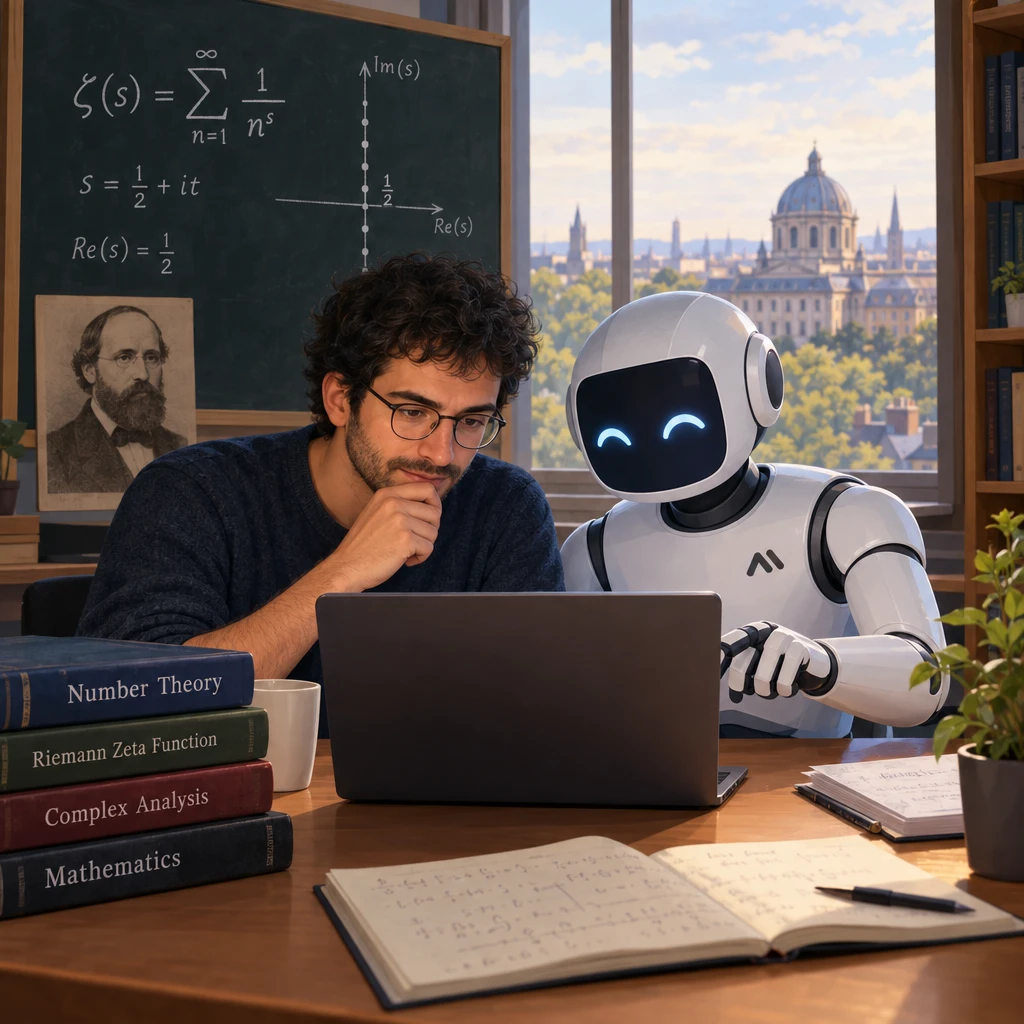
A statement from 1859 about where the zeros of the Riemann zeta function lie. If true, it pins down how evenly prime numbers are spread out. It is one of the most famous open problems in mathematics.
Every so often, a headline comes along that makes mathematicians sit up, put down their coffee, and quietly open a new browser tab. This week’s entry: an Anthropic mathematician, Levent Alpöge, says he and the company’s AI model, Claude, have proved the Riemann Hypothesis. If that’s true, it’s one of the biggest mathematical results in a very long time. If it isn’t, it’s another chapter in a story that mathematics has been telling for over a century.
First, a quick refresher for anyone who skipped their number theory classes (no judgment, most of us did). The Riemann Hypothesis was proposed by Bernhard Riemann in 1859, in a paper about how prime numbers are distributed. It concerns the zeros of the Riemann zeta function, and it predicts that the nontrivial zeros all lie on a particular line in the complex plane. That sounds abstract because it is abstract, but the consequences reach deep into how we understand primes. Proving it would tell us a huge amount about how those numbers behave. It has resisted every serious attempt for 167 years, which is why it’s on the Clay Mathematics Institute’s list of Millennium Prize Problems, with a $1 million reward attached.
So what exactly is Alpöge claiming? According to the reports, the purported proof exists as Lean code posted on his personal website. Lean is a proof assistant, a programming language where mathematical statements and their proofs can be written in a form a computer can check step by step. That’s the appealing part. A Lean proof doesn’t ask you to trust a mathematician’s prose; it asks the software whether each step follows. The reported code also reportedly covers the Generalized Riemann Hypothesis, which extends the same idea to a broader family of functions used throughout number theory.
Here’s the catch, and it’s a big one. A Lean file that compiles is only as meaningful as the statement it’s checking. Verifying the code is one job. Making sure the formal statement actually matches the original conjecture, with no sneaky loophole or misstated definition, is another. That second check takes time, expertise, and a lot of careful reading. Right now, according to the coverage, no independent mathematicians have verified the claim. Several outlets were blunt about this, with one headline noting that no one has verified it yet. That’s the correct level of enthusiasm for the moment.
It’s also worth being honest about the track record. Claims of proving the Riemann Hypothesis have a long and not especially glorious history. Many have come from serious people, and many have collapsed under scrutiny. Even high-profile attempts, such as the one Sir Michael Atiyah presented in 2018, did not win acceptance from the wider community. Mathematicians have learned, painfully, to treat big announcements with a healthy dose of skepticism until the experts have gone through the work line by line.
That said, there’s something genuinely new in this story. The fact that an AI system is part of the claimed collaboration is what has everyone talking. AI tools have been getting better at formal reasoning and at writing Lean code, and some researchers have been excited about using them to speed up tedious parts of proofs. A claim like this tests how far that goes. It also raises questions that the community will need to answer: How much did the human contribute? How much did the AI contribute? And how should credit and verification work when the line between them gets blurry?
So where does that leave us? Cautiously curious. If the proof holds up, it will be a landmark moment for mathematics and a strong signal about what AI-assisted research can achieve. If it doesn’t, it will be a useful reminder that a proof is not a proof until people who know what they’re looking for have checked it. Either way, the next few weeks of expert review will be far more interesting than any press release.
For now, the safest summary is this: a striking claim has been made, the code is public, and the verdict is still out. Grab some popcorn, and maybe keep an eye on the people who actually understand the zeta function. They’re the ones who will decide whether this is history or just another very ambitious blog post.
Inspired by: “Anthropic mathematician claims he and Claude proved Riemann Hypothesis” (r/News)