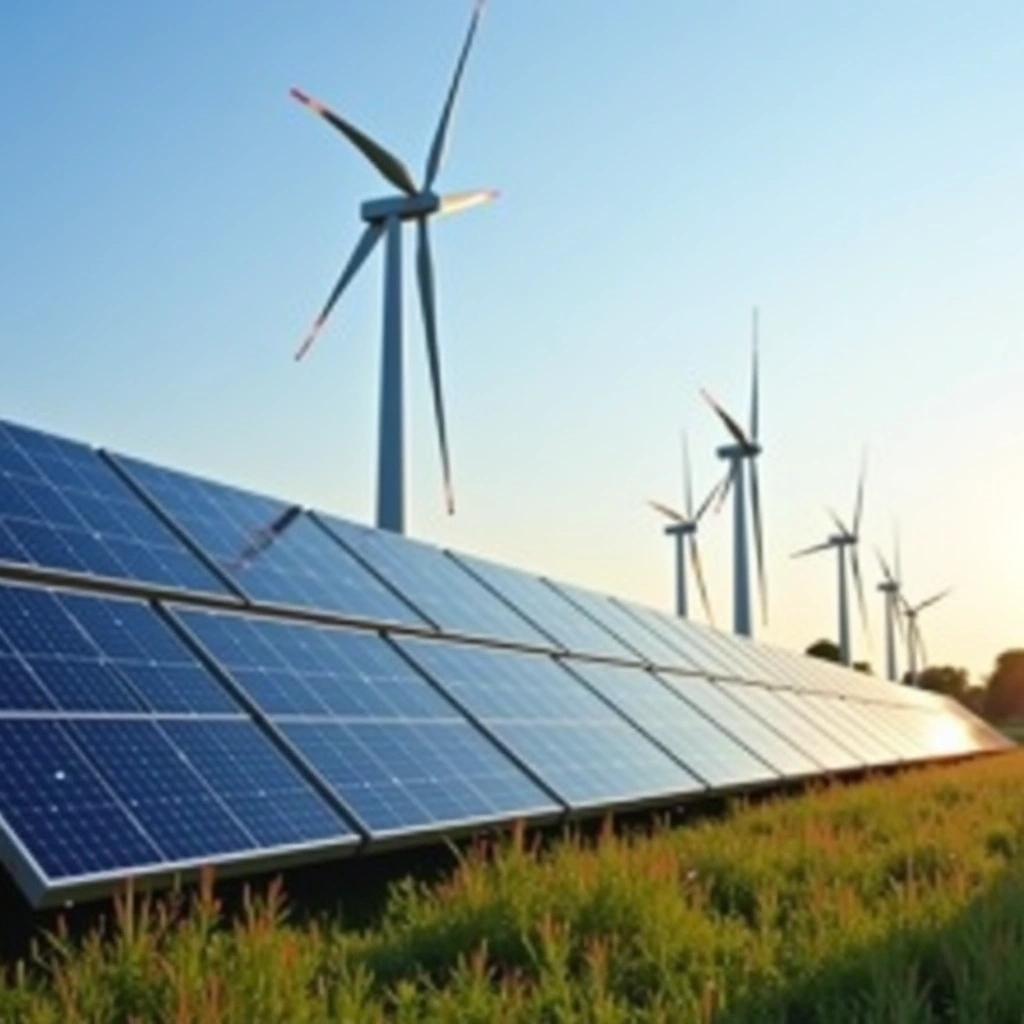
Amazon plans to invest an additional $7 billion in Indian renewable energy through 2030 , bringing its total contracted and planned clean-power spending in the country to more than $11 billion.
Most of us think of Amazon as the company that gets a phone charger to our door before we’ve finished regretting the purchase. Lately it has been buying something much bigger than impulse gadgets: renewable energy, and a lot of it, in India.
Amazon has announced plans to invest an additional $7 billion in renewable energy projects in India by 2030. That money comes on top of the $4 billion it has already contracted. Alongside the announcement, the company unveiled four new wind and solar projects with a combined capacity of 934 megawatts.
Let’s look at what that means, why it matters, and why it’s worth more than a polite nod.
First, the Numbers
The headline is easy to repeat and hard to picture, so here it is in pieces.
– $7 billion in new planned investment in Indian renewable energy projects by 2030.
– $4 billion already contracted before this announcement.
– Together, that’s $11 billion. Most of us stop counting after the second zero.
– Four new projects, a mix of wind and solar.
– 934 MW of combined capacity across those four projects.
– 234 MW of that comes from a single wind project in Karnataka, which Amazon describes as its largest contracted wind project in Asia.
Simple subtraction says the other three projects add up to about 700 MW. That’s a substantial chunk of clean capacity on its own, even if the Karnataka project gets the spotlight.
The Karnataka Wind Project Gets Top Billing
The 234 MW wind facility in Karnataka is clearly the star. Calling it Amazon’s largest contracted wind project in Asia is the corporate version of a mic drop, and it tells you something about how seriously the company is treating India as part of its energy plans.
Wind and solar complement each other well. Solar produces during the day. Wind output depends on location and season, and it doesn’t clock out when the sun goes down. Investing in both gives a portfolio more balance than relying on one source. A diversified energy portfolio is the grown-up version of not putting all your eggs in one basket, except the eggs are turbines and panels.
Why Is Amazon Doing This?
Large technology companies use a great deal of electricity. Data centers, warehouses, logistics networks and offices all need power, and lots of it. As these companies expand, their energy demand grows with them. Contracting renewable capacity is one of the main ways big corporations try to keep that growth from turning into a climate liability.
According to the announcement, these projects are meant to contribute to India’s energy security and its net-zero emissions goals. Those two aims go together naturally. Every megawatt produced from domestic wind and sunlight is a megawatt that doesn’t depend on fuels that have to be burned, shipped or bought on volatile markets.
There’s also the cynical reading: it’s good business. Committing billions to clean energy looks great in a sustainability report. But being sarcastic about corporate motives doesn’t make the turbines spin any slower. If the outcome is more clean power on the grid, the motives can be mixed and the result can still be useful.
What Does 934 MW Actually Mean?
A megawatt is a unit of power capacity, meaning how much electricity a facility can produce at full tilt. The catch is that wind and solar don’t run at full tilt all the time. The sun sets and the wind has moods. So 934 MW of capacity doesn’t mean 934 MW flowing every second of every day.
It’s still a serious amount of capacity. Projects of this size need land, equipment, grid connections and years of planning. Announcing four of them at once is not a weekend side project.
The Bigger Picture for India
India is one of the world’s most important energy stories. It’s a huge, growing economy with rising electricity demand, and how it meets that demand will matter far beyond its borders. Private investment in renewables, from domestic companies and global giants like Amazon, adds capital and momentum to the transition.
The story drew attention from several outlets, including the Times of India, Deccan Herald, Seeking Alpha and The Hindu. Coverage across business, national and regional publications suggests the announcement matters both as a corporate milestone and as an energy policy story.
A Few Reasonable Questions
Before we hand Amazon a trophy shaped like a wind turbine, a few questions are worth keeping in mind.
Will the money actually get spent? “Plans to invest by 2030” is a commitment, not a receipt. Projects can be delayed, renegotiated or reshaped. That’s not an accusation, just how large infrastructure works.
Where will the other three projects be, and on what schedule? The Karnataka project is the headline, but the full details of the remaining capacity will matter to anyone tracking how this plays out.
How does this fit into the grid? Adding renewable capacity is one part of the job. Transmitting and balancing that power is the other part, and it’s the one nobody puts on a billboard.
None of these questions cancel out the announcement. They’re just what you ask when someone tells you they’re about to spend $7 billion.
The Takeaway
Amazon’s plan to invest another $7 billion in Indian renewable energy by 2030, on top of the $4 billion already contracted, is a big commitment by any measure. The four new wind and solar projects, totaling 934 MW and led by a 234 MW wind farm in Karnataka, give that commitment a concrete shape.
Whether you see it as corporate responsibility, smart business or a bit of both, the result is more clean energy capacity in one of the world’s most important energy markets. In a world where many climate announcements are mostly adjectives, a plan with dollar figures, megawatt counts and named locations is a refreshing change.
Now if only it could deliver the wind and sunshine with the same one-day shipping.
Inspired by: “Amazon plans $7 billion renewable energy investment in India by 2030; unveils 4 projects of 934 MW” (r/News)