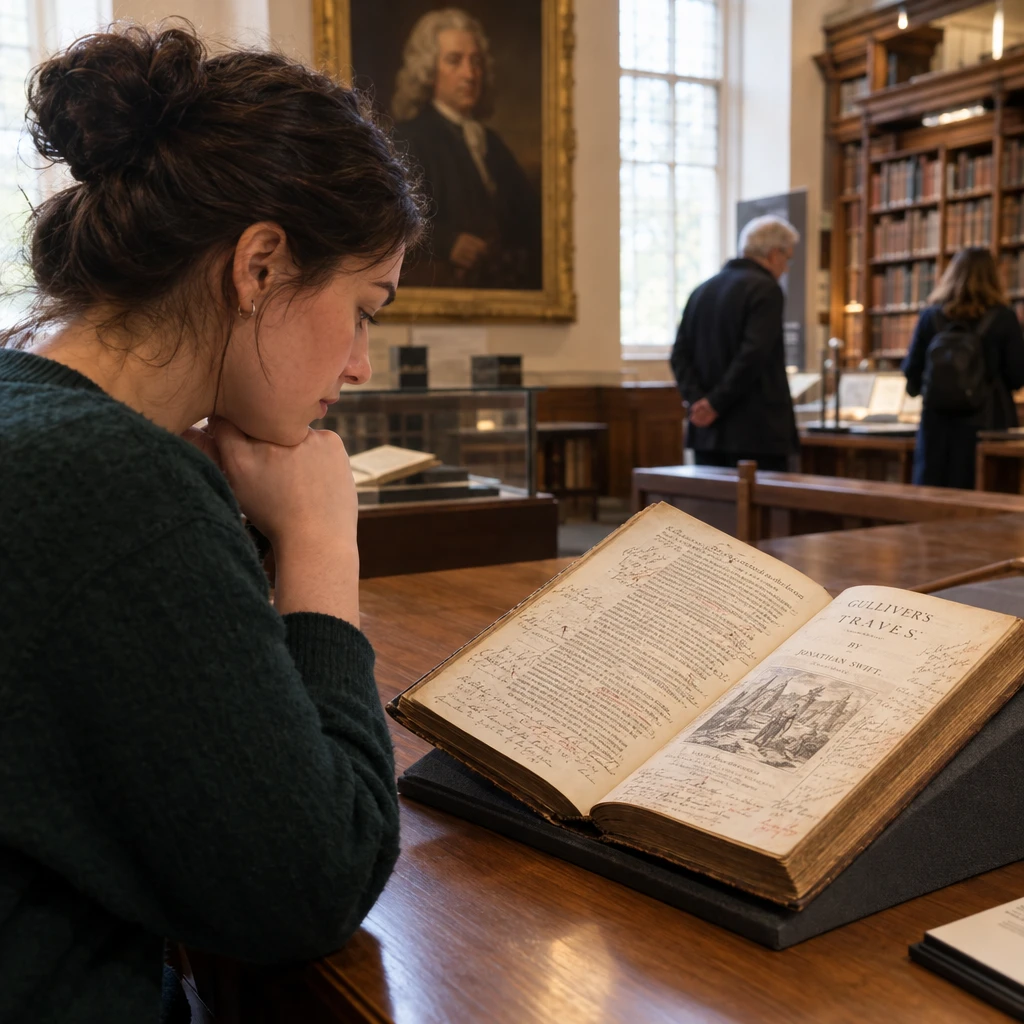
“While the publisher changed the text to protect his own reputation, Swift’s intense frustration with that censorship is vividly alive right here on our pages in Armagh.” · The library is celebrating the 300th anniversary of the publication of Gulliver’s Travels, and this week will host a lecture by Aileen Douglas, Professor of Eighteenth-Century Studies at Swift’s alma mater Trinity College Dublin.
Every so often a book turns up that makes you rethink what ‘dangerous’ means. Nobody expects a 300-year-old novel about a shipwrecked surgeon wandering among tiny people and giants to cause much trouble these days. Yet a first edition of Jonathan Swift’s Gulliver’s Travels is now on display at the Armagh Robinson Library in Northern Ireland, and the reason it’s on show is that someone, back in 1726, decided the book was too risky to print as written.
The novel is celebrating its 300th anniversary, and the library has chosen to mark it with a copy that tells a more interesting story than the familiar one about giants and Lilliputians. The book was published in London by Benjamin Motte, who altered the text to avoid prosecution for political libel. In the eighteenth century, that was no small worry. Swift’s satire poked at politics, power, and the people who held it, and a publisher who ignored the risks could find himself in serious legal trouble.
So Motte made changes. Swift, to his credit, was not pleased. He took his own copy and hand-wrote corrections into it, restoring the material he had originally intended to publish. Picture the scene: an author, annoyed that his work has been watered down, sitting down with a pen to put back the bits that made it sharp. It’s the literary equivalent of quietly fixing a sign someone has tried to tidy up. Honestly, it’s hard not to admire the sheer stubbornness of it.
That is what makes this edition so valuable. It offers a window into how the novel was first received and into Swift’s reaction to censorship. Rather than presenting a single, polished version of the book, it shows the tension between what an author wanted to say and what the world was willing to hear. Anyone who has ever had an editor cut their favourite paragraph may find Swift’s corrections oddly comforting.
It’s also a reminder of how much the book’s reputation rests on its bite. Many readers know Gulliver’s Travels as a children’s adventure, thanks to abridged versions that keep the giants and the tiny kingdoms but leave out much of the cutting commentary. The full novel is a different beast. It is funny, sometimes savage, and deeply suspicious of human pride. Swift wasn’t writing bedtime stories. He was writing a satire of his society, and a good deal of that satire was aimed at the political establishment of his day.
Swift himself was no stranger to controversy. He was a clergyman and the Dean of St Patrick’s Cathedral in Dublin, and he wrote often about Irish affairs, sometimes with a bluntness that got him into trouble. That background helps explain why a book so full of pointed jabs would worry its publisher. Swift understood, perhaps better than anyone, that sharp satire rarely makes friends among those it targets.
The display in Armagh, housed in one of the oldest libraries in Ireland, gives visitors a chance to see the physical evidence of that struggle. It’s one thing to read about censorship in a history book. It’s another to look at a page where the author’s own handwriting pushes back against it.
So if you are in the area, or if you simply enjoy a good literary mystery, take a moment with this anniversary edition. The book that many of us remember as a bit of harmless fun was, at its first printing, a slightly dangerous piece of writing. Three hundred years later, it still has the power to make us laugh, wince, and wonder how much of the story was lost before it ever reached the shelves.
Inspired by: “‘Dangerous’ edition of Swift’s classic Gulliver’s Travels celebrated in Armagh” (r/News)