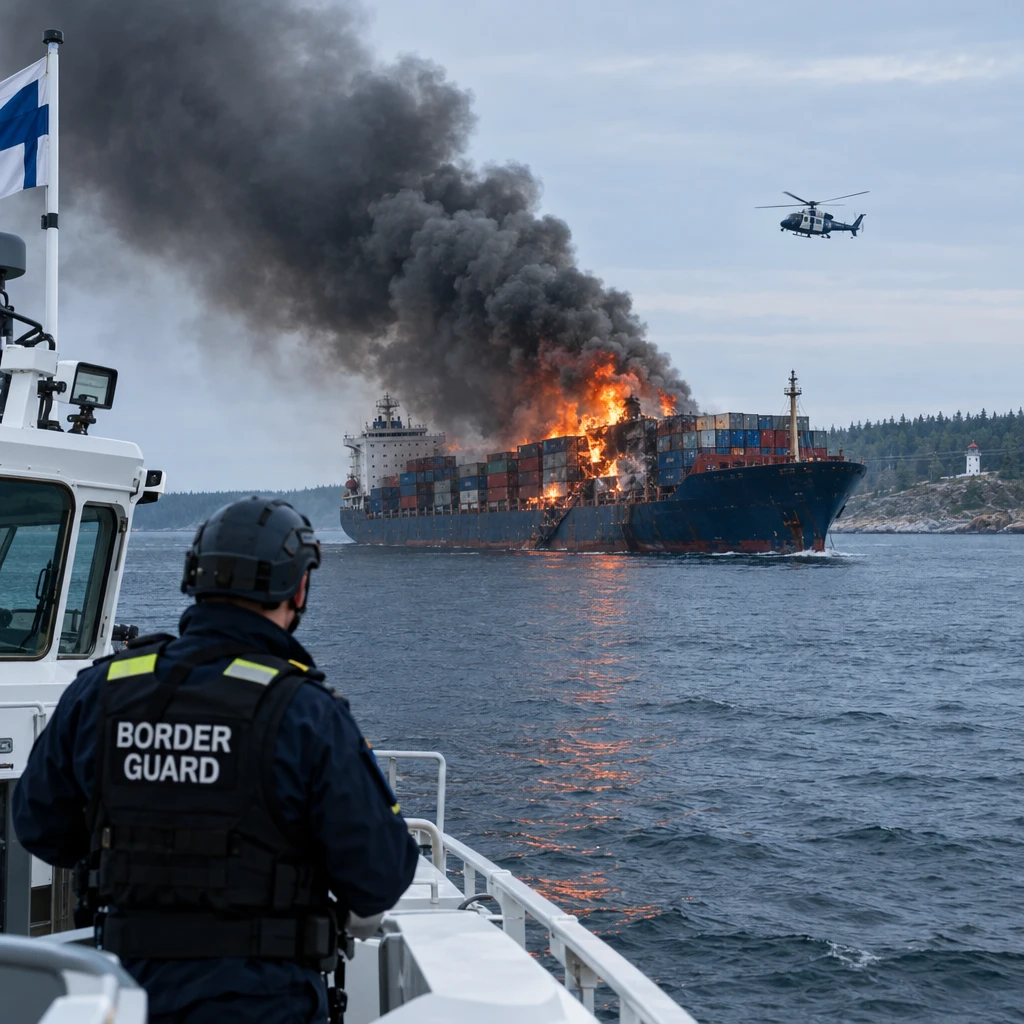
The vessel is subject to US sanctions , according to the US Department of the Treasury.
Some mornings you wake up hoping for a quiet news cycle. Then you read that a Russian container ship has been set on fire by Ukrainian drones and is now drifting toward Finland, and you realize that was never going to happen.
Here is the situation as reported. The Russian container ship Sparta II was traveling from St. Petersburg to Kaliningrad when it was hit by Ukrainian drones and caught fire. The damaged vessel lost control and drifted into Finnish territorial waters, according to Finnish public broadcaster Yle. It is now roughly off the city of Loviisa, and an exclusion zone has been set up around it for safety. Finnish officials say there is currently no threat to other vessels or to the public. That’s the reassuring part. The rest of the story is less cozy.
The ship is under US sanctions and operates under Russia’s Defense Ministry, which makes it a bit more than an ordinary cargo carrier. According to Finnish Border Guard commander Ilya Ilyin, the strike happened in Russian territorial waters, and only afterward did the ship enter the area covered by Finnish maritime rescue services. So the vessel was hit on one side of the water and ended up as a problem on the other. Anyone who has had a car break down in the wrong lane knows how that goes.
The most sobering part of the coverage is Ilyin’s own assessment. He said he could not say how great the risk of an explosion was, and that the fire had not yet been contained, so further explosions were quite possible. If the fire kept burning for a long time, he added, the ship could even sink. Nobody enjoys hearing a senior official describe a burning ship as a possible sinking hazard, least of all the people who live along that coast.
For now, the crew is trying to put out the fire. Finnish border guards are coordinating a maritime rescue operation and weighing options for evacuating the sailors. No decision has been made about bringing the crew into Finland or about towing the ship to a Finnish port. Those are big choices with no obvious good answer, and they will depend on how the fire and the vessel’s condition develop.
There is also the question of what the ship might be carrying. Finnish officials have not ruled out the possibility that it carries weapons or military equipment. Ilyin said the container ship has ties to Russia’s armed forces, but information about any military cargo has not been confirmed. So for the moment, everyone is working with a lot of possibilities and very few verified facts. That gap is exactly where rumors like to move in.
Finland’s stated priorities are clear: saving lives and preventing an environmental disaster. Those two goals sit at the top of the list, ahead of the politics. A burning vessel with an uncertain cargo and a possible sinking risk is the kind of thing that can cause real ecological damage if fuel or other substances leak into the water. Coastal communities and wildlife would bear the cost, and they had no say in any of it.
This incident also doesn’t exist in a vacuum. Back in April, dozens of tankers in Russia’s so-called “shadow” fleet were stranded in the Gulf of Finland after attacks paralyzed port operations. The Gulf of Finland is becoming a busy and tense corridor for vessels linked to sanctioned shipping, and each incident adds to the sense that the region is being pulled into a conflict that started far away. Finland, which shares a long border with Russia and has its own memories of living next to a large neighbor, is watching closely.
One detail that stands out is that the attack happened in Russian waters, and the consequences landed in Finnish waters. That is the sort of cross-border spillover that makes international maritime law and emergency response much harder than they look on a map. Rescue services, coast guards, and governments have to coordinate even when they are not on the same side of the wider conflict, because the sea does not respect borders when a ship starts drifting.
The story also got a second headline in the Jerusalem Post, which framed it alongside reports that Ukraine had struck Russian vessels docked in Libya. Taken together, those reports paint a picture of a conflict that is reaching shipping routes and ports far from the front lines. Whether that makes the sea a more dangerous place or simply a more visible one, it is not a comforting trend for anyone who depends on maritime traffic.
So where does this leave us? A sanctioned, possibly military-linked ship is on fire near a Finnish coastal town. Officials say there is no current threat to the public, but they also say the situation could get worse if the fire keeps going. The crew needs to be saved, the environment needs to be protected, and nobody yet knows what the cargo really is. It is not a story that ends neatly, and anyone hoping for a clean resolution in the next news cycle may be disappointed. Stay tuned, keep your distance from the exclusion zone, and maybe skip the seafood special for a while.
Inspired by: “Russian ship burns in Finnish waters after Ukrainian drone strike” (r/News)