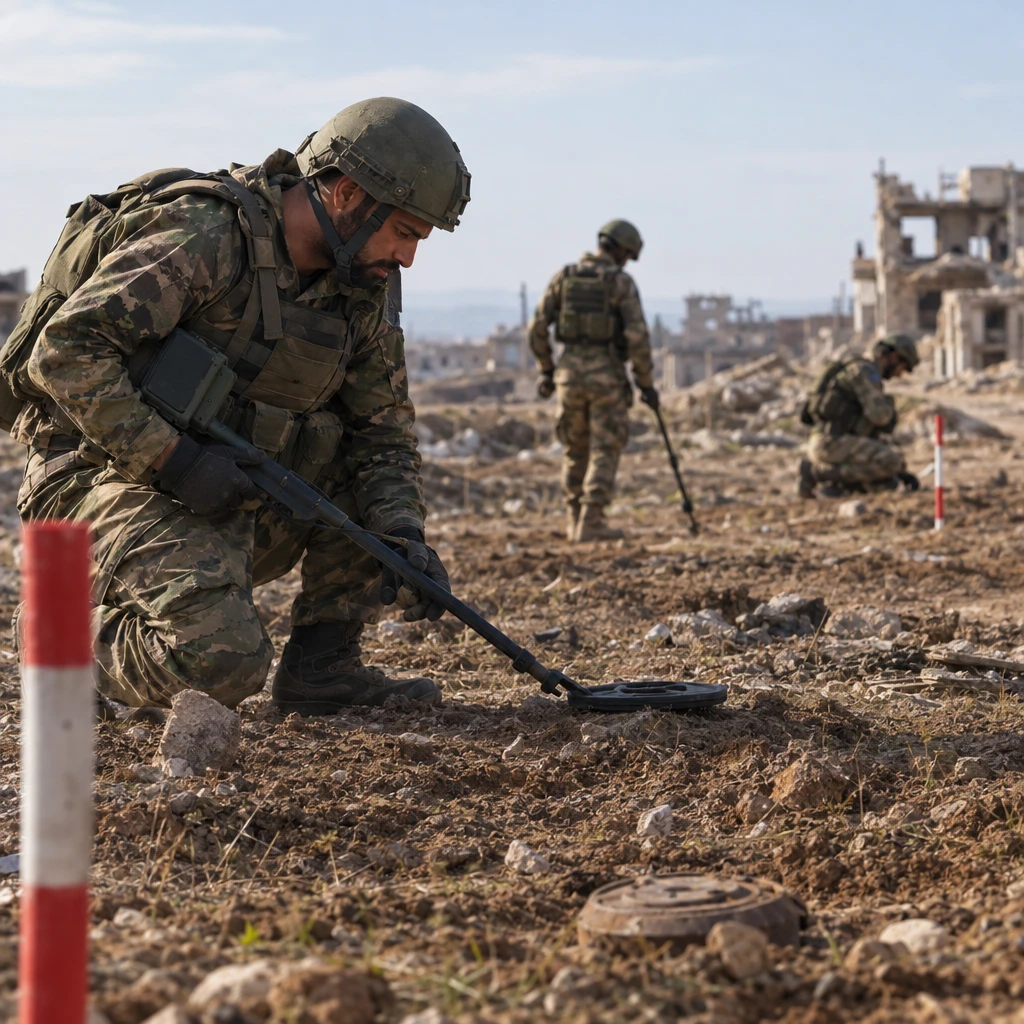
A Syrian soldier was killed and two others were injured during a mine-clearing operation in the western rural area of Syria's eastern Deir ez-Zor province , the Defense Ministry said on Sunday.
Some news stories arrive with a headline that does most of the talking. This one is a good example. According to reports carried by Anadolu Agency, a Syrian soldier was killed and two others were wounded while dismantling mines and other remnants of war in the town of Al-Tarif, in eastern Syria. The Defense Ministry confirmed the casualties, and the same incident was also picked up under headlines pointing to Deir ez-Zor, the province where the operation took place.
It is the kind of sentence you can read in about four seconds. Soldiers were working. Something went wrong. Three people were hurt, one of them fatally. Then the next story loads and the scroll keeps going. But it is worth slowing down on this one, because the work these men were doing is far less glamorous than the word “combat” suggests, and it is quietly one of the most dangerous jobs a military can hand out.
Why mine clearance is so hard
Most people picture a war as a series of battles with clear fronts and clear endings. In reality, the fighting often leaves behind a messy layer of hazards long after the shooting stops. Landmines, unexploded shells, grenades, and other leftover explosives can sit in fields, roads, buildings, and rubble for years. They do not care whether the conflict is officially over. They simply wait.
Clearing them is painstaking work. Each device has to be located, identified, and then either removed or destroyed, and every step carries risk. Some mines are designed to be triggered by pressure, some by movement, and some are old enough that their condition is unpredictable. A mistake that takes a fraction of a second can end a career or a life. That is why this type of work is usually done slowly, methodically, and with more patience than most of us could manage while standing in a dusty town square.
The people doing the work
It is easy to reduce these incidents to a line in a casualty count, but behind every number is a person who signed up for dangerous work and was doing exactly what was asked of them. The soldier who died and the two who were wounded were part of a larger effort to make towns and communities safer for people who want to return home. That effort rarely gets headlines unless something goes badly wrong, which is a bit unfair to everyone who spends their days doing it without incident.
There is also a practical side to all of this. Until these hazards are cleared, families cannot safely farm their land, children cannot safely walk to school, and aid workers cannot safely reach certain areas. Clearing a road or a field is not just a military task. It is a precondition for ordinary life coming back.
What the report does and does not tell us
The available reporting is fairly brief. It confirms the basic facts: one soldier killed, two wounded, mine-clearing underway, Al-Tarif as the location, and the Defense Ministry as the source of the confirmation. Beyond that, readers should be cautious about filling in the gaps with assumptions about cause, responsibility, or what happened in the minutes before the blast. Those details are not in the material available here, and it is better to say so plainly than to pretend otherwise.
A small reminder
The next time you see a short news item about a clearing operation, it might be tempting to scroll past. Maybe pause for a moment instead. A soldier died doing something that most of us will never have to do, in conditions most of us will never see. Their families will feel the loss long after the story drops off the front page. That deserves more than a glance.
So here is to the people who walk carefully through places most of us would rather avoid, and to the hope that one day the job of clearing mines in Syria becomes a lot less necessary.
Inspired by: “Syrian soldier killed, 2 wounded during mine-clearing operation in eastern Syria” (r/World)