Andreas Sieber, head of political strategy, at 350.org, concluded: “The final draft confirms what has become increasingly clear throughout COP31: an indefensible failure of leadership by the Turkish and Australian presidencies .
If you’ve ever tried to agree on dinner with a group of friends, you already understand the basic problem facing climate negotiators in Antalya, Türkiye. Everyone wants to be reasonable, nobody wants to be the one who blinks first, and the clock keeps ticking. At COP31, that clock ran out, and the talks kept going anyway, because the deal on the table had a glaring omission that several countries weren’t willing to swallow.
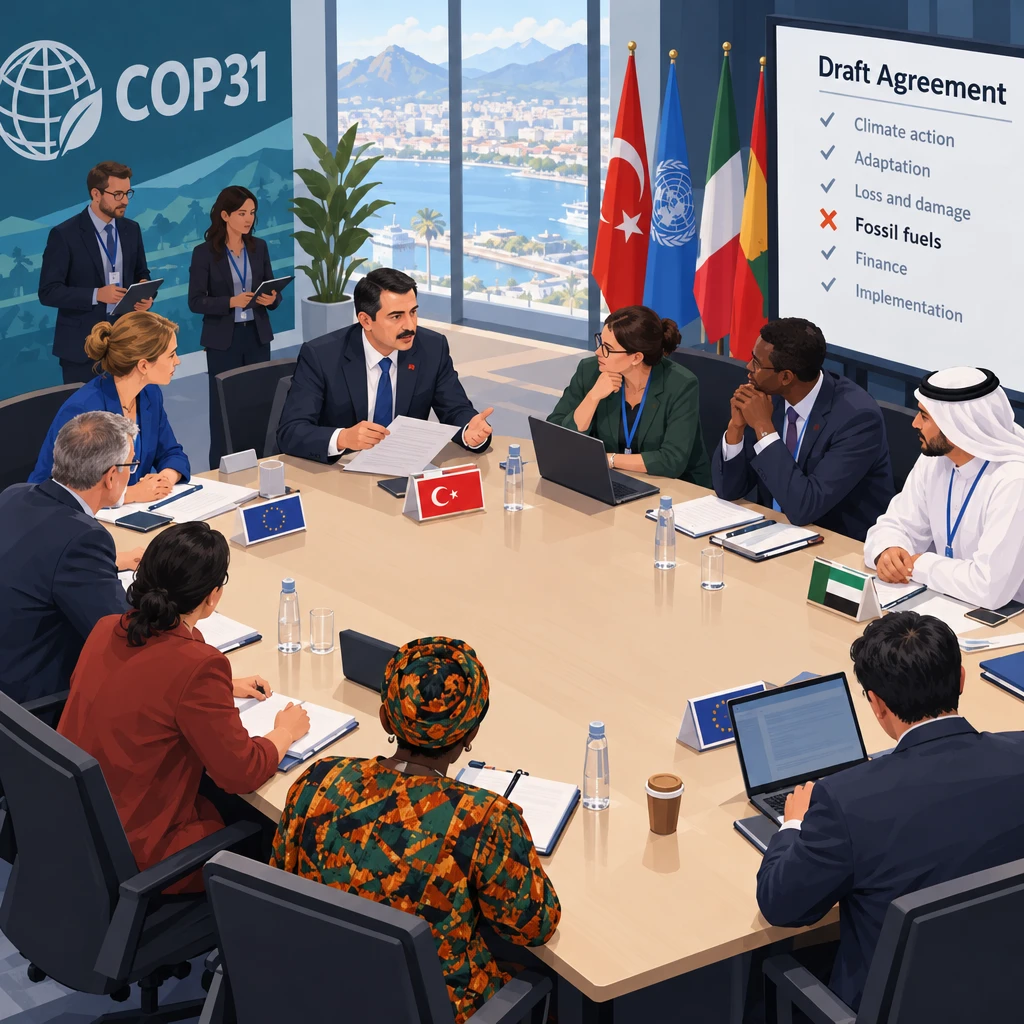
The problem is the draft agreement. Released by Turkish Environment Minister Murat Kurum, it did not include explicit commitments to phase out coal, oil, or gas. For a conference that has spent years circling the fossil fuel question, that’s a pretty big gap. Leaving it out didn’t go unnoticed. Several participating countries objected, and the negotiations were extended past their deadline as delegates tried to sort out the language.
Why does a single missing phrase matter so much? Because in climate diplomacy, words are not decoration. A sentence about fossil fuels is essentially a statement about the future of the global economy. It tells investors, governments, and energy companies where things are headed. When that sentence goes missing, people reasonably ask whether the agreement is meant to change anything at all, or whether it’s a polished document that politely avoids the hard part.
Some background helps here. The UN climate process runs on consensus, which means that agreements generally need broad buy-in from nearly every country in the room. That’s a feature when you want everyone on board, and a headache when a handful of nations feel the text is too weak or too strong. In practice, that means a single disagreement can stall an entire outcome, and a late-night session can stretch into a very long morning.
The fossil fuel debate also has a history. At COP26 in Glasgow, countries agreed to phase down unabated coal power, a notably specific commitment that was the result of last-minute negotiation. Two years later, at COP28 in Dubai, the global stocktake outcome called for countries to transition away from fossil fuels in energy systems, language that was celebrated by some and criticized by others as more cautious than it looked. So the topic isn’t new. What’s new is the sense that some are hoping to move back from those already-hard-won positions.
That’s what makes the current situation so tense. Supporters of stronger language argue that the science is clear: to keep global warming in check, emissions from fossil fuels need to fall sharply. They see a draft without fossil fuel references as a step backward, or at least a missed opportunity. Other countries, often those whose economies depend heavily on oil, gas, or coal, argue that energy transitions need to be gradual, realistic, and tailored to national circumstances. Their concern is that a rigid timeline could hurt jobs, energy security, and development.
Both sides have a point, which is exactly why these talks are so difficult. Nobody gets to be purely righteous here. The climate-vulnerable countries want certainty and urgency. The fossil-fuel-dependent countries want flexibility and time. Developed and developing nations also tend to disagree about who should cut emissions first and who should pay for the transition. Fossil fuel language sits right at the center of all those tensions, so it’s no surprise that it became the flashpoint.
What happens next is genuinely uncertain. Negotiators could find compromise wording that satisfies enough countries to move forward, perhaps by restoring some reference to transitioning away from fossil fuels while softening the commitments. They could also reach a thinner agreement that avoids the topic entirely, which would probably trigger a fresh round of criticism. Or the talks could drag on without a deal at all, leaving the question for another day and another conference.
For observers, the lesson is to read these outcomes carefully. A climate deal is not just a headline about success or failure. The details matter: which verbs are used, which deadlines are included, and which sectors are named. A draft that quietly drops a phrase can say as much as one that loudly adds a new target.
So, will COP31 end with a deal? At the moment, nobody can say for sure. What is clear is that the question of fossil fuels is still very much alive, and the outcome will shape how seriously the world takes its own climate promises. Stay tuned, keep an eye on the wording, and maybe keep the coffee close. This one could run late.
Inspired by: “COP31 deal in doubt after draft text drops mention of fossil fuels” (r/World)