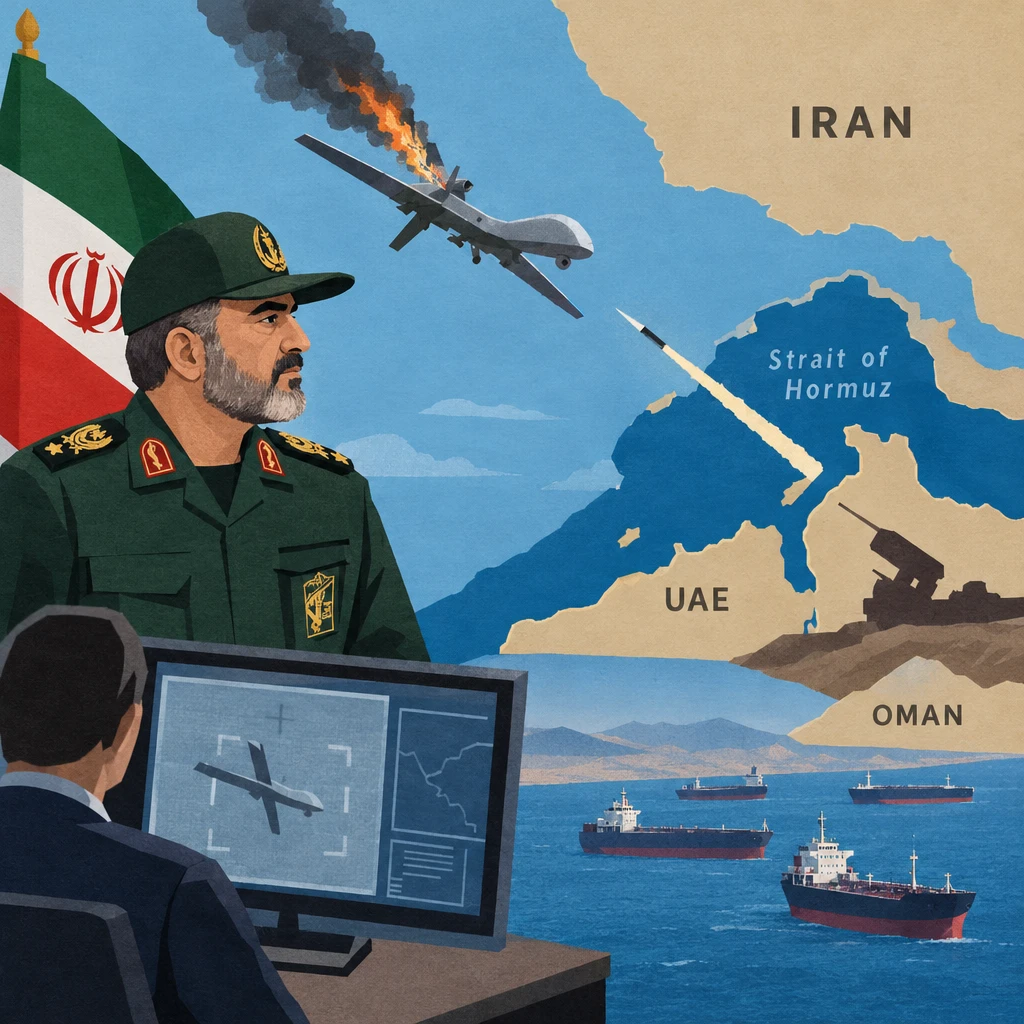
Iran’s Revolutionary Guard Corps (IRGC) claimed on Sunday that its air defences shot down a US MQ-1 type drone east of the Strait of Hormuz .
Every so often, a headline comes along that makes you reach for a map. This week’s came from Iran, which says its air defenses shot down a US MQ-1 drone east of the Strait of Hormuz. According to the Islamic Revolutionary Guard Corps (IRGC), it was the 20th such drone intercepted, and the fourth in just one day. The claim was reported by state media IRIB, and it has not been independently verified. So let’s slow down, unpack what’s being said, and look at why a story like this matters more than its short length suggests.
Start with the basics. The Strait of Hormuz is a narrow waterway that connects the Persian Gulf to the open ocean. It sits between Iran to the north and Oman and the United Arab Emirates to the south. A large share of the world’s seaborne oil passes through it, which is why almost anything that happens there gets attention from shipping companies, energy markets, and governments far from the water. When tensions rise in that corridor, the consequences ripple outward quickly.
Now, the drone. The MQ-1 is the Predator, a medium-altitude, long-endurance unmanned aircraft that the US used for surveillance and, in later years, for strike missions. It first entered service decades ago and has since been largely replaced by newer designs. It’s not exactly the cutting edge of military technology anymore, which makes it a slightly odd choice for a headline-grabbing shootdown. Still, older drones can be perfectly capable of flying over sensitive areas and collecting information, and that’s usually the point.
The IRGC’s statement is the key detail here, and it’s worth reading carefully. The claim is that Iranian air defenses downed the aircraft. The count, twenty drones in total with four in one day, suggests a pattern rather than a single incident. Patterns are interesting because they imply repeated activity in the same area. If that’s accurate, it would mean drones are regularly operating close to Iran’s airspace. If it’s exaggerated, it would mean a state is using a dramatic number to make a point. Either way, the number is doing a lot of work in the story.
And that’s where things get murky. The claim has not been independently verified. No outside party has confirmed the wreckage, the time, or the location, at least not in the reporting available. This is a common situation in regional military stories. Governments often announce successes quickly, sometimes before the facts are fully known, and sometimes because announcing a success serves a political purpose. Reading an official statement as a statement, rather than as settled fact, is good practice.
Iran also warned against violations of its airspace. That’s a standard message from a country that considers its skies to be its own. Nations generally take a dim view of foreign aircraft flying close to or inside their borders, and they tend to say so loudly. The warning fits a familiar script: a country asserts its sovereignty, signals that it is watching, and reminds everyone that it has the means to respond.
It’s easy to get lost in the drama, so here’s a simple way to think about it. There are three layers to any story like this. The first is what was claimed: a drone was shot down, and it was the twentieth. The second is what can be checked: the existence of the drone, its location, and whether it was actually destroyed. The third is what it means: how it affects relations between Iran and the United States, how it might influence shipping through the strait, and whether it signals an escalation or simply another routine incident. Most of the time, the first layer gets the headlines, the second gets quietly ignored, and the third gets argued about on cable news for days.
So what should a reader take away? First, keep your expectations calibrated. An official claim is information, but it is not proof. Second, pay attention to the numbers and the timing, because they reveal how a government wants to be perceived. Third, remember that a narrow strait with heavy oil traffic is a place where small events can have large effects.
Will this single claim change much on its own? Probably not. But stories like this add up. Each one nudges the broader tension a little higher or a little lower, and each one tests how carefully both sides communicate. The Strait of Hormuz has seen its share of confrontations over the years, and the people who work in and around it tend to prefer calm, predictable headlines to dramatic ones. Whether that happens here remains to be seen.
For now, the honest summary is this: Iran says it shot down a US drone, possibly its twentieth, possibly its fourth today, and nobody outside has confirmed it yet. Keep an eye on follow-up reporting, look for independent verification, and treat dramatic numbers with a healthy dose of skepticism. In the meantime, the sky over the Strait of Hormuz remains busy, and so does the news cycle that watches it.
Inspired by: “Iran claims it downed US MQ-1 drone near Hormuz” (r/World)