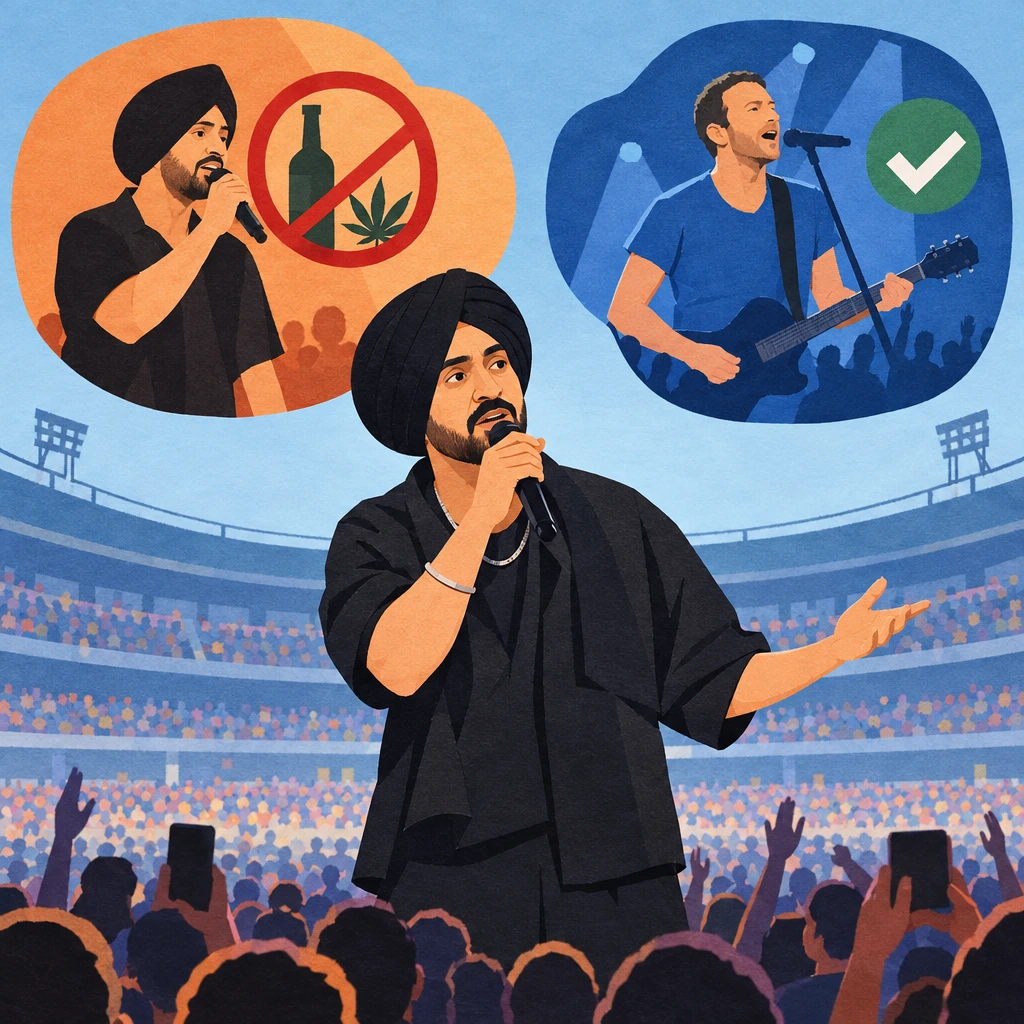
Singer Diljit Dosanjh took a swipe at the critics who had objected to some of his songs claiming that they promote alcohol and substance use .
If you’ve ever sung along to a song in the car and suddenly wondered whether the lyrics were allowed, you’re not alone. Singer Diljit Dosanjh has been asking that same question out loud, and he picked a pretty big stage to do it.
During a concert in Ahmedabad, India, Dosanjh criticized restrictions on his song lyrics that refer to alcohol and substance use. His complaint wasn’t just that the rules exist. It was that they seem to apply unevenly. He pointed to international acts like Coldplay, who were reportedly allowed to perform songs about getting drunk and high without the same kind of limits. In other words, the rulebook seemed to have a different chapter for visiting bands.
If you’re wondering why this stings, think about it from his side. Dosanjh is one of the biggest names in Punjabi music, and his songs reflect the stories, slang, and everyday life of the communities that made him famous. Drinking and partying show up in a lot of music across genres, from rock and pop to hip-hop and folk. Singling out one artist’s lyrics while another’s pass without comment naturally raises eyebrows. It’s the sort of thing that makes people say, ‘Wait, what exactly is the standard here?’
The performance itself added some extra drama. Dosanjh noted that the venue, Narendra Modi Stadium, is the world’s largest stadium. Whether you see that as a fun fact or a pointed reminder of how much attention the show was getting, it made the complaint hard to ignore. When you’re performing in front of a crowd that size, every line you sing is effectively being heard by tens of thousands of people at once, and that makes any restriction feel even more noticeable.
Coverage of the remarks ran in outlets including the Hindustan Times and Deccan Herald, both of which framed the story around his ‘double standards’ question. That framing is a big part of why it caught on. Calling something a double standard is a clever way of turning a rule into a fairness argument. Nobody wants to be the person defending unequal treatment, so the question lands with force even if the rules themselves are debated for other reasons.
Now, it’s worth being fair here. Rules about public performances, especially in large venues with broad audiences, often involve judgment calls, and those calls can look inconsistent from the outside. Different performers, different contexts, and different expectations can all shape how content is handled. That doesn’t automatically make the complaint wrong, but it does explain why these disputes are rarely simple.
Still, the core question Dosanjh raised is one that artists and audiences keep coming back to. If a song is acceptable when it comes from one performer, why should it become a problem when it comes from another? Creative freedom and cultural expectations don’t always line up neatly, and when they clash on a stage this visible, the conversation tends to spread quickly.
So where does this leave us? Probably with a more interesting debate than a simple yes or no. Dosanjh has put a sharp, easy-to-understand question on the table, and whether you think the rules are fair or not, it’s a question that deserves a real answer. For now, the most honest response might be the one he already gave: why the double standards?
Inspired by: “’Why the double standards?’: Diljit Dosanjh cites Coldplay to slam lyrics curb at Ahmedabad concert” (r/News)