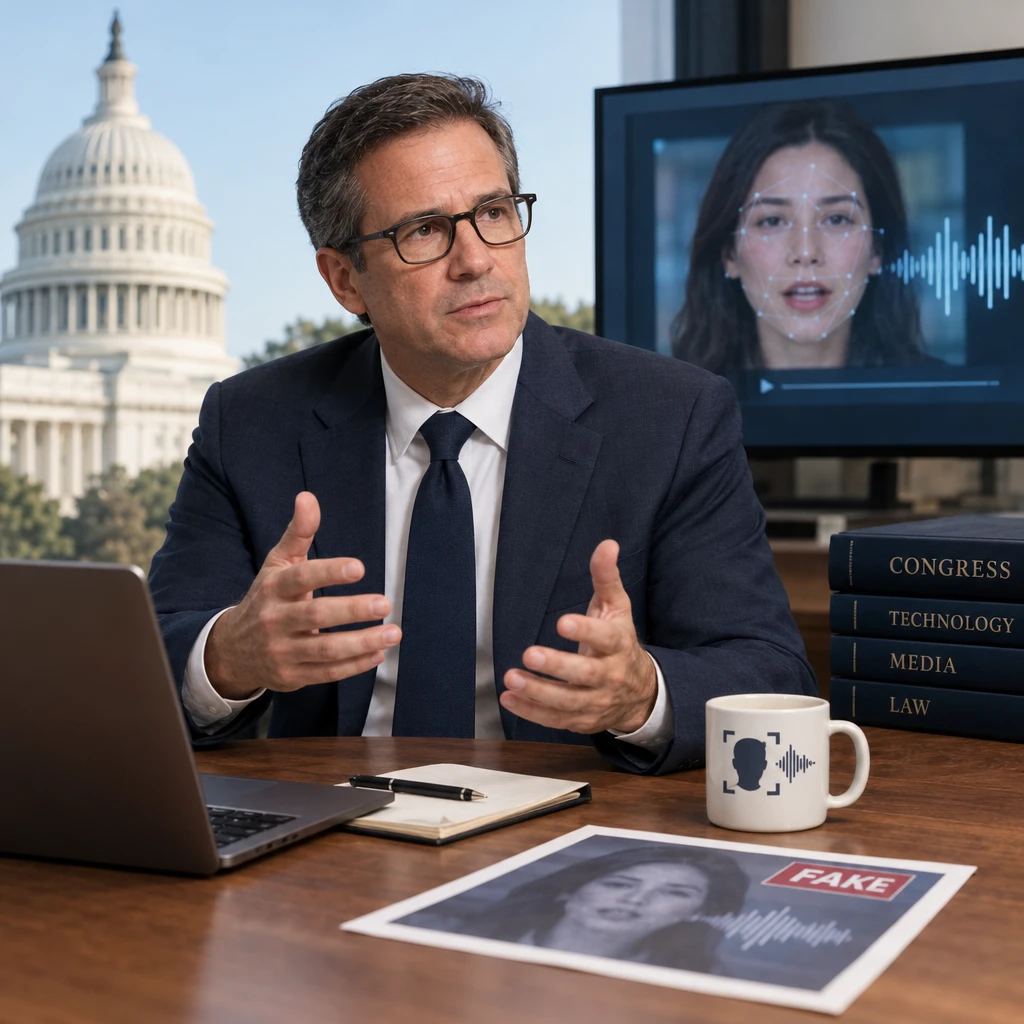
The No Fakes Act was approved unanimously by the Senate Judiciary Committee in June, and, Lourd contends, there "is momentum to pass it through the full Congress before the end of the year." He calles it "one of the few A.I. bills with true bipartisan support." Hollywood, Lourd writes, "is not afraid of new technology." "The objection from actors, musicians and other creators is to a world in which anyone can use their face or voice without permission," he writes.
Let’s start with a sentence that would have sounded like science fiction not long ago: somebody can now make a convincing video of you saying things you never said, and it can take less effort than making a sandwich. That’s the problem Creative Artists Agency CEO Bryan Lourd wants Congress to deal with, and he’s making the case loudly.
Lourd is pushing for passage of the NO FAKES Act, a bill aimed at unauthorized AI deepfakes. The idea is simple enough to fit on a bumper sticker: if someone wants to create a digital copy of your voice or likeness, you should get a say in it. The proposed legislation would set federal standards around control, consent, and compensation for these digital replicas. In other words, it’s about who gets to decide how your face and voice get used, and whether you get paid when they do.
The headline pitch is that this protects “famous or not.” That phrase matters. It’s easy to assume that AI cloning is a problem for movie stars, the people whose faces are on billboards and whose voices are on every podcast ad. Celebrities certainly have plenty to lose, and they have the lawyers and publicists to fight back. But the same technology that can fake a famous actor can also fake your aunt, your coworker, or the local news anchor who never asked to be in anyone’s experiment. Lourd’s argument is that everyday people deserve the same basic protection, and that they’re often the ones least equipped to chase down a fake after it spreads.
To be fair to the people writing these bills, the situation is messy. Existing protections for likeness vary from state to state, and they were largely written before anyone imagined software that could generate a realistic performance from a few seconds of audio. Trying to police AI-generated content with a patchwork of rules is a bit like trying to fix a leaky roof with a collection of umbrellas. A federal standard would create one consistent framework instead of a maze of different rules depending on where you live.
What gives the NO FAKES Act a fighting chance is that it isn’t a partisan project. The bill has advanced out of committee in the Senate and has bipartisan support, which in today’s Washington is roughly as rare as a quiet week on social media. The catch is that it still needs to get through the full Congress, and that’s where good intentions often go to die in a stack of other priorities. Anyone who has watched a bill sit in limbo knows that bipartisan support is a great start and a terrible finish line.
Lourd’s broader message, as reported across the entertainment press, is captured in a line that’s been widely quoted: “Every one of us should have the right to say no.” It’s a deceptively modest idea. Nobody is saying AI has to disappear. The argument is that consent should come before replication, not after the damage is done. If a company or a person wants to use your likeness to build a digital double, they should ask first and pay fairly. That’s not a radical position. It’s the kind of thing most people assume is already the law.
It’s also a reminder that the entertainment industry has been here before. Every major technological shift, from recordings to film to the internet, has forced creators and performers to fight over who owns their work and their image. AI simply speeds up the cycle and makes the stakes more personal. When a tool can clone a voice from a short clip pulled off a public video, the question stops being abstract very quickly.
So where does this leave us? The NO FAKES Act is still waiting for its moment before the full Congress, and nobody can yet say how it will look after all the negotiating. But the push from someone with Lourd’s profile signals that the conversation has moved beyond tech conferences and into the places where laws actually get written. Whether you’re a household name or someone who has never been on a stage, the basic principle is hard to argue with: your face and your voice belong to you, and you should have a real say in how they’re used.
Watch this space. If the bill passes, you may never think about it again, which is usually how the best protections work. If it stalls, expect to see a lot more very convincing videos of people saying things they never said, and a lot more people wishing somebody had just asked.
Inspired by: “CAA’s Bryan Lourd Urges Congress To Pass AI Legislation To Protect Americans “Famous Or Not”” (r/Entertainment)