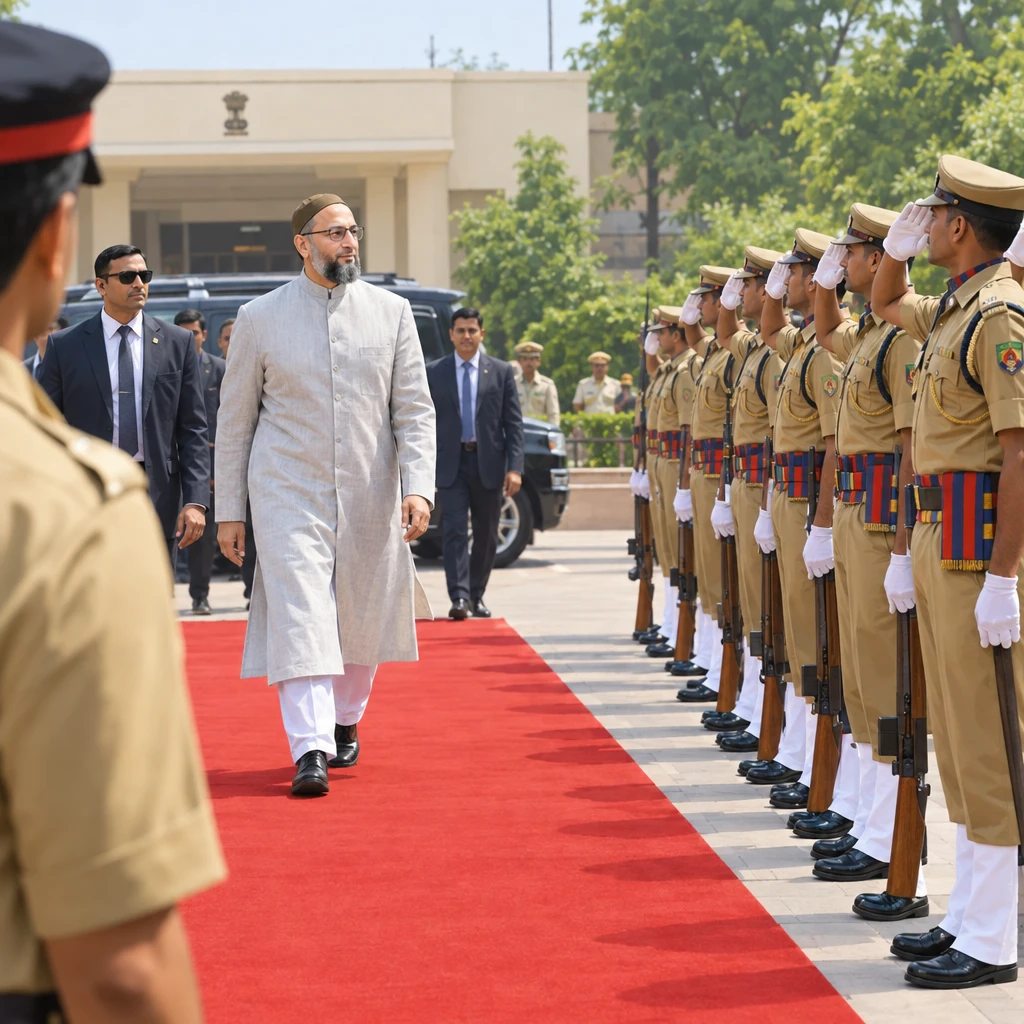
Saharanpur, Uttar Pradesh: AIMIM chief Asaduddin Owaisi was given a Guard of Honour at the Circuit House instead of a Supreme Court judge, who was supposed to receive it pic.twitter.com/osoxpkB8Gn— IANS (@ians_india) November 21, 2026 · Videos of the wrong welcome quickly went viral on social media, showing the police suddenly prepare themselves, and perform the ceremonial salute for the AIMIM leader.
Every so often, a news story comes along that makes you wonder whether anyone in the room was paying attention. This week’s example comes from Saharanpur, Uttar Pradesh, where police mistakenly gave a guard of honour to AIMIM chief Asaduddin Owaisi on Saturday. The salute was meant for a visiting Supreme Court judge.
Here is what reportedly happened. Owaisi arrived at the Circuit House before the judge was scheduled to arrive. Police personnel, apparently working from the assumption that the next important person through the gate would be the judge, accorded him the ceremonial salute. Somewhere between the arrival time and the drill, the wrong guest got the red carpet treatment. A probe has now been ordered into the protocol lapse.
It is easy to laugh at this, and honestly, a little bit of laughter is warranted. A guard of honour is not a casual gesture. It is a formal ceremony with a specific purpose, reserved for dignitaries in particular roles, and it comes with a choreographed routine that officers are expected to know by heart. The idea that a unit could line up and present arms to the wrong person suggests a breakdown somewhere in the chain of communication. Was the arrival schedule unclear? Did someone assume a car was carrying the judge? Did the people on the ground fail to confirm the identity of the guest before the salute began? These are the questions the probe will presumably try to answer.
It is also worth noting what a guard of honour actually signals. It is a public acknowledgment of rank and office. When it is given, it tells everyone watching who matters. When it is given to the wrong person, the message gets scrambled, and not just for the person who received it. The officers involved, the institution they represent and the judge who was supposed to be honoured all end up tangled in an awkward episode that nobody planned.
The reaction to such incidents tends to follow a familiar pattern. Some people treat it as a harmless blunder, the kind of mix-up that happens when schedules shift. Others see it as evidence of carelessness in official protocol, especially when the mistake involves a senior constitutional figure. Owaisi himself is a politically prominent and often controversial figure, so the episode also inevitably gets filtered through political lenses. Whatever one thinks of the man, the core issue here is not his politics. It is whether the state machinery can follow its own basic script.
The story was covered by several outlets, including News Hindustan Times, The Hindu and Deccan Herald, and their headlines reflect the tone of the coverage: “protocol lapse,” “mistakenly,” and, in one case, “gaffe.” Those words capture the situation neatly. Nobody was hurt, nothing dramatic happened, but the embarrassment is real.
So what should come out of the probe? Ideally, a clear account of how the confusion started and clear steps to prevent it from happening again. Simple measures, like confirming a visitor’s identity before a ceremony begins and keeping arrival timings tightly coordinated, would go a long way. Nobody expects police to be psychic, but they are expected to read the guest list.
In the meantime, Saharanpur will likely be remembered for a salute that went to the wrong person. It is a small story, but it is a useful reminder that in public life, even the smallest details can carry a surprisingly large amount of meaning. Next time, perhaps someone should check the name tag before the trumpets start.
Inspired by: “Protocol lapse: Owaisi gets guard of honour meant for SC judge in Saharanpur; probe ordered” (r/News)