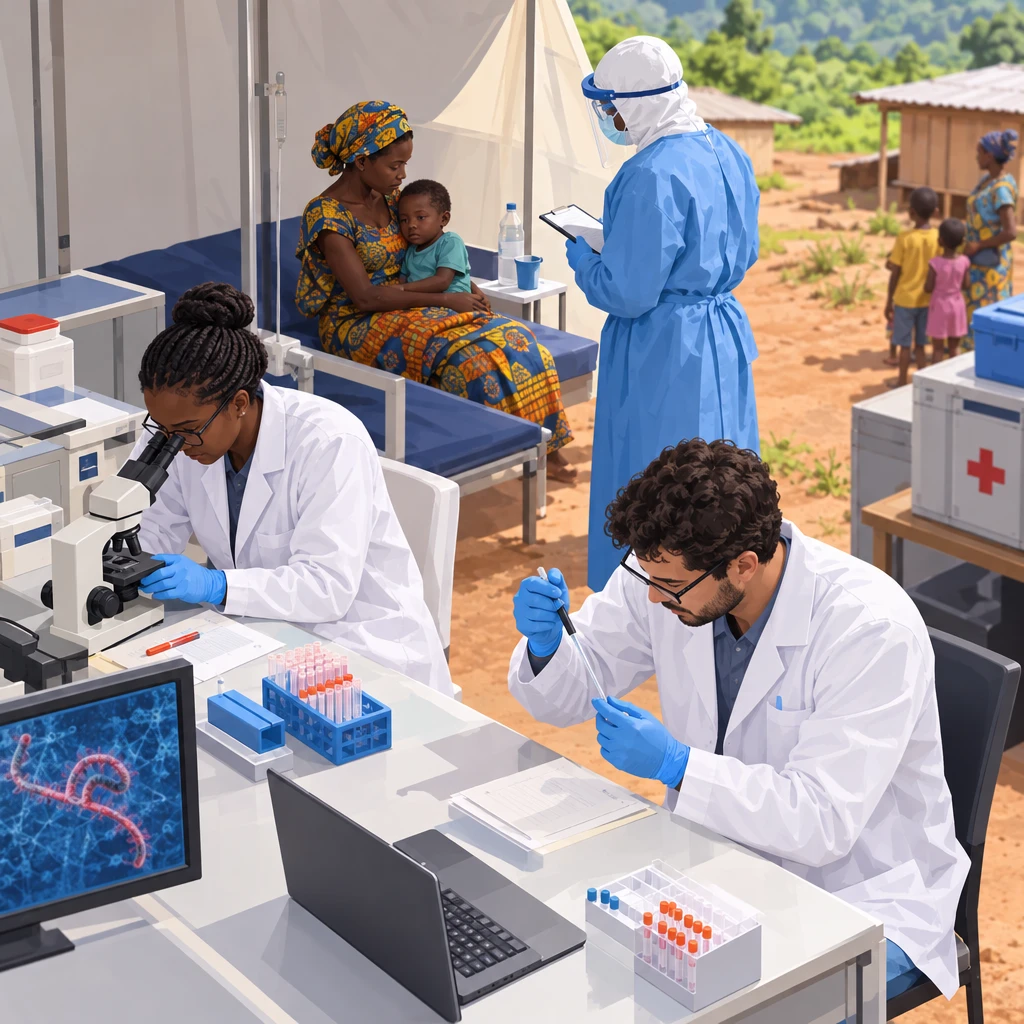
Children are being disproportionately affected by a deadly Ebola outbreak in the Democratic Republic of Congo, with around seven in 10 infected under-fives dying as scientists race to understand a rare strain of the virus.
Nobody wakes up hoping for a public health crisis to make the morning news, but every so often the world gets a reminder that viruses don’t care about our schedules. The current Ebola outbreak in the Democratic Republic of Congo is one of those reminders, and it’s a sobering one.
According to reporting from several outlets, including The Independent, The Straits Times, and SRN News, the outbreak has resulted in more than 11,000 cases and over 5,500 deaths. Those numbers are hard to hold in your head for very long. Each one represents a person, and often a family, a neighborhood, or a community that is now dealing with the loss.
What makes this outbreak stand out is the strain. It is caused by the Bundibugyo virus, which is one of the less common species of Ebola. That rarity is part of the problem. Scientists have studied Ebola for decades, but much of that research has centered on other strains, so there is less existing knowledge about Bundibugyo specifically. Researchers are now working to understand how it behaves, how it spreads, and what kinds of tools might be effective against it. Anyone who has spent time in a science classroom knows that studying the unfamiliar is slow, careful work, and that’s exactly what is happening here.
The speed of the spread is another major concern. Reports indicate the virus is moving at roughly double the pace of a previous major Ebola outbreak. That kind of acceleration puts enormous strain on health workers, hospitals, and supply chains, especially in a region where resources are already stretched. When cases climb faster than response efforts can keep up, every day counts, and every gap in testing, isolation, or treatment can allow the virus to move further.
Perhaps the most heartbreaking detail is who is being hit hardest. Children under five are being affected disproportionately, and their fatality rate is significantly higher than that of adults. Young children are especially vulnerable to dehydration and infections, and they depend entirely on caregivers who may themselves be at risk. When a child falls ill, a whole household often becomes involved in caregiving, which can increase exposure and spread. It is a painful reminder that the most vulnerable members of any community tend to suffer first and most.
This is where the work of scientists and health responders becomes so important. Understanding why young children are more severely affected could help shape better clinical care, from supportive treatment such as rehydration to more targeted medical interventions. Learning more about the virus’s transmission patterns can help public health teams decide where to focus testing, contact tracing, and community education. None of this is glamorous, and none of it happens overnight, but it is the kind of groundwork that saves lives.
There is also a broader lesson here about preparedness. Rare pathogens tend to get less funding and attention until they show up in a headline. By the time an outbreak is large enough to draw global notice, the response is already playing catch-up. Investing in research on less common strains, maintaining reliable health systems, and supporting local responders in affected regions are not luxuries. They are the difference between reacting to a crisis and getting ahead of one.
It would be easy to feel helpless reading numbers like these, and a little bit of sarcasm about the state of the world is understandable. But it’s worth remembering that behind every statistic are scientists running experiments, nurses working long shifts in protective gear, and families trying to care for sick children with limited resources. Staying informed, supporting credible health organizations, and paying attention to the stories of the people most affected are small but meaningful steps.
The outbreak in Congo is far from over, and the science is still catching up. What is clear is that the children are paying the highest price, and the people working to understand this virus deserve both our attention and our support.
Inspired by: “Children hit hardest as scientists race to understand rare Ebola outbreak” (r/News)