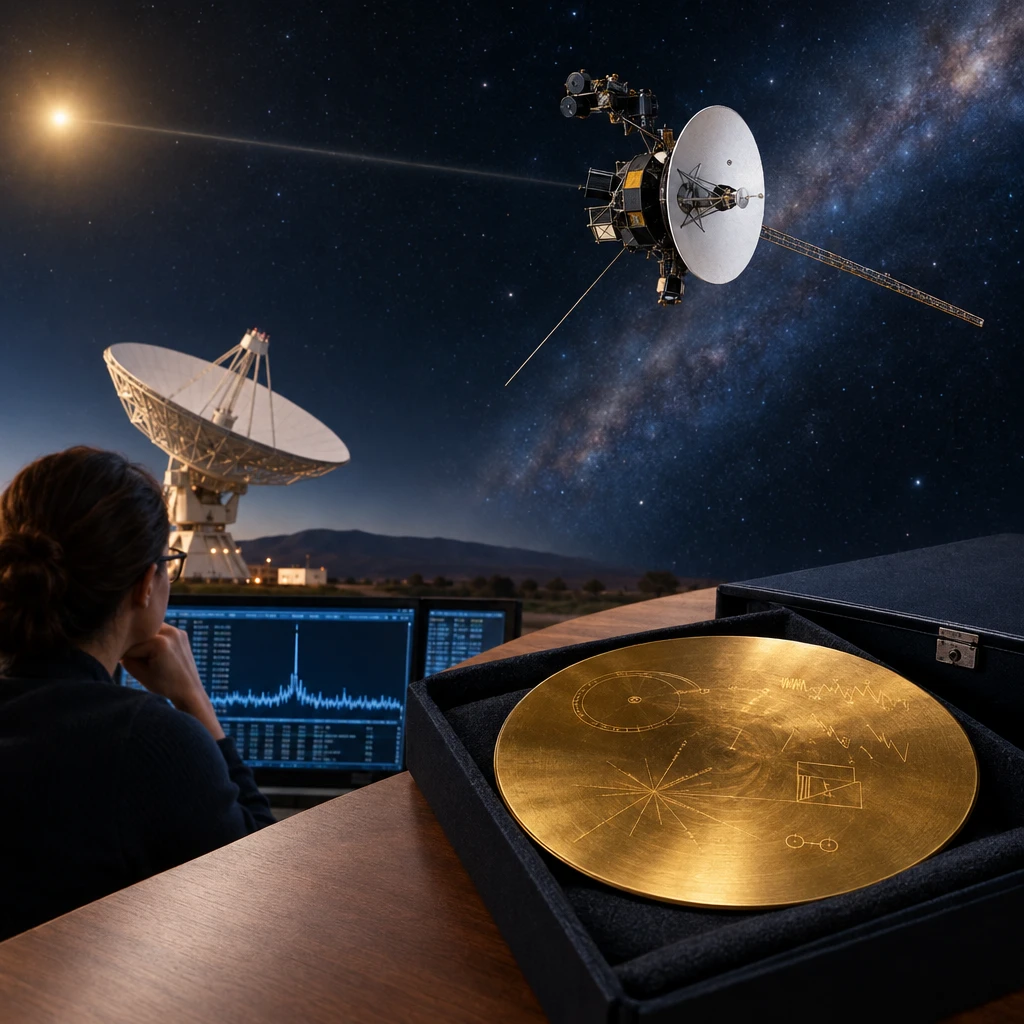
On November 18, Voyager 1 will reach one light-day from Earth . It’s still finding surprises in interstellar space.
Let’s start with a number that’s hard to wrap your head around. NASA’s Voyager 1 probe, humanity’s farthest-flying spacecraft, has now reached one light-day from Earth. That’s the distance light covers in 24 hours, which works out to roughly 16.1 billion miles, or about 25.9 billion kilometers.
For a sense of scale, sunlight takes about eight minutes to reach us. Voyager 1 is so far away that a radio signal sent from Earth takes a full day to get there, and the reply takes another day to come back. So if you ask the probe a question on Monday, you might not hear back until Wednesday. Most of us have had group chats that moved faster than that.
The milestone was reached at 2:16 a.m. PST (5:16 a.m. EST) on Nov. 18. Nobody at mission control was throwing a party at that hour, but the achievement is still a big deal. The Voyager team has been keeping this machine alive for decades, and reaching this distance is a sign of how far the mission has come since its launch.
A Trip That Started in 1977
Voyager 1 launched in September 1977, which means it has been traveling for more than 49 years. That’s a remarkable run for any machine, let alone one built with 1970s technology. Your phone has more computing power than the probe’s onboard systems, and it still manages to feel slow when you’re trying to load a single web page. Voyager has been quietly doing its job the whole time.
The probe’s original mission was a flyby of Jupiter and Saturn. It did that job spectacularly, sending back images and data that changed how scientists understood those planets and their moons. Then it kept going. Voyager 1 eventually crossed into interstellar space, the region beyond the influence of the Sun’s solar wind, and it has been sending back data from there ever since.
Why a Light-Day Matters
A light-day is a neat way to describe distance because it turns an abstract number into something you can picture, even if you can’t really picture 16 billion miles. It also highlights a practical challenge. The farther a spacecraft travels, the weaker its signal becomes by the time it reaches Earth. Engineers at NASA’s Jet Propulsion Laboratory have to pick up whispers from a machine that is extraordinarily far away, using large antennas on the ground.
That’s why every milestone like this one is worth noting. It tells us the spacecraft is still communicating, and that the people operating it are still finding ways to make the most of what’s left.
The Catch: Power Is Running Out
Here’s where the story gets a little bittersweet. Voyager 1 runs on radioisotope thermoelectric generators, which convert heat from the decay of plutonium into electricity. Those generators weaken over time, so the spacecraft has to be managed carefully. Over the years, engineers have shut down instruments one by one to conserve power, deciding which systems matter most and which can be switched off.
So while reaching one light-day is a triumph, it also serves as a reminder that the mission won’t last forever. Every instrument still working is a bonus, and every year of data is something to appreciate.
Still Carrying a Message
Voyager 1 also carries the Golden Record, a gold-plated disc with sounds, images, and greetings meant for any intelligent life that might find it someday. It’s a charming and slightly optimistic gesture. Whether anyone out there ever plays it is a question nobody can answer yet. Still, it’s hard not to smile at the idea that a 1970s spacecraft is carrying a sort of time capsule into the dark.
Why It Still Feels Worth Caring About
It’s easy to scroll past headlines about spacecraft milestones, especially when the news cycle is full of noise. But Voyager 1 is a rare example of a project that has kept working far longer than anyone expected. Its engineers built something durable, and the people who have operated it over nearly half a century deserve real credit for keeping it talking.
So the next time you feel stuck in traffic or annoyed that your Wi-Fi dropped, consider the probe that is now a full light-day away, still sending data home, and still doing its job without complaint. It has more patience than most of us, and that’s something to admire.
Inspired by: “NASA’s Voyager 1 Makes History Reaching One Light-Day From Earth” (r/Science)