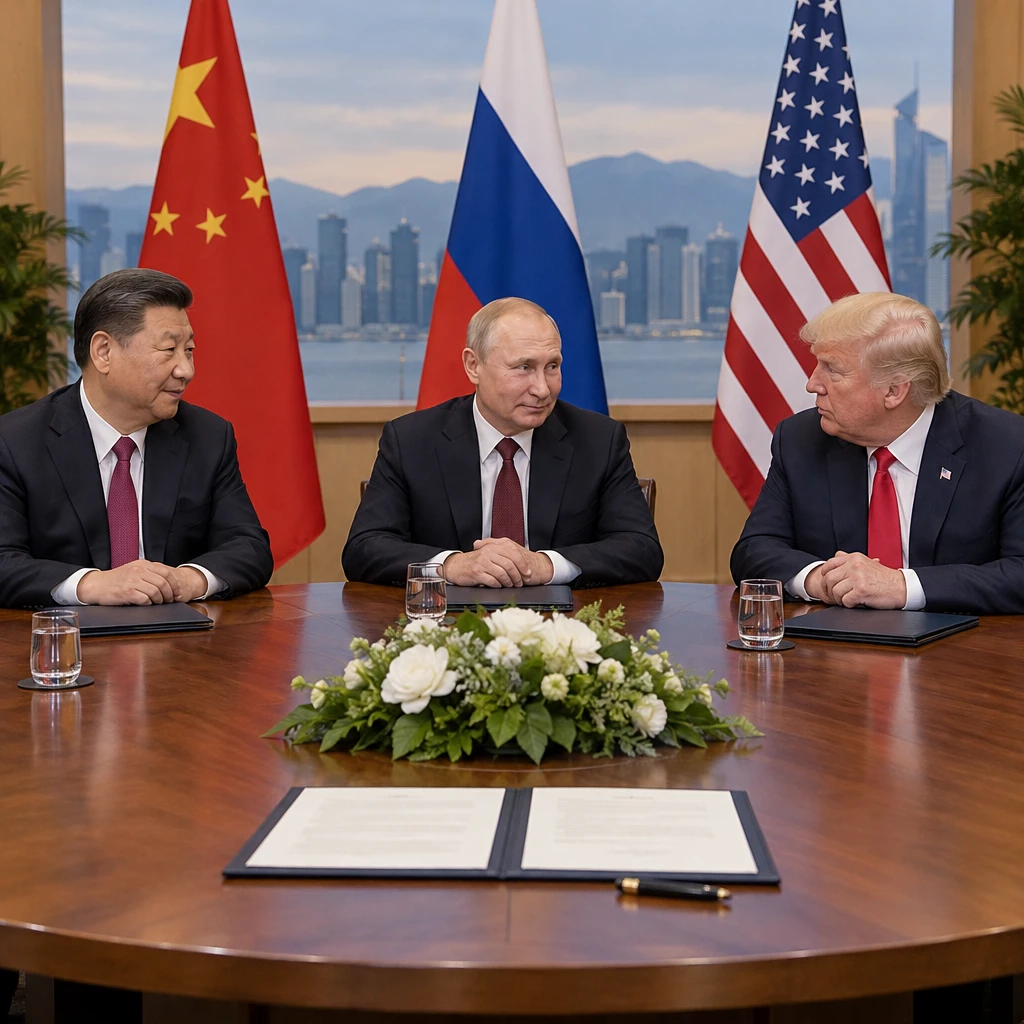
China's Xi Jinping, Russian President Vladimir Putin and his US counterpart Donald Trump met for a historic summit in Shenzhen, China, on Thursday, where they agreed on a "peace declaration". The thre…
Every so often, three of the world’s most powerful leaders end up in the same room, and everyone else holds their breath. That’s what happened in Shenzhen on Thursday, when Chinese President Xi Jinping, Russian President Vladimir Putin, and U.S. President Donald Trump met for a summit that multiple outlets have already called historic. Whether it lives up to that label is a question for later, but the headlines have been impossible to miss.
The centerpiece of the meeting is a document called the ‘Declaration toward Peace.’ Its most eye-catching line is a simple one: a nuclear war cannot be won and must never be fought. You would hope that’s a given among world leaders, but in a period when nuclear weapons still sit at the center of global security debates, it’s worth saying out loud, and saying it together is a bit more notable than a solo statement from one capital.
Beyond that core message, the declaration reportedly commits the three leaders to strengthening global security, reforming international institutions, and discussing ways to reduce nuclear risks. Those are broad goals, and broad goals are easy to sign. Anyone who has sat through a long diplomatic communique knows that the real test is what happens next. Promises like these tend to get judged by follow-through, not by the photo op.
The summit also drew attention because of who was sitting at the table. Relations between these three countries have been rocky for years, marked by trade fights, military tensions, and plenty of public sniping. So a joint document, even a fairly general one, gets read closely. Supporters will see it as a sign that dialogue is still possible at the highest level. Skeptics will point out that a statement about peace is not the same thing as peace, and that words on paper don’t stop a missile.
It’s also worth noting how quickly the story spread. Coverage appeared across a wide range of outlets, from Chinese state-linked English-language media and Russian channel RT to Al Monitor, The National, Times of India, Anadolu Agency, Korea Herald, and France 24. Some outlets published the full text of the declaration, while others focused on the most headline-friendly parts. If you want the actual wording rather than someone else’s summary, the full texts are the place to look, and it’s a good habit to read the primary document before deciding what it means.
So what should you take away from all this? First, the declaration is a meaningful signal that the three leaders are at least willing to agree on the basic idea that nuclear war is a catastrophe with no winners. Second, the commitments on security, institutions, and nuclear risk are a starting point rather than a finished plan. Third, the real story will be told over the coming months, in whether talks continue, whether concrete steps follow, and whether anyone bothers to check the promises against reality.
None of this means you should expect world peace by next week. Diplomacy at this level moves slowly, and declarations are often more about setting a tone than solving problems. Still, after a year of headlines that mostly sounded like threats, a summit that ends with a document about peace is at least a change of pace. Cautious optimism seems like the right mood, with a healthy dose of ‘we’ll see.’
Inspired by: “What to know about Xi, Putin and Trump’s historic trilateral summit” (r/World)