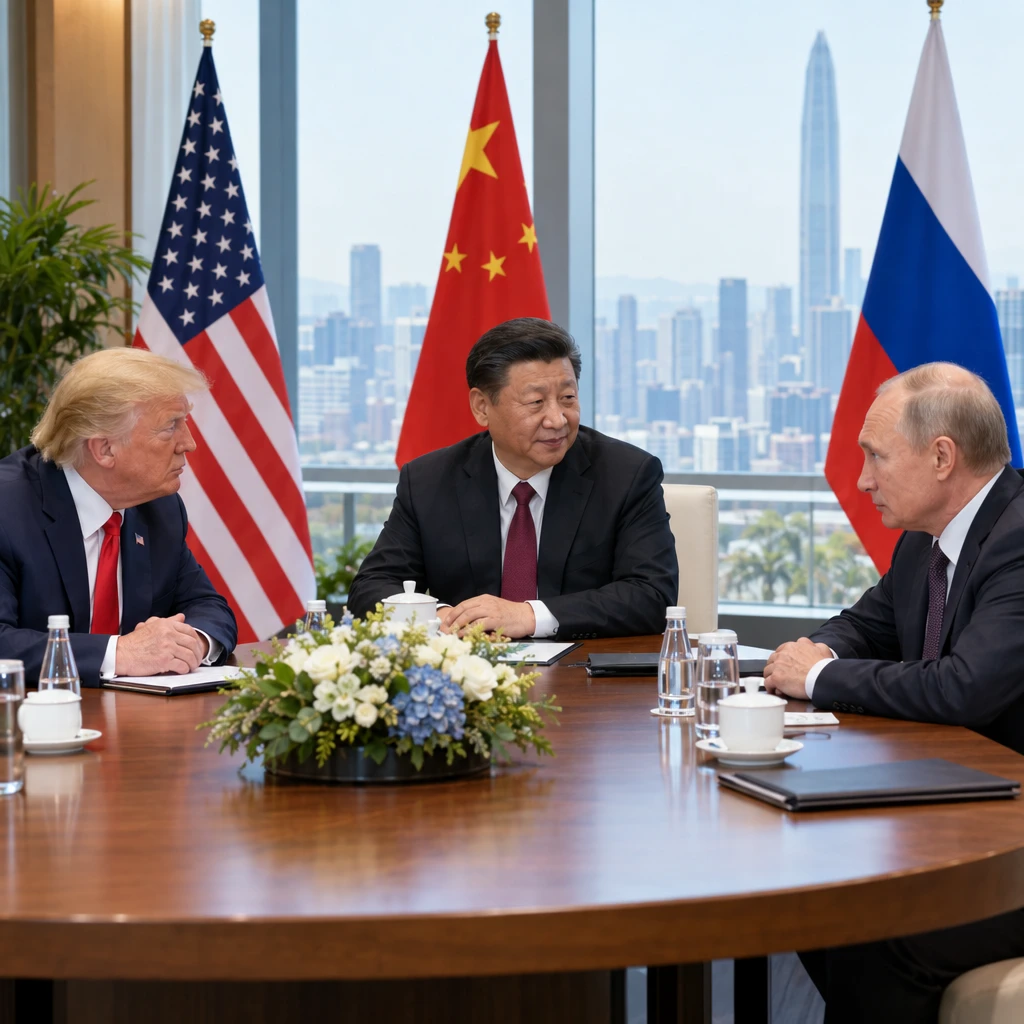
Trump, who will test his reputation … two of America's leading rivals — as a chance to hash out rules for controlling nuclear arms and to start resolving the wars in Ukraine and Iran ….
Every so often, world leaders gather in one place with a long list of problems and a short list of solutions. This time, the setting was Shenzhen, China, where President Donald Trump sat down with Chinese leader Xi Jinping and Russian President Vladimir Putin. If that sounds like the opening line of a bad joke, you are not alone. But the agenda was serious, and the stakes are high.
According to reports, Trump promoted the meeting as a chance to talk about controlling nuclear arms and resolving two conflicts: the war in Ukraine and the tensions involving Iran. Those are heavy topics to pack into one conversation, and they are not exactly the kind of issues that get settled over a quick photo op.
The meeting took place during the Asia-Pacific Economic Cooperation (APEC) summit, a regional forum that usually focuses on trade, economic growth, and cooperation across the Asia-Pacific. Having a US-China-Russia discussion on the sidelines of an economic summit is a little like discussing your home renovation at a book club. It is not the official purpose of the gathering, but everyone is in the room anyway, so why not?
Why does nuclear arms control matter so much? The United States, Russia, and China are the world’s largest nuclear powers. Arms control agreements, the rules and limits that countries agree to follow so they do not build up dangerous stockpiles, have been a central part of global security for decades. In recent years, many of those agreements have weakened or fallen apart, and new ones have been hard to negotiate. Bringing the three powers together at least signals that someone is willing to talk, which is more than can be said for some of the alternatives.
The Ukraine war has been one of the defining conflicts of the past several years, with massive human costs and a deep rift between Russia and Western countries. Any discussion that includes Putin inevitably raises questions about whether Russia is ready to change course. The Iran situation adds another layer, touching on regional security in the Middle East and the broader question of how nuclear programs are monitored and limited.
So did they solve everything? Almost certainly not. Experts quoted in coverage of the meeting anticipated only limited progress, which is diplomat-speak for ‘do not expect fireworks.’ Summits like this often produce statements about wanting peace, agreeing to keep talking, or setting up future working groups. Those steps can matter, but they rarely end wars or dismantle arsenals overnight.
Still, there is something to be said for leaders choosing to meet rather than shout at each other from a distance. Diplomacy is slow, frustrating, and often underwhelming, which is exactly why it is so easy to dismiss. Yet it remains one of the few tools that can keep a bad situation from getting worse.
The bigger takeaway is this: the world’s most powerful governments are still willing to sit at the same table, even when they disagree on almost everything. Whether that leads to real progress on nuclear arms or on the wars in Ukraine and Iran remains to be seen. For now, the summit is a reminder that high-stakes diplomacy happens in unlikely places, sometimes between the economic panels and the coffee breaks, and that the outcome will matter far beyond the meeting room.
Inspired by: “Trump meets Xi and Putin in China with nuclear arms and two wars on the table” (r/News)