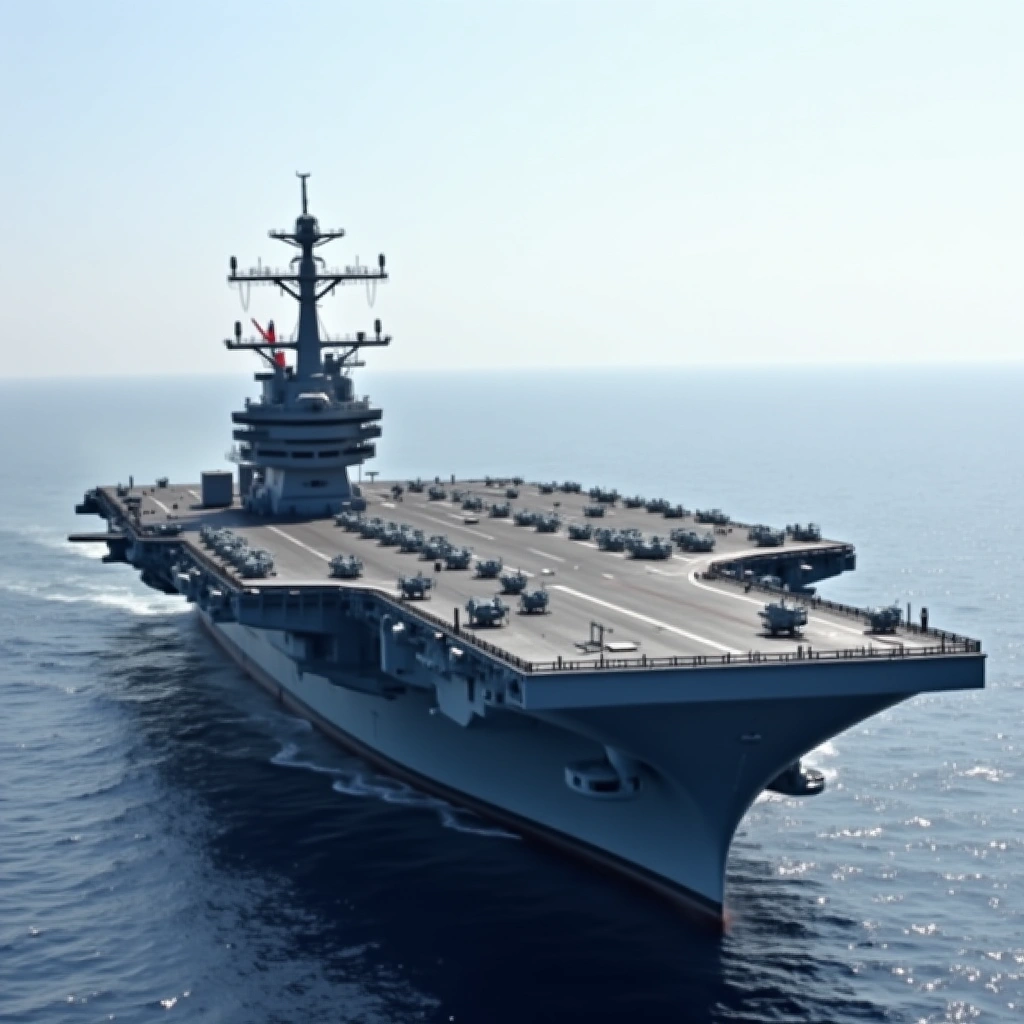
The US military is moving roughly 9,000 troops aboard a group of ships, including the USS Theodore Roosevelt aircraft carrier, to the Middle East. The deployment could mean three carriers will be in the Middle East as early as the end of October .
Some people collect stamps. Some people collect vintage vinyl. The United States, apparently, collects aircraft carriers in the Middle East, and as of Sunday the set has grown to three.
According to multiple reports, the USS Theodore Roosevelt has arrived in the U.S. Central Command (CENTCOM) area of responsibility. It joins the USS George Washington and the USS George H.W. Bush, which were already operating there. That puts three American aircraft carrier strike groups in the region at the same time, during a period of heightened tensions with Iran.
The arrival was reported by the Hindustan Times, The National, and the Jerusalem Post. The Jerusalem Post added another layer: the deployment comes as President Trump heads to China for talks with Chinese President Xi Jinping and Russian President Vladimir Putin. So we have floating airbases on one side of the map and high-stakes diplomacy on the other. It’s quite the week.
First, What Exactly Just Showed Up?
It’s worth clarifying what “a carrier arrived” means, because it isn’t one boat cruising into port and waving at the locals.
An aircraft carrier strike group is a package deal. At its center is the carrier, a ship big enough to launch and recover fighter jets at sea. Around it are escort warships and support vessels, plus the air wing of aircraft and crews that make the carrier useful. When reports say there are now three carrier strike groups in the region, they mean three of these full packages, not three lonely ships.
For scale: many countries would love to have even one operational carrier. Having three in a single region at once is the naval version of showing up to a potluck with three entire turkeys.
Meet the Trio
The three carriers involved are:
– USS Theodore Roosevelt, the newest arrival, which entered the CENTCOM area on Sunday.
– USS George Washington, already operating in the region.
– USS George H.W. Bush, also already there.
That’s two presidents named George and one Teddy. If the Navy ever needed a group name, “The Presidents’ Club” is available. Probably.
What Is CENTCOM, and Why Does It Keep Coming Up?
CENTCOM, or U.S. Central Command, is one of the military’s geographic combatant commands. It’s responsible for U.S. military operations across a large part of the world that includes the Middle East. When a ship “enters the CENTCOM area of responsibility,” it has moved into the zone that command oversees.
For most people this sounds like an administrative detail. In practice, it’s often the line news outlets watch, because it marks when military assets officially become part of the regional picture.
Why Three, and Why Now?
The reports frame the deployment against heightened tensions with Iran. The sources don’t lay out a detailed official explanation for the move, so it’s worth being careful not to read tea leaves too aggressively. Still, you don’t need a defense degree to see that stationing three carrier strike groups in one region sends a message.
Carriers are among the most visible tools a country has for projecting military presence. They can stay at sea for long stretches, they carry substantial air power, and everyone can see where they are. A carrier is less a whisper and more a megaphone.
So when the count goes from two to three, governments, analysts, and anxious observers all notice. That’s sort of the point.
Meanwhile, Over in Diplomacy Land
The timing is part of what makes this story interesting. As the Theodore Roosevelt was reaching the region, President Trump was preparing for talks with Chinese and Russian leaders, with the Jerusalem Post reporting that he was heading to China for meetings with Xi and Putin.
It’s tempting to draw a direct line between the two, as if someone planned the carrier’s arrival to coincide with the summit for maximum dramatic effect. The reports don’t say that, so let’s not pretend they do. What we can say is that both things are happening at the same time, and that pairing military visibility with diplomatic engagement is a well-worn pattern in international affairs. Talk softly and park three very large ships nearby, to loosely paraphrase the guy one of these carriers is named after.
It also makes this a good moment to remember that geopolitics isn’t a single-player game. Developments in the Middle East, talks among major powers, and military deployments all affect one another, even when official statements keep them in separate boxes.
What This Doesn’t Mean (Probably)
Whenever a headline mentions aircraft carriers and tensions in the same sentence, some corners of the internet decide the sky is falling. Let’s dial it back.
Based on the reports, three carrier strike groups are now in the region during a tense period. That’s notable and worth paying attention to. But a deployment is not a declaration of anything by itself. Militaries move assets for deterrence, reassurance, readiness, and signaling, and sometimes for all of those at once. Treating every naval movement as the opening scene of a disaster movie is great for clicks and bad for understanding.
The reasonable takeaway: the U.S. has significantly increased its naval presence in the Middle East while tensions with Iran remain high and while major diplomatic talks are underway elsewhere. That’s already a big story without adding anything to it.
Why Regular People Might Care
If you’re not a defense analyst, it’s fair to ask why any of this should matter to you. A few reasons:
– Regional stability matters globally. What happens in the Middle East tends to ripple outward, affecting economics, travel, and international relations.
– Military posture shapes diplomacy. The presence of major naval forces can influence how negotiations go, both in the region and among the major powers involved in talks.
– It’s a signal worth reading. Governments use deployments like this to communicate. Even if you aren’t the intended audience, it helps to know a message is being sent.
The Bottom Line
The USS Theodore Roosevelt’s arrival in CENTCOM’s area of responsibility means three American aircraft carrier strike groups are now operating in the Middle East, alongside the USS George Washington and the USS George H.W. Bush. It comes amid heightened tensions with Iran and as President Trump moves toward talks with the leaders of China and Russia.
What happens next is anyone’s guess, and those guesses are best left to people with access to more than three news reports. For now, the situation is simple to summarize and complicated to interpret: the U.S. now has three very large, very visible floating airfields in one of the world’s most closely watched regions, and everyone involved is paying attention.
We’ll be watching too, from a safe distance, without an air wing.
Inspired by: “Third US aircraft carrier arrives in Middle East amid Iran tensions: Report” (r/News)