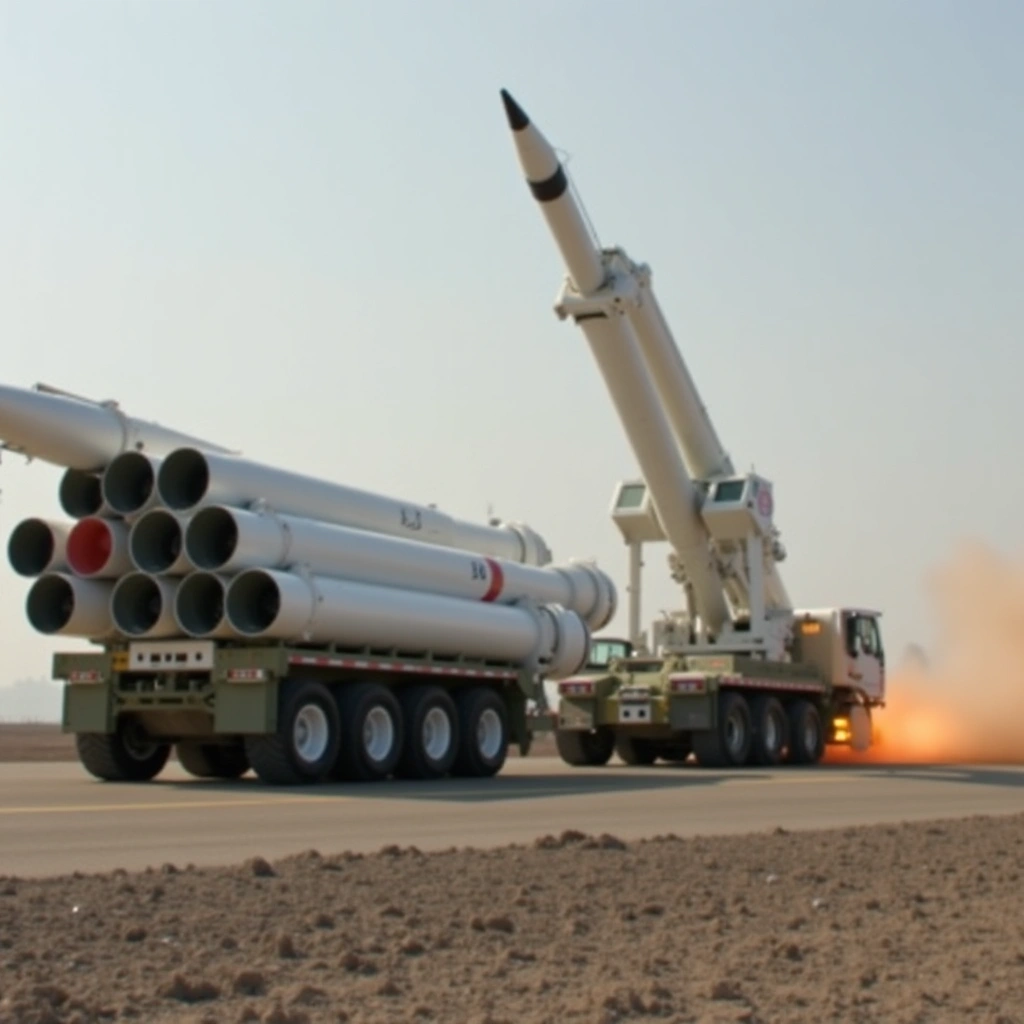
Iran may have between 1,500 and 2,500 missiles left in its arsenal , according to a US intelligence assessment.
There is a particular kind of news headline that makes you sit up and pay attention, and then makes you squint. “Iran rebuilds missile arsenal, intelligence estimates up to 2,500 missiles” is one of those. The first part sounds alarming. The second part sounds precise. Then you read the fine print and learn the people behind the number are not especially confident in it.
Let’s walk through what was actually reported, what it means, and why a range of “somewhere between 1,500 and 2,500” deserves both your attention and your skepticism.
What Was Reported
According to The Wall Street Journal, which cited American officials, US intelligence agencies estimate that Iran currently has between 1,500 and 2,500 missiles in its arsenal. The story was picked up by Israel Hayom and the Jerusalem Post. The Jerusalem Post framed it this way: Iran still has up to 2,500 missiles and could mount a major assault even after rounds of strikes.
The core takeaway from the assessment is that Tehran keeps significant capacity to strike US and allied targets if full-scale war resumes.
The officials also added a caveat that matters a lot: the estimate carries a low degree of confidence.
So, to summarize: there could be a lot of missiles. There could be a lot of missiles plus another thousand. And the analysts would like you to know they are not betting the house on either number.
About That 1,000-Missile Gap
A range of 1,500 to 2,500 is wide. The upper figure is about 67 percent higher than the lower one. If your mechanic told you a repair would cost somewhere between $1,500 and $2,500, you would at least ask a follow-up question.
In intelligence work, though, a wide range is often a sign of honesty, not sloppiness. Counting another country’s weapons is hard, especially when that country has every reason to hide them, scatter them, store them underground, or make it difficult to tell what is a real launcher and what is a decoy. Analysts work from satellite imagery, intercepted communications, human sources, and assumptions about production rates. Each one of those carries uncertainty, and the uncertainty adds up.
When officials give you a range instead of one tidy number, they are telling you how much they don’t know. That is more useful than false precision, even if it makes for a less satisfying headline.
What “Low Confidence” Actually Means
“Low confidence” may be the most important phrase in the whole report, and it’s the one most likely to get skipped by anyone skimming headlines.
In intelligence assessments, confidence levels describe how solid the underlying information is. Low confidence generally means the sources are thin, fragmentary, hard to corroborate, or open to more than one interpretation. It does not mean the estimate is wrong. It means the people making it are telling you plainly that it could be.
The original report notes that the low confidence stems from specific factors, though the excerpt available here cuts off before spelling them out. I’m not going to fill in that blank with guesses, because guessing about missile counts is precisely the activity everyone in this story is trying to do carefully.
What we can say is this: a low-confidence estimate is a starting point for planning and debate. It is not a verified inventory.
The “Rebuilds” Part of the Story
The Israel Hayom headline says Iran “rebuilds” its missile arsenal, and the Jerusalem Post says Iran still has this capacity “even after rounds of strikes.” Together those phrases point to the bigger concern. Military pressure hasn’t simply erased Iran’s missile capability, and Tehran appears to keep enough to pose a serious threat.
This is the part defense planners care about most. The total number matters, but so does the question of whether a capability can be degraded and then partly restored. If strikes reduce an arsenal only for a while, the long-term picture looks very different from one where damage sticks.
The reporting also frames the assessment around the scenario of “full-scale war” resuming. That wording tells you the concern isn’t abstract. Officials are weighing what Iran could do if hostilities escalate again, and against whom: US and allied targets.
Why Missile Counts Matter (and Why They Don’t Tell the Whole Story)
A headline number is easy to grasp, so it gets the spotlight. But the number of missiles is only one part of a much bigger picture. Analysts also look at things like:
– How many launchers are available to fire them
– What range and accuracy the missiles have
– How quickly they can be launched and reloaded
– How well defensive systems can intercept them
– Whether production can continue under pressure
The reports summarized here don’t break the estimate down along those lines, so I won’t pretend they do. The point is simply that “2,500 missiles” and “2,500 usable missiles that can all be launched at once” are not automatically the same sentence. The first is an inventory question. The second is an operational one.
Still, the officials’ overall conclusion is clear enough: whatever the exact count, it’s large enough to represent significant strike capacity.
How This News Traveled
It’s worth noticing the path this information took to reach you. American officials briefed or spoke to The Wall Street Journal. The Journal reported it. Israel Hayom and the Jerusalem Post then reported on the Journal’s reporting. Now you’re reading a blog post about those reports. We are several layers removed from whatever spreadsheet sits on a desk somewhere in the US intelligence community.
None of that makes the story untrue. It does mean the useful details, like the confidence level and the width of the range, tend to get trimmed as a story moves along. Headlines love “up to 2,500.” They are much less fond of “low confidence,” which nobody has ever clicked on out of excitement.
So What Should You Take Away From This?
Here’s the sensible reading:
1. US intelligence believes Iran still has a substantial missile arsenal, likely somewhere in the 1,500 to 2,500 range.
2. That capacity could be used against US and allied targets if full-scale war resumes.
3. Previous strikes have not eliminated the threat, according to the way both outlets characterized the assessment.
4. The estimate is explicitly low confidence, meaning the real figure could fall outside that range, and the officials themselves are flagging that uncertainty.
The less sensible reading would be to treat “2,500” as a precise, confirmed count, or to wave off the whole thing because the estimate is uncertain. Uncertainty cuts both ways. A low-confidence estimate could be too high, or it could be too low.
Final Thoughts
There’s something oddly reassuring about intelligence officials saying, in effect, “Here’s our best guess, and please don’t hold us to it.” In an era of loud certainty about everything, a carefully hedged assessment is almost refreshing.
It’s also a reminder that the scariest number in a headline is rarely the whole story. The full picture here is a large, uncertain arsenal, a capability that has apparently survived rounds of strikes, and a lot of people trying very hard to count things that are designed not to be counted.
We’ll find out more as further reporting emerges. Until then, the honest answer to “How many missiles does Iran have?” appears to be: “A lot. Probably. We think.”
Inspired by: “Iran rebuilds missile arsenal, intelligence estimates up to 2,500 missiles” (r/World)