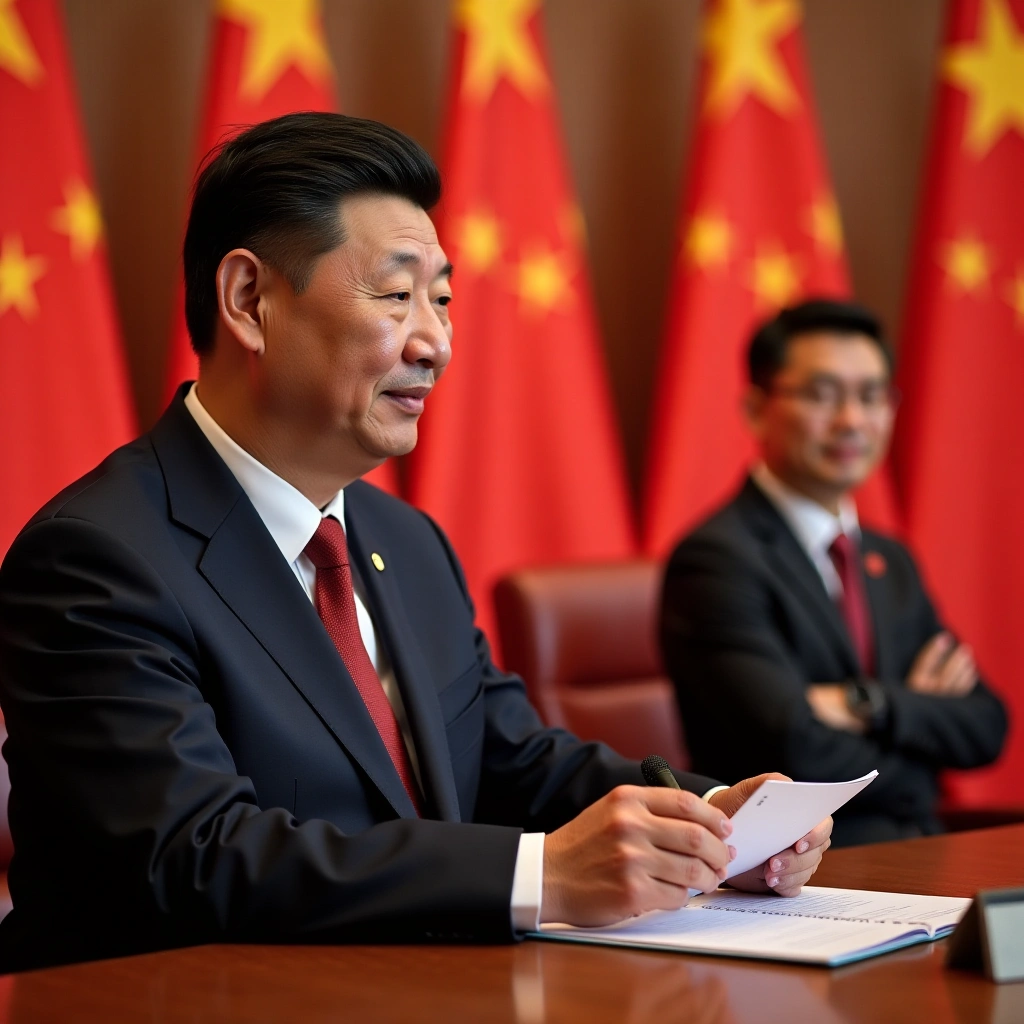
China’s President Xi Jinping has urged support for “free and open trade”, pitching Beijing as a stable partner – as opposed to President Donald Trump-led Washington – and pledging to stand up to trade protectionism .
There’s a special kind of irony in hearing a head of state champion open markets at a business conference while the world argues about who gets to buy the most advanced computer chips. That’s the scene from Shenzhen this week, where Chinese President Xi Jinping spoke at the Asia-Pacific Economic Cooperation (APEC) CEO Summit and made the case for free and open trade.
The message was pretty clear. Xi argued for free and open trade and came out against protectionism, the economic version of building a fence around your yard and then complaining that nobody visits. For a room full of executives, that’s the kind of line that gets nods and polite applause. Whether it gets the same reaction in Washington is a different question.
Xi also called for stronger international cooperation on artificial intelligence. AI is one of those topics where everyone agrees the technology is important and nobody agrees on the rules. Xi’s pitch was for countries to work together rather than race off in separate directions, which sounds sensible on paper. It’s a lot easier to say in a speech than to deliver in practice, especially when the technology itself has become a strategic prize.
He also spoke about keeping a rules-based multilateral trading system, with the World Trade Organization at its center. The WTO, created in 1995, is meant to set common rules for global trade and settle disputes between member countries. Xi’s emphasis on it was a clear signal that Beijing sees itself as a defender of that system, not an outsider trying to tear it down. Anadolu’s headline framed it as upholding the postwar international order, which is a big phrase for what is, at heart, a speech about trade rules.
Why the emphasis now? The timing matters. The remarks came amid rising tensions after Washington’s recent restrictions on China’s access to advanced AI chips. When one country limits the high-end technology another country can buy, the second country tends to start talking a lot about fairness, openness, and the dangers of walls going up. Read that way, Xi’s speech was partly a rebuttal and partly a sales pitch. China wants to look like the reasonable party in a dispute that is, admittedly, not entirely one-sided in how it is perceived.
It’s worth noticing how this is being covered. Bloomberg focused on Xi’s call for deeper cooperation. France 24 put AI and global cooperation front and center. The Straits Times and Salem Radio Network kept the headline on free and open trade. Each outlet highlighted a slightly different piece of the same speech, which is a good reminder that a single address can be read in several ways depending on what you care about most.
So what should readers take away? First, the broad position is that China supports open trade and opposes protectionism, at least in public and at an event designed for business leaders. Second, Beijing is pushing AI cooperation as a shared project, not a contest to be won alone. Third, the speech was delivered against a backdrop of real friction over chips and technology access, and that friction is unlikely to disappear because of one conference.
APEC gatherings are often as much about signaling as about signed deals. Leaders use them to tell investors, rivals, and partners where they stand. This time, Xi told the room that China is committed to open trade and multilateral rules. Whether the actions that follow match those words is the part worth watching. Speeches are cheap, and the world’s trade policy has a long memory for the gap between what leaders say and what they do.
For now, the takeaway is simple: free trade is popular in conference halls, and the real test is always what happens after the applause ends.
Inspired by: “China’s Xi calls for free and open trade at APEC summit” (r/News)