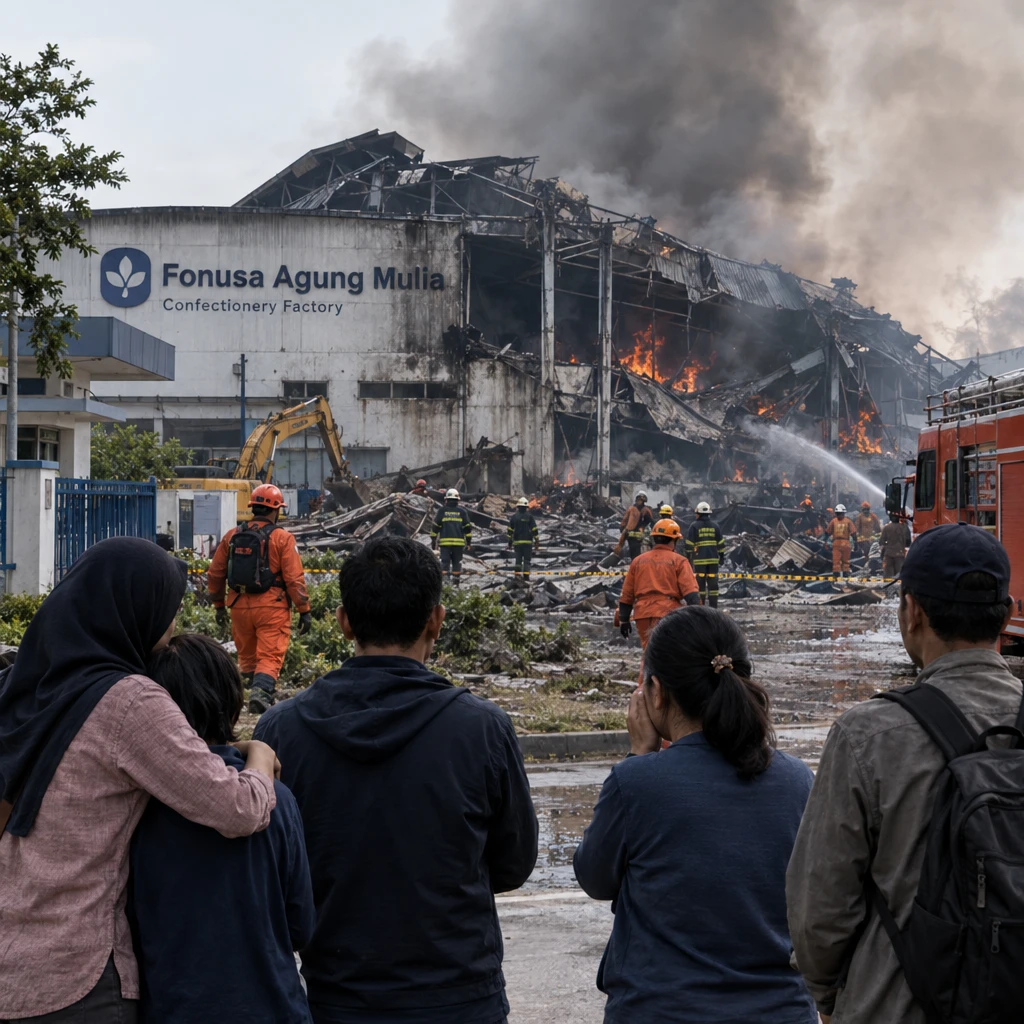
JAKARTA: A fire at a confectionery factory west of Jakarta killed three people and 36 remain missing , an Indonesian rescue official said on Sunday (Nov 22).
Some news stories arrive with a headline that sounds like a math problem, and this is one of them. Three dead, 36 missing. But behind those numbers are families waiting by the rescue lines, workers who went to their shifts on a Saturday afternoon, and a factory that, until recently, was just another workplace on the outskirts of Jakarta.
Here is what has been reported so far. A fire broke out at the Fonusa Agung Mulia confectionery factory, located in the Serang district, roughly 50 kilometres west of Indonesia’s capital. It started on Saturday afternoon. By the time the smoke cleared enough for anyone to take stock, three people were confirmed dead. Estimates of the missing have varied across outlets, with figures ranging from 36 to 39. Rescue teams have been searching the site for those unaccounted for, and four others were injured and taken to a local clinic.
The damage is severe. Reports describe roof collapses at the factory, and fires were still burning as of Sunday. That detail matters, because it explains why the search is slow and dangerous. Crews cannot simply walk through a building that is partly falling down and still on fire. Every step forward has to be weighed against the risk of another collapse, and that is a hard trade-off when you know people may still be inside.
It is worth noting how the story spread. Five separate outlets covered the event, including CNA, The Straits Times, The Hindu, Salem Radio Network News and RNZ. Their headlines differed slightly, with some citing 36 missing and others 39. That gap is a useful reminder that in the early hours of a disaster, numbers are fluid. Missing lists get reconciled, people turn up safe, and sometimes the count goes up as more information comes in. Anyone who tells you they know the exact toll in the first day or two is either guessing or selling something.
So what should readers take away from this? First, the human scale. Every one of those missing names belongs to someone’s parent, sibling, or friend. A factory fire does not make the evening news because of its statistics alone. It makes the news because it reminds us how much of daily life depends on workplaces that most of us never think about until something goes wrong.
Second, the broader question of workplace safety. Fires at industrial and manufacturing sites are unfortunately not rare, and the collapse of roofs in a blaze is a recurring danger for firefighters and rescuers as well as the people inside. Whether this particular incident reveals specific failures is something investigators will need to determine, and it would be irresponsible to speculate about causes before that work is done. What is fair to say is that the reports of structural collapse and ongoing fires point to a situation where the building itself became a major hazard.
Finally, there is the waiting. For the families of the 36 to 39 people still unaccounted for, every hour without news is a long one. Rescue work in conditions like these can take days, and updates will likely come in fragments. The best thing outside observers can do is follow reliable reporting, avoid passing along unverified names or claims on social media, and keep the people affected in mind.
This story is still developing. Numbers will change, the search will continue, and questions will eventually be asked about what happened at the Fonusa Agung Mulia factory. For now, the most important thing is simple: three people have died, dozens more are missing, and rescuers are still working to bring them home.
Inspired by: “Three dead, 36 missing after Indonesia factory fire” (r/News)