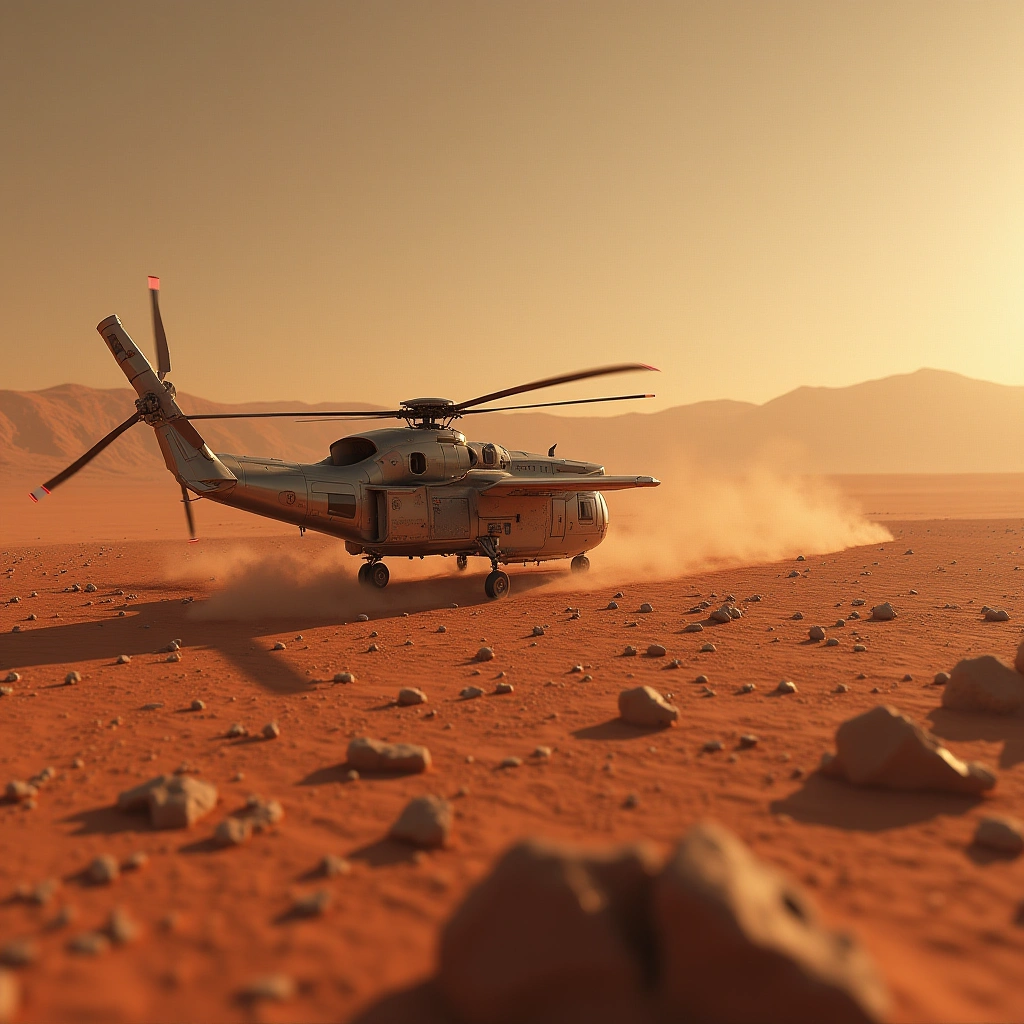
Hey there, space enthusiasts and Earth-bound couch potatoes! Buckle up because we’re about to dive into a thrilling adventure that’s not just out of this world but also spinning faster than your grandma on a dance floor after two cups of coffee!
Related reading: Original source
Nasa has done it again, folks! They’ve taken helicopter technology and cranked it up to 11—no, wait, more like 37! This week, the space agency announced that its next-gen aircraft, affectionately dubbed ‘SkyFall,’ has successfully pushed its rotors past the speed of sound. That’s right, SkyFall’s rotors are now whirling at a jaw-dropping 3,750 RPM. To put that in perspective, that’s ten times faster than your average helicopter, which is probably more than the speed at which your last relationship went downhill.
Now, why does this matter? Well, for starters, Mars doesn’t have the same atmosphere as Earth. It’s thinner than a supermodel on a diet, making it quite the challenge for standard helicopters. But NASA, being the overachievers they are, decided to tackle this issue head-on with technology that’s more advanced than a smartphone with 100 camera lenses.
Imagine trying to fly a helicopter without enough air to give it lift. Sounds like a recipe for disaster, right? But that’s where the brainiacs at NASA shine! The SkyFall’s rotors are engineered to spin so fast, they create enough lift to defy the Martian gravity, allowing humanity to explore the Red Planet like never before. Who knows? Maybe one day we’ll be sending pizza delivery drones out there. Mars needs its pepperoni!
But hold on to your space helmets, because this isn’t just about speed. The implications of SkyFall reaching such incredible rotor speeds are enormous. Think about it: improved aerial surveillance, scouting potential landing sites, and even advanced weather monitoring. NASA is basically saying, ‘Hold my Tang,’ as they prepare to revolutionize how we explore extraterrestrial terrain.
Of course, with great power comes great responsibility. And while the SkyFall may be able to zip around Mars like a kid on a sugar high, we have to ask ourselves: are we ready for the consequences? Will we be sending a fleet of these aircraft to steal Martian real estate? Or worse, will they deliver our space pizzas without tipping?
In conclusion, NASA’s SkyFall is not just a technological marvel; it’s a testament to human ingenuity (or perhaps our obsession with flying things). As we stand on the precipice of interplanetary exploration, let’s hope that we’re not just speeding towards Mars, but also towards a future where we can all enjoy a slice of Martian pizza without breaking the bank—or the sound barrier!
So, keep your eyes on the skies, my friends! Who knows what other incredible feats await us among the stars? Until then, let’s just hope our terrestrial helicopters can keep up with their Martian cousins. After all, if NASA can break the sound barrier, maybe we can finally break the barriers of awkward small talk at parties!
Inspired by: “NASA pushes Mars helicopter rotors past the speed of sound for the first time ever — next-gen “SkyF…” (r/technology)