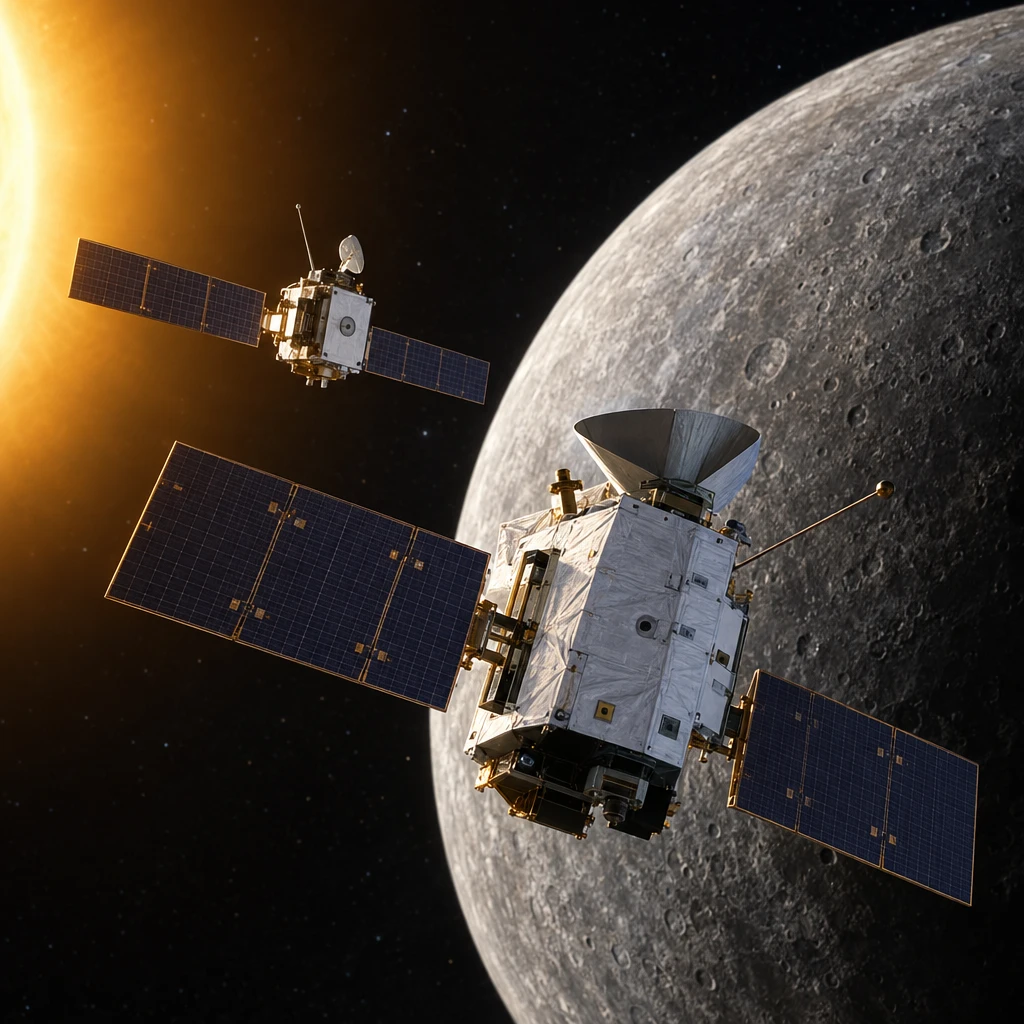
A pair of spacecraft have slipped into orbit around Mercury after an eight-year cruise through the inner solar system
Every so often, the solar system does something that sounds almost casual when you describe it in a headline. This weekend, it was this: two spacecraft entered orbit around Mercury, the smallest planet and the one closest to the Sun. Nobody threw a parade, but it was still a big deal.
The spacecraft belong to BepiColombo, a mission made up of European and Japanese components. The European Space Agency and Japan’s space agency worked on it together, and it launched in 2018. After an eight-year journey, the pair reached Mercury on Saturday. If you’ve ever spent eight years waiting for a package to arrive, you’ll understand why this feels like a long time to wait for a delivery to a planet that’s barely bigger than our Moon.
Getting there was the hard part. Mercury is a tough neighbourhood. It sits deep in the Sun’s gravity well, so a spacecraft can’t simply coast in and settle down. It has to slow itself down enough for the planet’s gravity to catch it. That’s where the thrusters came in. A series of thruster firings gradually reduced the spacecraft’s speed until Mercury could pull it into orbit. Think of it as braking on a steep hill, except the hill is a planet and the brakes have to work perfectly the first time.
The European Space Agency announced the arrival on social media once the burns had done their job. Honestly, that feels like the most modern possible way to share news from the edge of the solar system: a quick post, a few cheers from engineers, and then back to work.
The spacecraft won’t stay together for long. Next month, they are scheduled to separate. Each one will then study Mercury from a different altitude, so the mission can build a more complete picture of the planet’s surface, its interior, and its thin exosphere, which is the very sparse atmosphere that surrounds it. Mapping from more than one height is a bit like taking photos from both the ground and a ladder: you get different details from each view, and together they tell a fuller story.
Mercury has always been a bit of an overlooked neighbour. It’s hard to observe from Earth because it never strays far from the Sun in our sky, and it’s hard to reach because of all that orbital energy you have to shed. Few missions have visited it. That’s why this one matters. Scientists want to understand how a small, dense, scorched world formed and evolved, and what its icy patches near the poles might be made of. Those are big questions, and having instruments actually circling the planet is a much better way to answer them than squinting through a telescope.
The price tag is also worth noting. The mission cost roughly $2 billion, or about 1.7 billion euros. That’s a lot of money, and it’s fair to ask whether a distant rock justifies it. The usual answer is that space missions like this pay off in knowledge that goes well beyond the target itself. Studying Mercury helps researchers understand planetary formation, which in turn helps explain how our own planet came to be. Not a bad return for a robot that spent most of a decade in transit.
So, welcome to Mercury, BepiColombo. You’ve made it through the long trip and the tricky braking, and now the real work begins. The planet has been waiting a while for a proper visitor, and it seems we finally sent one.
Inspired by: “Little Mercury gets its first visitor in years as a pair of spacecraft loop into orbit” (r/News)