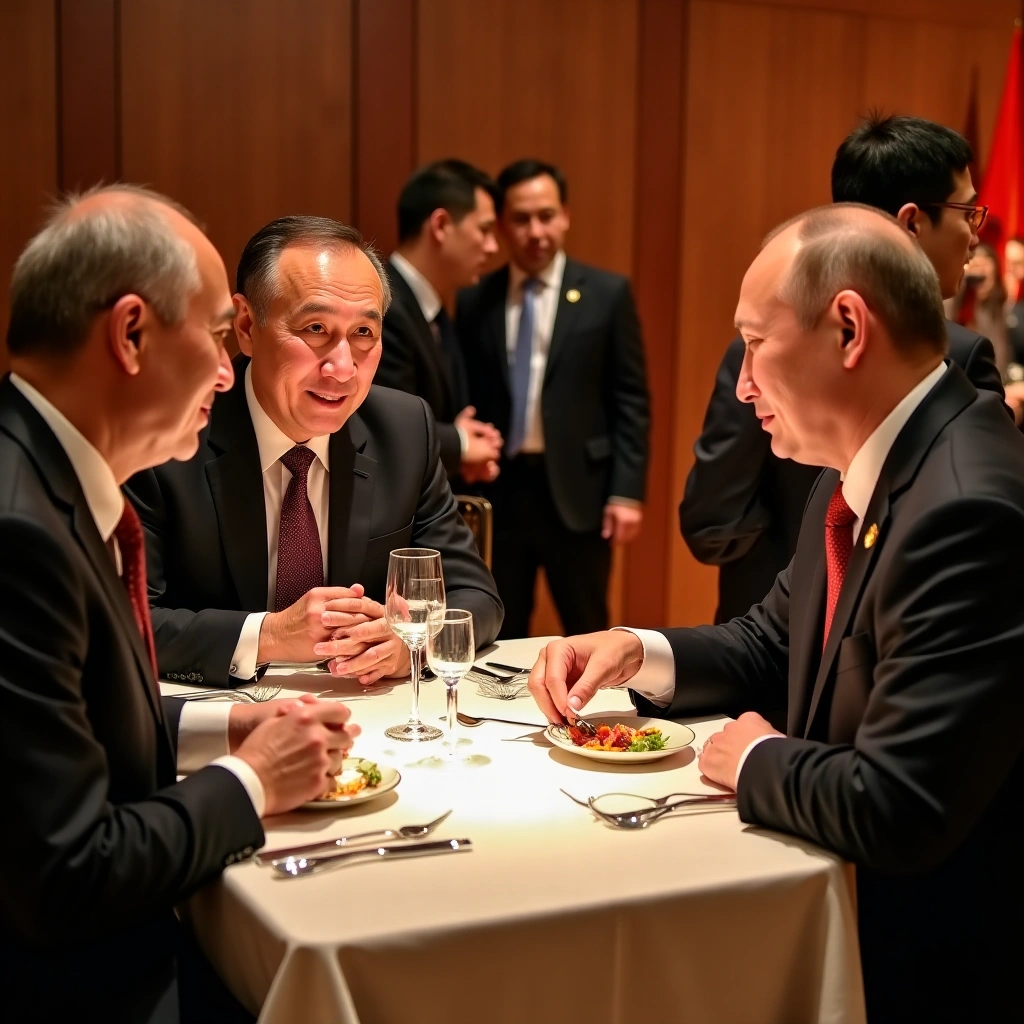
19 · 12:10 a.m. Japanese Prime Minister Sanae Takaichi spoke with Russian President Vladimir Putin for about 30 minutes on the sidelines of the APEC summit and related meetings in Shenzhen , their countries' first face-to-face leaders' meeting …
Every so often, a dinner party turns out to be more important than anyone expected. This week, the guest list at the Asia-Pacific Economic Cooperation (APEC) summit in Shenzhen, China, included a sit-down between Japanese Prime Minister Sanae Takaichi and Russian President Vladimir Putin. According to Japan’s foreign ministry, the two leaders had a proper conversation over the meal, which is more than some summit dinners manage to produce.
For anyone who has never been to an international summit, here is how these things usually work. Leaders arrive with a stack of talking points, a team of aides who are very worried about the schedule, and a strong suspicion that the most useful conversations will happen in the hallway, not at the podium. A dinner event gives heads of state a relaxed setting to raise the issues that don’t fit neatly into a formal agenda. It is less like a press conference and more like a family gathering where someone finally brings up the thing everyone has been avoiding.
According to reports from The Straits Times, Salem Radio Network News, and CNA, Takaichi used the meeting to lay out Japan’s position on several sensitive issues. Two stood out. The first was the detention of a Japanese journalist. Detained journalists are never a small matter. They involve human rights, press freedom, and the basic question of whether a country’s citizens are safe when they are doing their jobs abroad. Raising the case directly with Putin signals that Tokyo is not willing to let the matter quietly fade into the background.
The second issue was the seizure of assets belonging to Japan Tobacco. Asset seizures are the sort of thing that sound dry on paper but carry real consequences for businesses and for the diplomatic relationship between the countries involved. When a company finds its property taken, it becomes a matter of commerce, law, and politics all at once, and it rarely gets resolved over a single plate of food.
So what came out of it? The main takeaway is that both leaders agreed to keep talking about these matters. That may sound underwhelming, and in some ways it is. Nobody announced a breakthrough, a settlement, or a warm new friendship. But in diplomacy, agreeing to continue discussions is often the realistic outcome, and it beats the alternative of shouting across a table and walking out. Think of it as the diplomatic equivalent of ‘let’s circle back next quarter,’ which is annoying in an office and quite a bit more significant when the stakes involve national relations.
It is also worth remembering the backdrop. Japan and Russia have a long and complicated history, including unresolved disputes over islands claimed by both countries and the absence of a formal peace treaty since the end of the Second World War. Any conversation between their leaders carries that weight, whether or not it appears on the menu. Against that background, a dinner conversation that touches on detained citizens and seized property is not a minor social exchange. It is a reminder that the two governments still have a list of grievances they are willing to put on the table, even if they are not yet ready to resolve them.
There is a broader lesson here too. Summits like APEC are often criticized as photo opportunities, where leaders smile for cameras and sign vague statements about cooperation. Yet these gatherings also create rare chances for direct contact between officials who might otherwise communicate only through formal channels or not at all. A meeting like this one may not change much immediately, but it keeps the lines open, and that matters more than it sounds.
So the next time you see a headline about leaders chatting over dinner, resist the urge to roll your eyes. Sometimes the soup is just soup. Other times, a quiet conversation between two heads of state is how the next phase of a difficult relationship begins, one awkward course at a time.
Inspired by: “Japan PM Takaichi spoke with Russia’s Putin at APEC summit: Foreign ministry” (r/News)