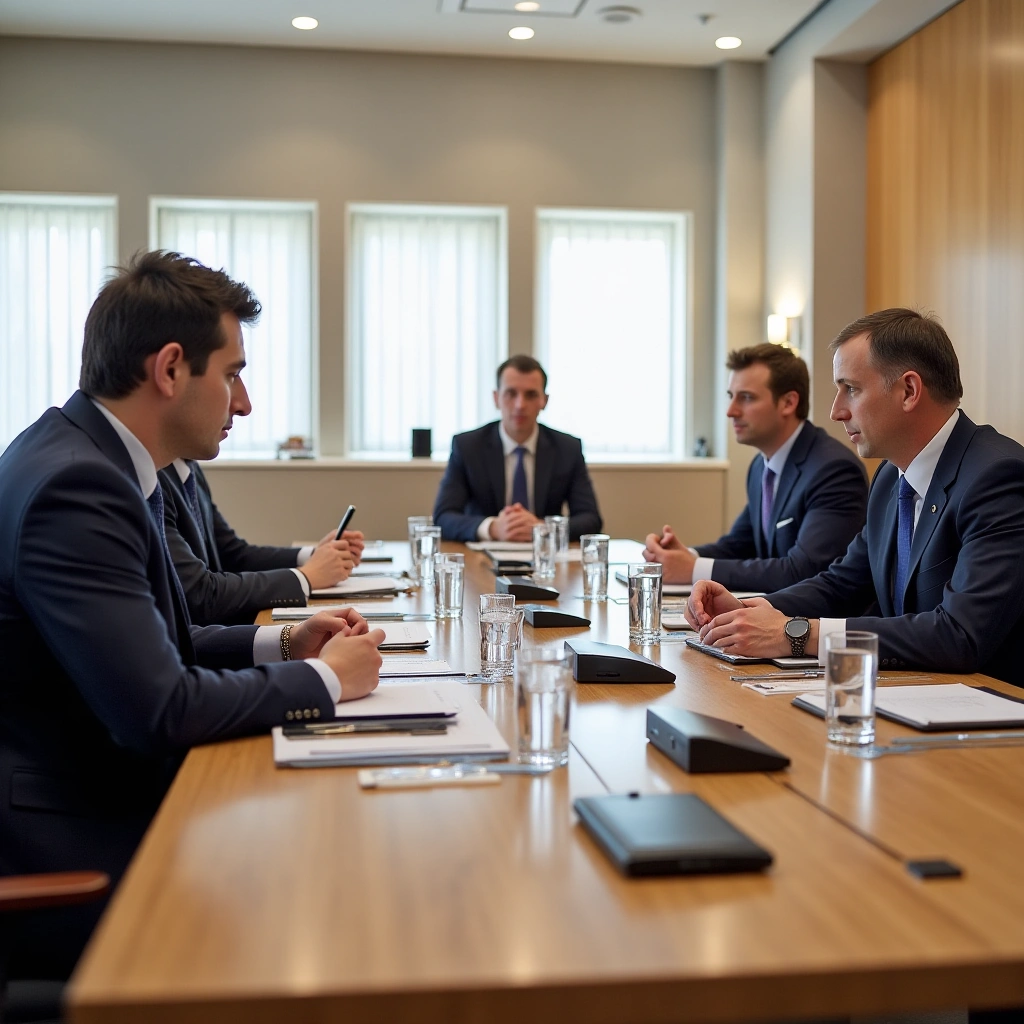
Trilateral talks in Abu Dhabi between Russia, Ukraine and the US aimed at ending the war in Ukraine have concluded after a second day .
If you thought the path to ending a major war ran through grand palaces, signing ceremonies, and leaders shaking hands for exactly as long as the photographers need, I have news. Sometimes it runs through an online meeting. Possibly with someone asking whether everyone can see the screen.
Ukrainian President Volodymyr Zelenskiy says Ukraine recently held new online talks with US envoys Steve Witkoff and Jared Kushner, along with European representatives, to explore possible ways to end the war with Russia. The story was picked up widely, with coverage from Salem Radio Network News, NDTV, The Straits Times, Hindustan Times, and the South China Morning Post. When that many outlets across that many regions run the same headline, it is fair to say the world is paying attention.
There is a catch, of course. There is always a catch. In the same breath, Zelenskiy said intelligence indicates Russia is planning significant strikes against Ukrainian targets in the coming days. So the mood is less ‘peace is at hand’ and more ‘we are talking about peace while bracing for impact.’ That is roughly where things have stood for a while now.
What Actually Happened
Here is what we know, without the decorative speculation:
– Ukraine held online discussions with US envoys Steve Witkoff and Jared Kushner.
– European representatives took part as well.
– The stated purpose was to explore potential resolutions to the war with Russia.
– The talks came shortly after a three-way meeting between US, Ukrainian, and Russian officials in Abu Dhabi.
– Zelenskiy also warned that intelligence points to major Russian strikes on Ukrainian targets over the next several days.
That is the substance. Notice what is missing: no announced breakthrough, no draft agreement waved at the cameras, no declaration that the war is over. Anyone hoping for a tidy ending will have to keep waiting. Diplomacy, it turns out, does not run on the same schedule as our news feeds.
The Abu Dhabi Factor
The timing is the interesting part. These online talks followed a three-way meeting between American, Ukrainian, and Russian officials in Abu Dhabi. Any session that puts representatives from all three countries in the same setting is notable, because getting the two sides of an active war into a shared conversation is not something that happens over a casual lunch.
The follow-up call with US and European officials suggests Ukraine is doing what anyone does after a big, complicated meeting: comparing notes, checking assumptions, and making sure its allies are aligned before the next step. If you have ever left a high-stakes meeting and immediately texted a colleague ‘Okay, what did they actually mean by that?’, you have a small, low-stakes sense of the dynamic. The stakes here are just a few billion times higher.
Why the Europeans Are in the Room
Including European representatives is not a courtesy invite. Europe has a direct interest in how this war ends, both because of geography and because of the long-term security questions any settlement would raise. A peace process that sidelined Europe would face obvious problems, not least that the Europeans would have opinions about it, and they would share them loudly.
Bringing US and European officials into the same discussion with Ukraine helps keep the Western side coordinated. Whether that coordination produces anything concrete is another question, but it is a lot easier to negotiate when your partners are not reading about your positions in the newspaper for the first time.
Talking Peace, Preparing for Strikes
The most sobering part of the announcement is Zelenskiy’s warning about planned Russian strikes. It is a reminder that talks and fighting are not taking turns. They run side by side.
This is one of the more frustrating realities of wartime diplomacy. Each side can talk about possible resolutions while military operations continue. For people living with the threat of attacks, a productive video call is cold comfort if the sirens still sound. Zelenskiy making the warning public at the same moment he announced the talks also sends a message: Ukraine wants its partners to see the gap between diplomatic language and what may be happening on the ground.
It is a bit like a contractor telling you the renovation is going great while you can hear something load-bearing being knocked down in the next room. You want to believe the progress report. You also want to know what that noise was.
Managing Expectations (A Public Service)
It is tempting to read every new round of talks as a sign that peace is around the corner. It is just as tempting to roll your eyes and assume nothing will come of any of it. Neither reaction is especially helpful.
Here is a more grounded way to look at it:
Talks are a process, not a product. An online meeting to explore potential resolutions is exactly that: exploration. Nobody announced a deal, and nobody should pretend they did.
Sequence matters. A three-way meeting in Abu Dhabi followed by a coordinating session with US and European officials looks like an effort to build momentum, or at least to keep the conversation going. In diplomacy, keeping the conversation going is not nothing.
Military pressure shapes the table. Warnings of major strikes are a reminder that leverage on the battlefield and leverage in negotiations are tangled together. Each side will be watching how events on the ground affect the other’s willingness to compromise.
Public statements are also messages. When Zelenskiy announces talks and a threat warning together, he is speaking to several audiences at once: Ukrainians, allies, and Moscow. Every leader in this situation is doing the same, and it is worth reading their statements with that in mind.
The Wider Attention
The range of outlets covering this story, from American radio news to major publications in India, Singapore, and Hong Kong, says something about how global this conflict has become. The war’s effects on security, energy, trade, and diplomacy reach far beyond Europe, so it makes sense that readers on several continents want to know whether a resolution is getting any closer.
The honest answer for now is: there is movement, there is dialogue, and there is still plenty of danger. Not exactly a satisfying headline, but an accurate one.
The Bottom Line
Ukraine has held new online talks with Steve Witkoff, Jared Kushner, and European representatives about possible ways to end the war, shortly after a rare three-way meeting with US and Russian officials in Abu Dhabi. At the same time, Zelenskiy is warning that Russia appears to be preparing significant strikes in the coming days.
So diplomacy is happening, but so is the war. The talks are worth watching, and so are the days ahead, because what happens on the ground will likely shape what happens at the table, whether that table is in Abu Dhabi or on somebody’s laptop.
We will keep an eye on it. Ideally with fewer ominous warnings next time, though nobody is placing bets on that just yet.
Inspired by: “Ukraine’s Zelenskiy says new talks on peace prospects held with US, European officials” (r/News)